Sheet metal gauge chart: gauge to inches and mm for steel, galvanized, stainless and aluminum
Updated on 06 November 2026
Sheet metal is ordered by gauge, 16, 14 or 10 gauge, and drawn in inches or millimetres. The gauge is a number, not a size, and the same number gives a different thickness in each material. This chart gives every gauge in inches and millimetres for carbon steel, galvanized, stainless and aluminum, and what a square foot and a square metre of steel weigh.
For the weight of a whole sheet or a cut part, the calculator is in the steel plate weight guide; for the thickness inside a bend calculation, in bend allowance and K-factor.
Sheet metal gauge chart
Steel is the Manufacturers' Standard Gauge (MSG) for uncoated carbon steel. Galvanized has its own gauge, measured over the zinc; stainless follows the older U.S. Standard Gauge; and aluminum is the Brown & Sharpe gauge, a different scale altogether.
| Gauge | Steel | Galvanized | Stainless | Aluminum |
|---|---|---|---|---|
| 7 | 0.1793 in · 4.554 mm | — | 0.1875 in · 4.763 mm | — |
| 8 | 0.1644 in · 4.176 mm | 0.1681 in · 4.270 mm | 0.1719 in · 4.366 mm | 0.1285 in · 3.264 mm |
| 9 | 0.1495 in · 3.797 mm | 0.1532 in · 3.891 mm | 0.1563 in · 3.969 mm | — |
| 10 | 0.1345 in · 3.416 mm | 0.1382 in · 3.510 mm | 0.1406 in · 3.572 mm | 0.1019 in · 2.588 mm |
| 11 | 0.1196 in · 3.038 mm | 0.1233 in · 3.132 mm | 0.1250 in · 3.175 mm | 0.0907 in · 2.304 mm |
| 12 | 0.1046 in · 2.657 mm | 0.1084 in · 2.753 mm | 0.1094 in · 2.778 mm | 0.0808 in · 2.052 mm |
| 13 | 0.0897 in · 2.278 mm | 0.0934 in · 2.372 mm | 0.0938 in · 2.381 mm | — |
| 14 | 0.0747 in · 1.897 mm | 0.0785 in · 1.994 mm | 0.0781 in · 1.984 mm | 0.0641 in · 1.628 mm |
| 16 | 0.0598 in · 1.519 mm | 0.0635 in · 1.613 mm | 0.0625 in · 1.588 mm | 0.0508 in · 1.290 mm |
| 18 | 0.0478 in · 1.214 mm | 0.0516 in · 1.311 mm | 0.0500 in · 1.270 mm | 0.0403 in · 1.024 mm |
| 20 | 0.0359 in · 0.912 mm | 0.0396 in · 1.006 mm | 0.0375 in · 0.953 mm | 0.0320 in · 0.813 mm |
| 22 | 0.0299 in · 0.759 mm | 0.0336 in · 0.853 mm | 0.0313 in · 0.794 mm | 0.0253 in · 0.643 mm |
| 24 | 0.0239 in · 0.607 mm | 0.0276 in · 0.701 mm | 0.0250 in · 0.635 mm | 0.0201 in · 0.511 mm |
| 26 | 0.0179 in · 0.455 mm | 0.0217 in · 0.551 mm | 0.0188 in · 0.476 mm | 0.0159 in · 0.404 mm |
| 28 | 0.0149 in · 0.378 mm | 0.0187 in · 0.475 mm | 0.0156 in · 0.397 mm | — |
| 30 | 0.0120 in · 0.305 mm | 0.0157 in · 0.399 mm | 0.0125 in · 0.318 mm | — |
Mills and service centres publish nominal thicknesses that differ from the chart by a thousandth or two, and the rolling tolerance is wider than that. To cut and to weigh, use the thickness measured with callipers or a micrometer.
Steel sheet weight by gauge
Weight per square foot and per square metre of carbon steel, at 0.2836 lb/in³ (7.85 kg/dm³), the density the weight calculator uses. A 4 × 8 ft sheet is 32 ft².
| Gauge | Thickness | lb/ft² | kg/m² | 4 × 8 ft sheet |
|---|---|---|---|---|
| 7 | 0.1793 in · 4.554 mm | 7.32 | 35.75 | 234.3 lb |
| 8 | 0.1644 in · 4.176 mm | 6.71 | 32.78 | 214.8 lb |
| 9 | 0.1495 in · 3.797 mm | 6.11 | 29.81 | 195.4 lb |
| 10 | 0.1345 in · 3.416 mm | 5.49 | 26.82 | 175.8 lb |
| 11 | 0.1196 in · 3.038 mm | 4.88 | 23.85 | 156.3 lb |
| 12 | 0.1046 in · 2.657 mm | 4.27 | 20.86 | 136.7 lb |
| 13 | 0.0897 in · 2.278 mm | 3.66 | 17.89 | 117.2 lb |
| 14 | 0.0747 in · 1.897 mm | 3.05 | 14.89 | 97.6 lb |
| 16 | 0.0598 in · 1.519 mm | 2.44 | 11.92 | 78.1 lb |
| 18 | 0.0478 in · 1.214 mm | 1.95 | 9.53 | 62.5 lb |
| 20 | 0.0359 in · 0.912 mm | 1.47 | 7.16 | 46.9 lb |
| 22 | 0.0299 in · 0.759 mm | 1.22 | 5.96 | 39.1 lb |
| 24 | 0.0239 in · 0.607 mm | 0.98 | 4.77 | 31.2 lb |
| 26 | 0.0179 in · 0.455 mm | 0.73 | 3.57 | 23.4 lb |
| 28 | 0.0149 in · 0.378 mm | 0.61 | 2.97 | 19.5 lb |
| 30 | 0.0120 in · 0.305 mm | 0.49 | 2.39 | 15.7 lb |
The MSG was defined by weight, 41.82 lb/ft² for every inch of thickness, so mill charts list 16 gauge at 2.5 lb/ft² and 10 gauge at 5.625. At the 0.2836 lb/in³ of carbon steel the same sheets weigh about 2% less, which is what a scale reads.
Why a higher gauge is a thinner sheet
The numbers come from wire drawing, where the gauge counted the passes through the draw plate: more passes, thinner wire. Sheet inherited the order, and each gauge became a row in a table. There is no formula from the number to the thickness.
Both American sheet gauges fix the weight per square foot of each number, not the thickness. The U.S. Standard Gauge of 1893 assumed wrought iron; the Manufacturers' Standard Gauge that replaced it for steel assumes steel, which is heavier. Both put 16 gauge at 2.5 lb/ft², which is why the older gauge is thicker: 0.0625 in against 0.0598 in.
Gauge in a flat pattern
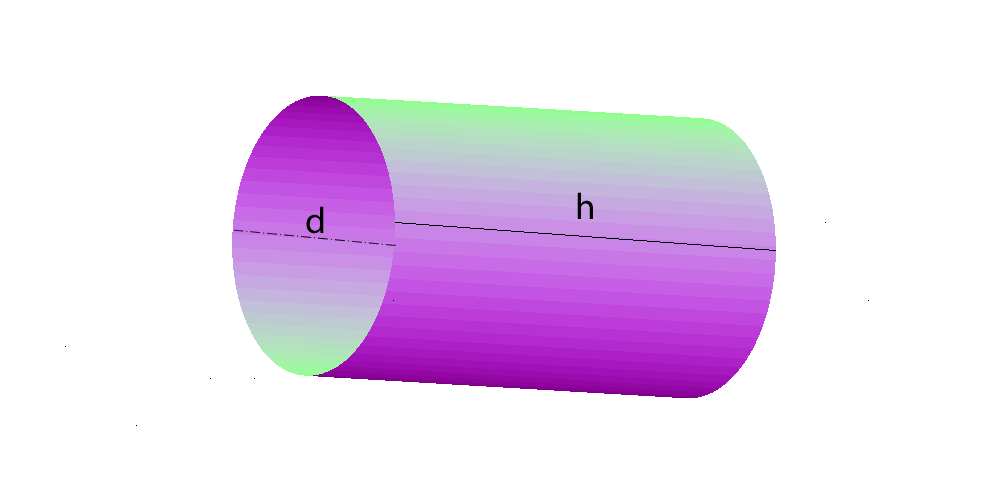
Every Planichapa pattern is laid out on the neutral axis, at mid-thickness. A 12 in OD cylinder in 16 gauge opens to π × (12 − 0.0598) = 37.51 in, 3/16 in shorter than the outside circumference. The thickness field of every part offers the gauges of steel, galvanized, stainless and aluminum, with the thickness of this chart.
In a press brake bend, the thickness sets the deduction at each fold: the bent profile and the bend allowance and K-factor guide do the arithmetic.
Frequently asked questions
- How thick is 16 gauge steel?
- 0.0598 in, or 1.519 mm, in uncoated carbon steel. 16 gauge galvanized is 0.0635 in (1.613 mm), stainless 0.0625 in (1.588 mm) and aluminum 0.0508 in (1.290 mm).
- How thick is 14 gauge steel?
- 0.0747 in, or 1.897 mm. It weighs 3.05 lb per square foot, 14.89 kg per square metre.
- How thick is 20 gauge steel?
- 0.0359 in, or 0.912 mm, and it weighs 1.47 lb per square foot. 20 gauge galvanized is 0.0396 in (1.006 mm).
- How thick is 10 gauge?
- 0.1345 in (3.416 mm) in steel, just over 1/8 in. 10 gauge aluminum is much thinner, 0.1019 in (2.588 mm), because aluminum follows another scale.
- What gauge is 1/8 inch?
- In steel, 11 gauge, 0.1196 in (3.038 mm), is the nearest. In stainless, 11 gauge is exactly 1/8 in, 0.125 in.
- What gauge is 3/16 inch?
- 7 gauge steel is 0.1793 in (4.554 mm), a little under 3/16 in (0.1875). Past 7 gauge, plate is ordered by the fraction: 3/16, 1/4, 3/8 in.
- Is a higher gauge thicker?
- No: the higher the gauge, the thinner the sheet. 10 gauge steel is 0.1345 in and 20 gauge is 0.0359 in.
Parts in this guide
Other guides
- How to develop a cone (frustum) in sheet metal: formula, sector radii and angle, step by step
- Lobster back bend calculator (segmented 90° elbow): gore angles, cut heights and how many plates
- Pipe saddle calculator and development: how to lay out a pipe-to-pipe branch (tee) at 90 and 45 degrees
- Square to round transition: development by triangulation, step by step
- Bend allowance and K-factor calculator, and the neutral axis: why every development uses D − t
- Sheet metal glossary: the terms of marking out and pattern development in plate fabrication
- How we check the Planichapa calculations, and who is behind them
- Plate 'n' Sheet alternative: Planichapa develops sheet metal parts in the browser, with the price on the page
- How to lay out a mitre-cut pipe: paper template, sine wave and ordinate table
- LITIO alternative: Planichapa develops sheet metal parts in the browser, nothing to install, now that LITIO2 is no longer sold
- Pipe ovality: a calculator, the formula, a worked example, the limits the codes use and how to measure it in the shop
- Steel plate and sheet metal weight calculator: weight per m² and ft², gauges and stock plate sizes
- Sheet metal pattern development software: how to choose, and what changes between a desktop program, a phone app and an online calculator
- Eccentric and concentric reducers: which one to use and how each one develops on plate
- Roller chain size chart: ANSI, ISO 606, motorcycle and bicycle chain pitch and roller diameter
- Sprocket dimensions: pitch diameter, outside and root diameter, tooth form and a pitch diameter chart
- Bolt circle layout: the position of each hole, the chord between holes and a chord chart
- Chain length and sprocket ratio: the formulas, a worked example and how many links to cut
- Screw flight calculator: the flat blank of a screw conveyor flight (auger), with the formula and a worked example
- Plate rolling calculator: the blank length of a rolled shell, with the formula, a chart and a worked example
- Tube notching template generator: a printable coping template for any tube, angle and offset
- Dished head calculator: depth, volume, blank diameter and weight of torispherical, 2:1 elliptical and hemispherical heads
- Cone template generator: a printable full-size cone template for hoppers, funnels and reducers
- Pie cut calculator for exhaust and tube bends: saw angle, pie lengths and a wrap-around template
- Duct transition layout: square to round duct, centred, offset or flat on one side
- Pipe template, printable at full size: tee saddle, 45° lateral and mitre cut for every pipe size from NPS 1/2 to 12
- Register boot layout: from a floor, wall or ceiling register to a round duct, in inches
- Plenum box and plenum transition layout: the sides, the end cap, the collar and the transitions
- Smoker stack and firebox templates: the cuts where pipe meets the cook chamber, in inches
- Laser and plasma cutting cost calculator: the formula, a worked example and how to measure the cut length
- Tank volume calculator and strapping chart: horizontal and vertical tanks with 2:1, torispherical, hemispherical or flat heads
- Merge collector template generator: a printable cutting template for 2, 3, 4, 6 or 8 into 1
- Dome template generator: printable gores for a dome or a hemisphere in paper, EVA foam or sheet metal
- DIY cyclone dust collector plans: every sheet of the cyclone from the Stairmand proportions, for any duct size
- Cable tray bend: how to make vertical and horizontal 90 and 45 degree bends with a V notch