Steel plate weight per m², gauges and stock plate sizes: weight table and formula
Updated on 17 September 2026
Every flat pattern ends in a purchasing question: how much plate, what gauge, and what does it weigh. Planichapa gives the minimum plate for each part; this page gives the rest: the weight table per square metre, the formula for any thickness and the sizes plate is sold in.
The weight formula
- Weight per square metre
kg/m² = t × 7.85t is the thickness in millimetres and 7.85 the density of carbon steel in kg/dm³ (7850 kg/m³). 3 mm plate: 23.55 kg/m². Austenitic stainless is a little heavier, 7.93; aluminium, 2.70.
- Weight of a plate
kg = length (m) × width (m) × t (mm) × 7.85A 3000 × 1500 plate in 3 mm: 3 × 1.5 × 3 × 7.85 = 106 kg.
- Weight of a developed part
kg ≈ template area (m²) × t × 7.85The template area is the area of the finished part, measured on the neutral axis; the plate you buy is larger, because the template is seldom rectangular.
Steel plate weight table
The usual thicknesses in Brazil, with the MSG gauge (Manufacturers' Standard Gauge) for thin plate and the inch fraction for thick plate. Weight is per square metre of carbon steel.
| Gauge | Thickness | kg/m² | 1000 × 2000 plate | 1500 × 3000 plate |
|---|---|---|---|---|
| 20 MSG | 0.90 mm | 7.07 | 14.1 kg | 31.8 kg |
| 18 MSG | 1.20 mm | 9.42 | 18.8 kg | 42.4 kg |
| 16 MSG | 1.50 mm | 11.78 | 23.6 kg | 53.0 kg |
| 14 MSG | 1.90 mm | 14.92 | 29.8 kg | 67.1 kg |
| 12 MSG | 2.65 mm | 20.80 | 41.6 kg | 93.6 kg |
| 11 MSG | 3.00 mm | 23.55 | 47.1 kg | 106.0 kg |
| 10 MSG | 3.35 mm | 26.30 | 52.6 kg | 118.3 kg |
| 3/16" | 4.75 mm | 37.29 | 74.6 kg | 167.8 kg |
| 1/4" | 6.35 mm | 49.85 | 99.7 kg | 224.3 kg |
| 5/16" | 7.94 mm | 62.33 | 124.7 kg | 280.5 kg |
| 3/8" | 9.53 mm | 74.81 | 149.6 kg | 336.6 kg |
| 1/2" | 12.70 mm | 99.70 | 199.4 kg | 448.6 kg |
| 5/8" | 15.88 mm | 124.66 | 249.3 kg | 561.0 kg |
| 3/4" | 19.05 mm | 149.54 | 299.1 kg | 672.9 kg |
| 1" | 25.40 mm | 199.39 | 398.8 kg | 897.3 kg |
The nominal thickness of a gauge varies a little from mill to mill (12 gauge appears as 2.65 or 2.70 mm; 10 gauge as 3.35 or 3.42). To weigh for real, use the thickness measured with callipers.
Stock sizes
In Brazil, thin plate (sheet, up to 1/4") is sold in 1000 × 2000, 1200 × 2000, 1200 × 3000 and 1500 × 3000 mm. Thick plate comes in 1500 × 6000, 2000 × 6000 and 2440 × 6000 or 12000, and is cut to size at the stockholder. Coil exists for thin plate, 1000 to 1500 wide, and is what a continuous tube-forming line consumes.
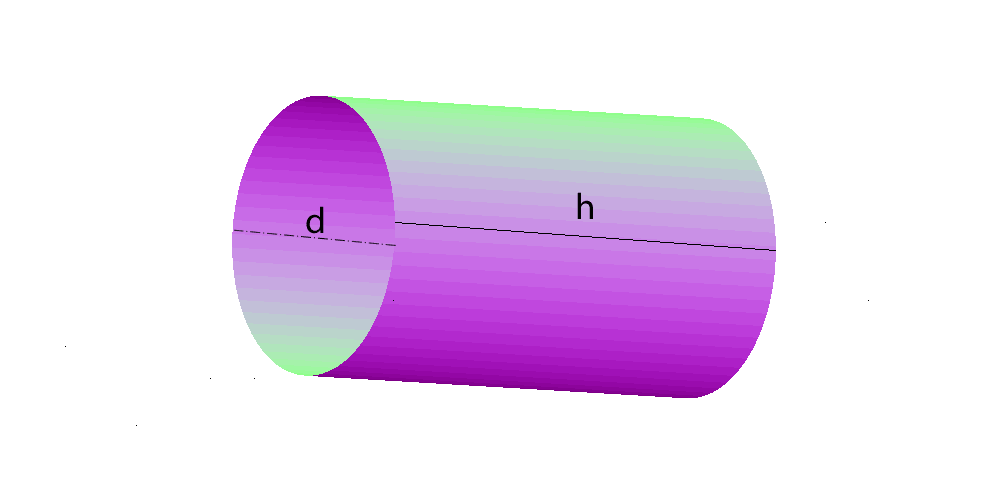
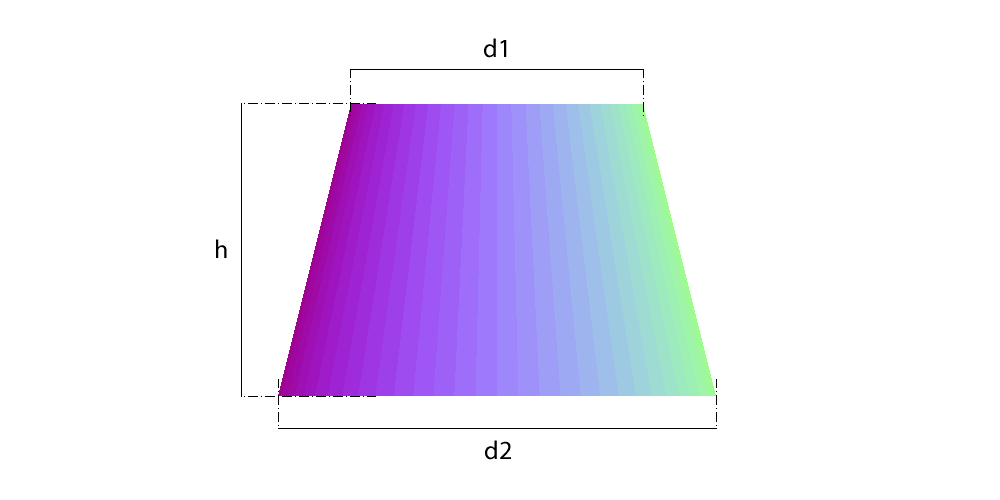
For a flat pattern the question is which of those formats the template fits in whole, or how to piece it together. The 300 by 500 shell of the cylinder example fits in any of them; the 800/1200/800 cone of the cone development guide asks for 3407 × 1279 mm, which only fits a 1500 × 6000 plate or forces the sector to be split in two halves, with one more seam along a generator.
Estimating the weight of a part
- Take the template area. For a rolled shell it is L × h; for a cone, the sector area, (θ/360°) × π × (Re² − Ri²); for a triangulated transition, add up the triangles or use the minimum plate as an upper bound.
- Multiply by the thickness in millimetres and by 7.85. The result is the weight of the finished part.
- For the material to buy, use the minimum plate the part page gives (template width × height), or the stock format it fits in, and multiply the same way: the difference is the waste.
| Example part | Template | Part area | Part weight | Minimum plate | Plate weight |
|---|---|---|---|---|---|
| Cylinder 300 × 500, 3 mm plate | 933 × 500 mm | 0.47 m² | 11.0 kg | 933 × 500 | 11.0 kg |
| Cone 800/1200/800, 3 mm plate | 87.3° sector, R 1643/2468 | 2.58 m² | 60.7 kg | 3407 × 1279 | 102.6 kg |
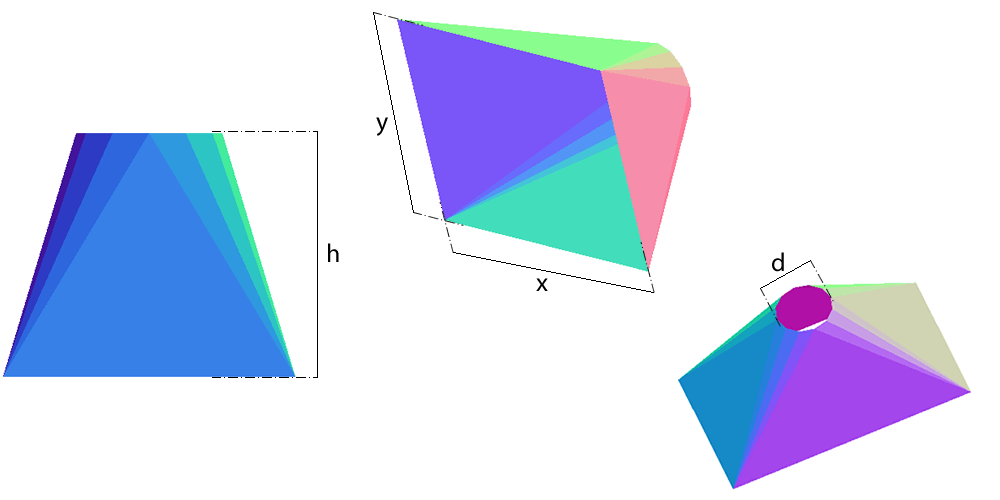
| Square to round 1000×600 → 450, h 1000, 3 mm plate | 2111 × 1889 mm | approx. 2.4 m² | approx. 57 kg | 2111 × 1889 | 93.9 kg |
Look at the cone: the part weighs 61 kg and the rectangular plate that contains it weighs 103. The 40% of waste is the price of an 87° sector on a rectangular plate, and it is why wide sectors are nested two to a plate, one inverted against the other.
Common mistakes
- Confusing kg/m² with kg/m: the first is for plate, the second for bar and section.
- Weighing by nominal thickness instead of measured: 12 gauge at 2.65 and at 2.70 differ by 2%, and on an order of tonnes that shows.
- Forgetting the waste: the template is not rectangular, and the plate you buy is. Quote by the minimum plate, not by the part area.
- Adding the thickness on the circumference: the development is on the neutral axis, D − t, and the part area is worked out from it.
Frequently asked questions
- How much does a 3 mm steel plate weigh?
- 23.55 kg per square metre: 3 × 7.85. A 1000 × 2000 plate weighs 47.1 kg and a 1500 × 3000 one weighs 106 kg.
- How do I work out the weight of a plate?
- Length in metres times width in metres times thickness in millimetres times 7.85. The result comes out in kilograms, for carbon steel.
- What thickness is 14, 16 and 18 gauge plate?
- In the MSG gauge used in Brazil: 14 gauge is 1.90 mm, 16 gauge is 1.50 mm and 18 gauge is 1.20 mm. 12 gauge is 2.65 mm and 11 gauge is 3.00 mm.
- What sizes is plate sold in?
- In Brazil, thin plate in 1000 × 2000, 1200 × 3000 and 1500 × 3000; thick plate in 1500 × 6000 and 2000 × 6000, cut to size. Coil for thin plate in widths from 1000 to 1500.
- Does the calculator give the weight of the part?
- It gives the minimum plate the flat pattern fits in, width by height. Multiply by the thickness and by 7.85 for the weight of the plate to buy; the finished part weighs less, by the template area.
Parts in this guide
Other guides
- How to develop a cone (frustum) in sheet metal: formula, sector radii and angle, step by step
- Lobster back bend (segmented 90° elbow): gore angles, cut heights and how many plates
- Pipe saddle development: how to lay out a pipe-to-pipe branch (tee) at 90 and 45 degrees
- Square to round transition: development by triangulation, step by step
- The neutral axis of plate: why every development uses D − t, and the bend deduction
- Sheet metal glossary: the terms of marking out and pattern development in plate fabrication
- How we check the Planichapa calculations, and who is behind them
- How to lay out a mitre-cut pipe: paper template, sine wave and ordinate table
- Plate 'n' Sheet alternative: Planichapa develops sheet metal parts in the browser, with the price on the page
- Sheet metal pattern development software: how to choose, and what changes between a desktop program, a phone app and an online calculator
- Eccentric and concentric reducers: which one to use and how each one develops on plate