Chain length and sprocket ratio: the formulas, a worked example and how many links to cut
Updated on 21 October 2026
A chain drive is two sprockets and a centre distance, and three numbers come out of them: the ratio, which sets the output speed; the chain length, in links; and the real centre distance once the chain is rounded to a whole number of links. This guide gives the formulas, a worked example for an ANSI 40 drive and the rules of thumb from the chain makers' catalogues.
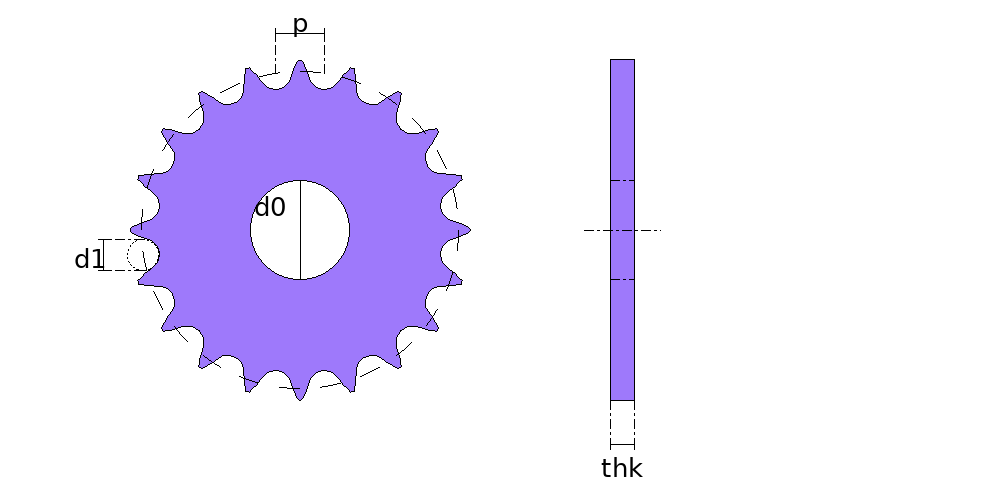
The sprocket generator draws both sprockets once the tooth counts are chosen; the pitch and roller of each chain are in the roller chain size chart.
The formulas
- Ratio and output speed
i = z2 / z1 ; n2 = n1 × z1 / z2z1 is the driving sprocket, z2 the driven one and n the speed in rpm.
- Chain length, in pitches
Lp = 2 C / p + (z1 + z2) / 2 + p × ((z2 − z1) / 2π)² / CC is the centre distance and p the chain pitch. Round Lp up to an even number: an odd count needs an offset link, the weakest link in the chain.
- Real centre distance for a whole chain
C = (p / 4) × [A + √(A² − 8 × ((z2 − z1) / 2π)²)], with A = Lp − (z1 + z2) / 2With the rounded Lp, the centre distance the chain actually gives, to set the tensioner or the slots of the motor base.
- Wrap on the small sprocket
wrap = 180° − 2 × asin((d2 − d1) / 2C)d1 and d2 are the pitch diameters, p / sin(180° / z). Below about 120° the chain can jump the teeth.
Worked example: an ANSI 40 drive, 17 to 42 teeth
An electric motor at 1450 rpm, a 17-tooth driving sprocket, a 42-tooth driven one, and about 500 mm between centres.
| Quantity | Value |
|---|---|
| Chain | ANSI 40, pitch p = 12.70 mm |
| Teeth, driving and driven (z1, z2) | 17 and 42 |
| Centre distance wanted (C) | 500 mm |
| Ratio, i = z2 / z1 | 2.471 |
| Output speed, n2 = 1450 × 17 / 42 | 586.9 rpm |
| Chain length, Lp | 108.64 pitches |
| Rounded up to an even number | 110 links |
| Real centre distance | 508.7 mm |
| Pitch diameters, d1 and d2 | 69.12 and 169.94 mm |
| Wrap on the small sprocket | 168.6° |
The chain comes to 108.64 pitches, so it is cut at 110 links -- 55 inner and 55 outer -- which moves the centres to 508.7 mm. Slot the motor base for that, plus room to take up the stretch as the chain wears.
Sizing a drive, step by step
- Pick the chain size from the chain maker's power ratings for the speed of the small sprocket.
- Choose the teeth of the small sprocket, then the large one's from the ratio: z2 = z1 × n1 / n2, rounded to a whole tooth.
- Choose the centre distance, 30 to 50 pitches, and work out Lp. Round it up to an even number of links.
- Work out the real centre distance for that chain and check the wrap on the small sprocket: at least 120°.
- Draw both sprockets in the generator with the chain's pitch and roller, and cut the chain at the link count.
Rules of thumb
- Centre distance between 30 and 50 pitches -- 380 to 635 mm on a half-inch chain. A shorter drive wears the chain faster, because each link flexes more often; with a pulsating load, though, keep it under about 20 pitches.
- More than 15 teeth on the small sprocket, and 17 or more on a drive that runs fast; no more than 120 on the large one.
- Up to about 7:1 in one stage. Beyond that, two stages run better than one huge sprocket.
- An even number of links, and some slack: a sag of about 4 % of the span on a normal drive, and 2 % on a vertical one, one over a metre between centres, or one that starts, stops or reverses often.
- At least 120° of wrap on the small sprocket.
Common mistakes
- Counting link pairs: the length is in pitches, and each inner or outer link is one. 110 links is 55 inner and 55 outer.
- An odd number of links on a fixed centre distance: it needs an offset link, which is weaker and wears first.
- Cutting the chain to the centre distance wanted: a chain is a whole number of links, so the shafts move to the real centre distance.
- Swapping z1 and z2: the output speed is the input speed times z1 / z2, with z1 the driving sprocket.
Frequently asked questions
- How do I calculate chain length?
- In pitches: Lp = 2C/p + (z1 + z2)/2 + p × ((z2 − z1)/2π)²/C, then round up to an even number. A 40 chain on 17 and 42 teeth at 500 mm centres: 108.64, so 110 links.
- How do I work out a sprocket ratio?
- Divide the driven sprocket's teeth by the driving sprocket's: 42 / 17 = 2.47. The output turns at the input speed divided by the ratio: 1450 rpm becomes 587 rpm.
- How do I find the centre distance for a given chain?
- With A = Lp − (z1 + z2)/2, C = (p/4) × [A + √(A² − 8 × ((z2 − z1)/2π)²)]. A 110-link 40 chain on 17 and 42 teeth gives 508.7 mm.
- Why should a chain have an even number of links?
- Because the links alternate inner and outer. An odd count needs an offset link, which is the weakest link of the chain and the first to wear.
Parts in this guide
Other guides
- How to develop a cone (frustum) in sheet metal: formula, sector radii and angle, step by step
- Lobster back bend calculator (segmented 90° elbow): gore angles, cut heights and how many plates
- Pipe saddle calculator and development: how to lay out a pipe-to-pipe branch (tee) at 90 and 45 degrees
- Square to round transition: development by triangulation, step by step
- The neutral axis of plate: why every development uses D − t, and the bend deduction
- Sheet metal glossary: the terms of marking out and pattern development in plate fabrication
- How we check the Planichapa calculations, and who is behind them
- LITIO alternative: Planichapa develops sheet metal parts in the browser, nothing to install, now that LITIO2 is no longer sold
- How to lay out a mitre-cut pipe: paper template, sine wave and ordinate table
- Plate 'n' Sheet alternative: Planichapa develops sheet metal parts in the browser, with the price on the page
- Steel plate weight calculator, weight per m², gauges and stock plate sizes: table and formula
- Pipe ovality: a calculator, the formula, a worked example, the limits the codes use and how to measure it in the shop
- Sheet metal pattern development software: how to choose, and what changes between a desktop program, a phone app and an online calculator
- Eccentric and concentric reducers: which one to use and how each one develops on plate
- Roller chain size chart: ANSI, ISO 606, motorcycle and bicycle chain pitch and roller diameter
- Sprocket dimensions: pitch diameter, outside and root diameter, tooth form and a pitch diameter chart
- Bolt circle layout: the position of each hole, the chord between holes and a chord chart
- Screw flight calculator: the flat blank of a screw conveyor flight (auger), with the formula and a worked example
- Plate rolling calculator: the blank length of a rolled shell, with the formula, a chart and a worked example
- Tube notching template generator: a printable coping template for any tube, angle and offset
- Dished head calculator: depth, volume, blank diameter and weight of torispherical, 2:1 elliptical and hemispherical heads
- Cone template generator: a printable full-size cone template for hoppers, funnels and reducers
- Pie cut calculator for exhaust and tube bends: saw angle, pie lengths and a wrap-around template
- Duct transition layout: square to round duct, centred, offset or flat on one side
- Pipe template, printable at full size: tee saddle, 45° lateral and mitre cut for every pipe size from NPS 1/2 to 12
- Register boot layout: from a floor, wall or ceiling register to a round duct, in inches
- Plenum box and plenum transition layout: the sides, the offset and the round outlet