Screw flight calculator: the flat blank of a screw conveyor flight (auger), with the formula and a worked example
Updated on 22 October 2026
A screw conveyor flight, the auger, is a helicoid: a ribbon of plate wound round a pipe, rising one pitch per turn. Each turn is cut flat as a ring with a wedge missing and then opened out and pressed to the pitch. The whole layout comes down to four numbers -- the two radii of the ring and the angle of the wedge, from the two helix lengths -- and this page gives them for any flight, with the formula, a worked example and the forming notes that the formula does not tell.
The screw flight generator draws the blank, with the 1:1 template and the DXF for the plasma or laser table.
Screw flight calculator
Type the shaft, the flight outside diameter and the pitch: the calculator gives the two radii of the blank, the angle to cut out, both helix lengths and the weight of one turn.
| Inner radius of the blank, Ri | – |
|---|---|
| Outer radius of the blank, Ro | – |
| Blank outside diameter | – |
| Ring kept, ω | – |
| Wedge to cut out, 360° − ω | – |
| Inner helix, one turn, Li | – |
| Outer helix, one turn, Lo | – |
| Area over the finished flight | – |
| Weight of one turn | – |
All lengths in millimetres; d is the outside diameter of the pipe the flight sits on. The blank is one turn: cut the wedge out and open the ring to the pitch. Nothing is sent anywhere: the sums run in your browser.
The dimensions
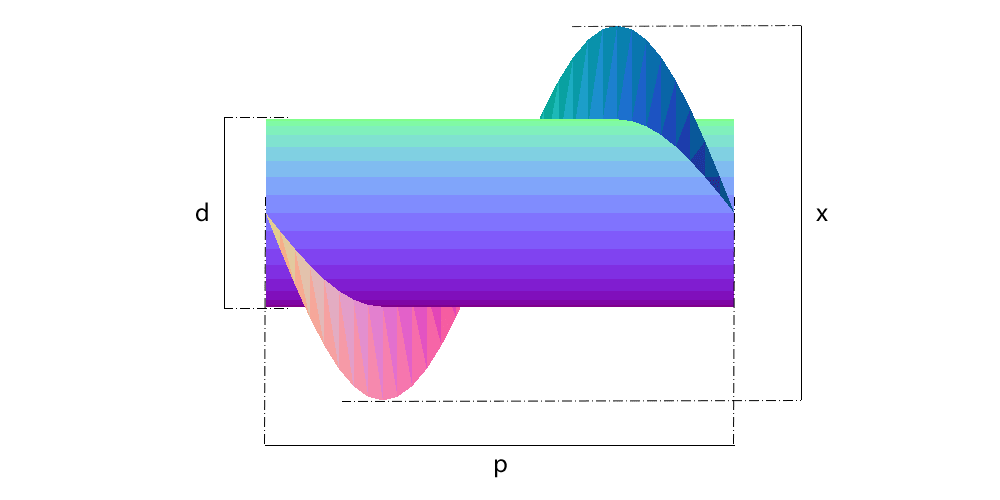
d is the inside diameter of the flight, which is the OUTSIDE diameter of the pipe or shaft it is welded to; D is the outside diameter of the flight; p is the pitch, the rise of the helix in one full turn, measured along the axis; t is the plate thickness, which does not change the blank but sets its weight and how it forms.
Standard pitch is equal to the flight diameter: a 200 mm screw has a 200 mm pitch. Half pitch is used on inclined screws and at the inlet of feeders, where the screw must not flood; long pitch, up to 1.5 D, for free-flowing material moved fast. Our example uses a long pitch, 250 mm on a 200 mm flight, because it shows the wedge clearly.
The hand: a right-hand flight, seen from the end, winds clockwise away from you, like a right-hand thread. Right hand is the default; the blank is the same for both hands -- what changes is the direction in which the two ends of the ring are opened.
The formula
- Length of the two helices, one turn
Li = √((π × d)² + p²) ; Lo = √((π × D)² + p²)The inner edge of the flight follows the helix on the pipe and the outer edge the helix at the flight diameter; each is the hypotenuse of a circumference and a pitch.
- Ring angle and radii
w = (D − d) / 2 ; ω = (Lo − Li) / w ; Ri = Li / ω ; Ro = Ri + wω in radians is the part of the ring that STAYS; the wedge cut out is 360° − ω. The ring's inner arc measures Li and its outer arc Lo, which is the condition the shop checks.
- Weight of one turn
weight = (ω / 2) × (Ro² − Ri²) × t × 7.85 / 10⁶ω in radians, lengths in mm, 7.85 kg/dm³ for carbon steel. Multiply by the number of turns, which is the screw length divided by the pitch.
The helicoid is not developable: no flat plate lies on it without stretching. This blank gets both EDGES right, which is what the bench measures, and its area comes out a little over the finished flight -- 0.7 % in the example, up to 1.5 % on a wide flight. Forming takes that up. A blank larger than the finished flight is expected, not an error.
Worked example: a 200 mm flight on a 100 mm shaft, 250 mm pitch
| Quantity | Value |
|---|---|
| Shaft (flight inside diameter), d | 100 mm |
| Flight outside diameter, D | 200 mm |
| Pitch, p | 250 mm |
| Inner helix, one turn, Li | 401.5 mm |
| Outer helix, one turn, Lo | 676.2 mm |
| Flight width, w | 50 mm |
| Ring kept, ω | 314.8° |
| Wedge cut out, 360° − ω | 45.2° |
| Inner radius of the blank, Ri | 73.1 mm |
| Outer radius of the blank, Ro | 123.1 mm |
| Blank outside diameter | 246 mm |
| Area over the finished flight | 0.68 % |
| Weight of one turn, 10 mm steel | 2.12 kg |
The blank is a ring 246 mm across with a 73.1 mm hole and a 45.2° wedge taken out. Opened until the two cut ends stand one pitch apart along the axis, it becomes one turn of the flight.
Forming the flight
- Cut the ring and the wedge: two concentric circles with Ri and Ro, and the two radii that bound the wedge of 360° − ω.
- Clamp one cut end and pull the other along the axis until the gap between them is the pitch. Thin plate opens by hand or with a bar through the hole; thick plate goes to the press, in a pair of helical dies or between two bars set to the pitch.
- Slide the turn over the pipe, set the pitch with a spacer or a gauge, and weld the inner edge to the pipe, one turn at a time, each butt-welded to the last. That is the sectional flight; the continuous helicoid flight is rolled from strip and is a different process.
- Check the outer edge: it must measure Lo per turn and stand at D over the whole length. A flight that cups or wanders was opened unevenly.
Common mistakes
- Cutting ω out instead of the wedge. ω is what stays (314.8° in the example); the wedge to remove is 360° − ω.
- Using the pipe's inside diameter for d. The flight sits on the OUTSIDE of the pipe: d is the pipe outside diameter.
- Expecting the blank to lie flat on the finished flight. It cannot; the surplus area is what forming absorbs.
- Opening the ring the wrong way. Both hands come from the same blank; opening it the wrong way gives a left-hand flight, which conveys backwards.
- A pitch far larger than the diameter. Above about 1.5 D the flight is nearly straight, and above 10 D the calculation refuses it.
Frequently asked questions
- How do I calculate a screw flight blank?
- From the two helix lengths of one turn, Li = √((πd)² + p²) and Lo = √((πD)² + p²): the ring angle is ω = (Lo − Li) / w with w = (D − d) / 2, the inner radius Ri = Li / ω and the outer Ro = Ri + w. A 200 mm flight on a 100 mm shaft with 250 mm pitch: Ri = 73.1 mm, Ro = 123.1 mm, wedge 45.2°.
- What is the standard pitch of a screw conveyor?
- Equal to the screw diameter. Half pitch for inclined screws and feeder inlets, and up to 1.5 times the diameter for fast, free-flowing material.
- Why is the blank bigger than the finished flight?
- Because a helicoid is not developable: no flat plate lies on it without stretching. The blank matches both edges, and its extra area, under 1.5 %, is taken up when the ring is opened and pressed to the pitch.
- How many blanks does a screw take?
- One per turn: the length of the flighted part divided by the pitch. A 2 m screw at 250 mm pitch takes 8 turns, welded one to the next on the pipe.
Parts in this guide
Other guides
- How to develop a cone (frustum) in sheet metal: formula, sector radii and angle, step by step
- Lobster back bend calculator (segmented 90° elbow): gore angles, cut heights and how many plates
- Pipe saddle calculator and development: how to lay out a pipe-to-pipe branch (tee) at 90 and 45 degrees
- Square to round transition: development by triangulation, step by step
- The neutral axis of plate: why every development uses D − t, and the bend deduction
- Sheet metal glossary: the terms of marking out and pattern development in plate fabrication
- How we check the Planichapa calculations, and who is behind them
- LITIO alternative: Planichapa develops sheet metal parts in the browser, nothing to install, now that LITIO2 is no longer sold
- How to lay out a mitre-cut pipe: paper template, sine wave and ordinate table
- Plate 'n' Sheet alternative: Planichapa develops sheet metal parts in the browser, with the price on the page
- Steel plate weight calculator, weight per m², gauges and stock plate sizes: table and formula
- Pipe ovality: a calculator, the formula, a worked example, the limits the codes use and how to measure it in the shop
- Sheet metal pattern development software: how to choose, and what changes between a desktop program, a phone app and an online calculator
- Eccentric and concentric reducers: which one to use and how each one develops on plate
- Roller chain size chart: ANSI, ISO 606, motorcycle and bicycle chain pitch and roller diameter
- Sprocket dimensions: pitch diameter, outside and root diameter, tooth form and a pitch diameter chart
- Bolt circle layout: the position of each hole, the chord between holes and a chord chart
- Chain length and sprocket ratio: the formulas, a worked example and how many links to cut
- Plate rolling calculator: the blank length of a rolled shell, with the formula, a chart and a worked example
- Tube notching template generator: a printable coping template for any tube, angle and offset
- Dished head calculator: depth, volume, blank diameter and weight of torispherical, 2:1 elliptical and hemispherical heads
- Cone template generator: a printable full-size cone template for hoppers, funnels and reducers
- Pie cut calculator for exhaust and tube bends: saw angle, pie lengths and a wrap-around template
- Duct transition layout: square to round duct, centred, offset or flat on one side
- Pipe template, printable at full size: tee saddle, 45° lateral and mitre cut for every pipe size from NPS 1/2 to 12
- Register boot layout: from a floor, wall or ceiling register to a round duct, in inches
- Plenum box and plenum transition layout: the sides, the offset and the round outlet