Eccentric and concentric reducers: which one to use and how each one develops on plate
Updated on 17 September 2026
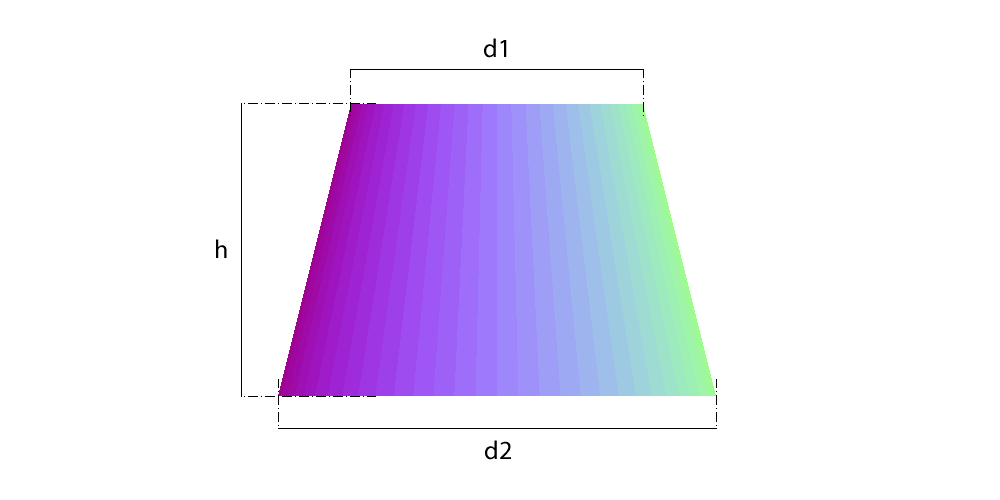
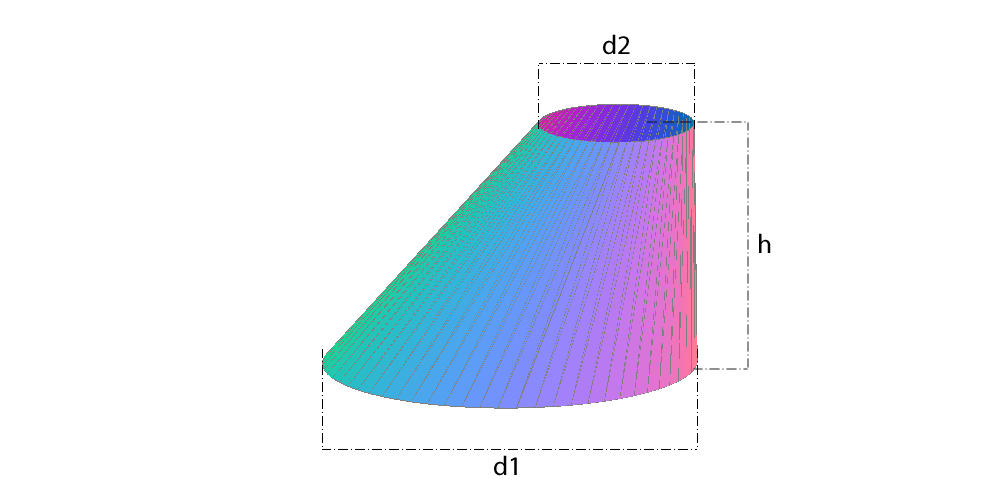
Every reducer joins two round openings of different diameters. On the concentric both sit on one axis; on the eccentric one opening is shifted until the two are tangent on one side, and that side comes out plumb. The first is a right cone and opens out as a trammel sector; the second is an oblique cone and only opens out by triangulation. This guide says when to use each and how the layout changes.
When to use the concentric and when to use the eccentric
The concentric is the standard reducer: funnel, hopper, chimney transition, reducer on a vertical pipe run. The eccentric exists for a fitting reason: with one side plumb, a horizontal run stays supported on the same bottom line (or top line) after the change in size. On a pump suction line, the eccentric with the flat side up avoids an air pocket; on a run resting on saddles, with the flat side down it keeps the support.
In hoppers and silos the eccentric turns up when the outlet has to sit against a wall or a beam: the bottom opening is shifted until that side is vertical, and the discharge comes out where the structure allows.
What changes in the layout
The concentric cone is a right circular cone: the generators converge on an apex, and the plate opens out as a sector of an annulus, struck with a trammel from one centre. Two radii and an angle settle everything.
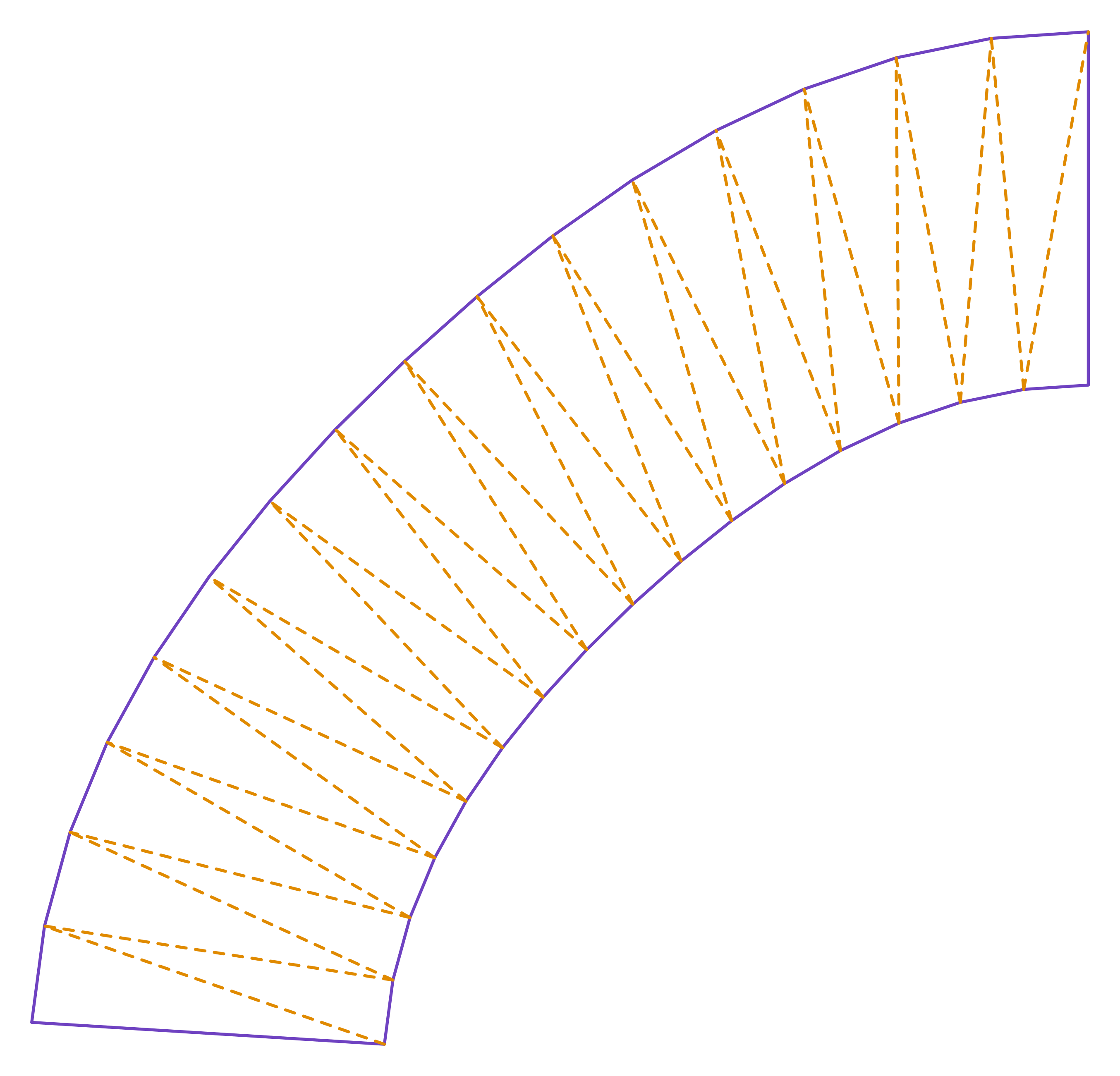
On the oblique cone and the offset cone the generators do not converge on any usable point, and the only exact layout is by triangulation: each opening is divided into stations, each bottom station is joined to its two neighbours at the top, the true length of every generator is worked out and the triangles are rebuilt on the plate with compasses. The plate comes out asymmetric: long on the sloping side, short on the plumb side.
- Offset of the eccentric
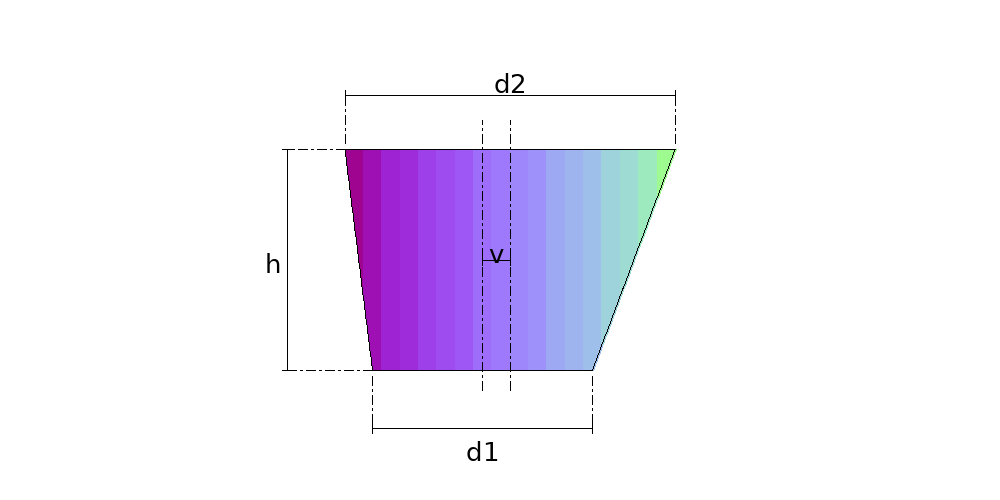
v = (D2 − D1) / 2It is the shift between the axes that leaves one side vertical. With v = 0 the part is the concentric; with v between 0 and (D2 − D1)/2 it is an offset reducer; above that the small opening leaves the projection of the large one, the external eccentric.
- True length of a generator
ℓ = √( h² + Δx² + Δy² )Δx and Δy are the distances in plan between the bottom station and the top one, and h the height. It is Pythagoras in three dimensions, once per generator.
One part that does both
The offset cone takes the shift as a dimension: zero gives the concentric, (D2 − D1)/2 gives the classic eccentric with one side plumb, and any value between the two gives the offset reducer that a crooked pipe run sometimes calls for. It is the same page for all three, and the calculation picks between the sector and triangulation by itself.
Common mistakes
- Laying out the eccentric as a trammel sector. Only the right cone opens out as a sector; an eccentric laid out that way closes with the opening skewed and the seam does not meet.
- Entering the wrong offset. The eccentric with one side plumb has v = (D2 − D1)/2 exactly; more than that and the part becomes an external eccentric, less than that and it is not plumb.
- Too few divisions. Triangulation approximates the curve by chords; 16 divisions is the minimum on 800 mm openings, and the calculation works from the arc length so the opening does not come out short.
- Forgetting the thickness. Both openings take the thickness offset on the neutral axis, as on the concentric cone; a plate that does not comes out π × t over at the seam.
- Rolling the eccentric in one pass. It is not a surface of revolution: it is formed in sectors, against a template, which is why the template has to be right before cutting.
Frequently asked questions
- What is the difference between a concentric and an eccentric reducer?
- On the concentric both openings sit on one axis and the part is a right cone. On the eccentric one opening is shifted by (D2 − D1)/2, the two are tangent on one side and that side comes out plumb. The concentric opens out as a trammel sector; the eccentric only by triangulation.
- When is an eccentric reducer used?
- When a pipe run has to keep its bottom or top line while changing size: pump suction with the flat side up, a supported run with the flat side down, a hopper with the outlet against a wall.
- How do I develop an eccentric reducer?
- By triangulation: divide both openings into stations, work out the true length of every generator with √(h² + Δx² + Δy²) and rebuild the triangles on the plate. The Planichapa offset cone does that with the offset you enter.
- Can I make an eccentric reducer with the oblique cone?
- Yes: the oblique cone is the offset cone with the shift locked at (D2 − D1)/2, the value that leaves one generator vertical. Both pages give the same plate in that case.
Parts in this guide
Other guides
- How to develop a cone (frustum) in sheet metal: formula, sector radii and angle, step by step
- Lobster back bend (segmented 90° elbow): gore angles, cut heights and how many plates
- Pipe saddle development: how to lay out a pipe-to-pipe branch (tee) at 90 and 45 degrees
- Square to round transition: development by triangulation, step by step
- The neutral axis of plate: why every development uses D − t, and the bend deduction
- Sheet metal glossary: the terms of marking out and pattern development in plate fabrication
- How we check the Planichapa calculations, and who is behind them
- How to lay out a mitre-cut pipe: paper template, sine wave and ordinate table
- Plate 'n' Sheet alternative: Planichapa develops sheet metal parts in the browser, with the price on the page
- Steel plate weight per m², gauges and stock plate sizes: weight table and formula
- Sheet metal pattern development software: how to choose, and what changes between a desktop program, a phone app and an online calculator