Square to round transition: development by triangulation, step by step
Updated on 15 September 2026
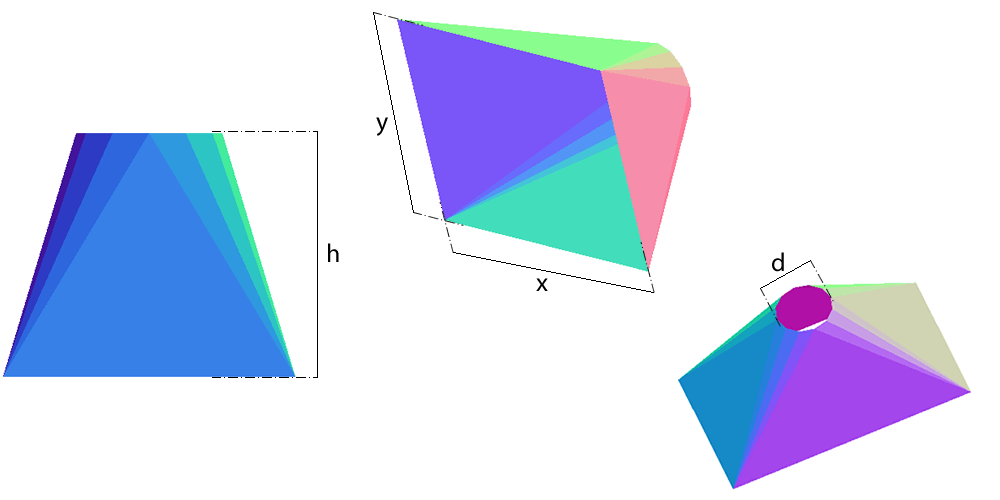
The square (or rectangle) to round transition joins a rectangular opening to a circular one: fan outlet to duct, hood to pipe, equipment to pipework. The surface is four flat triangles on the sides of the rectangle alternating with four conical fans at the corners. There is no closed formula for it: the development is by triangulation, one line at a time.
This guide shows the method, with the figures of the example worked by Planichapa, and the two checks that tell you the layout closed before you cut.
The dimensions
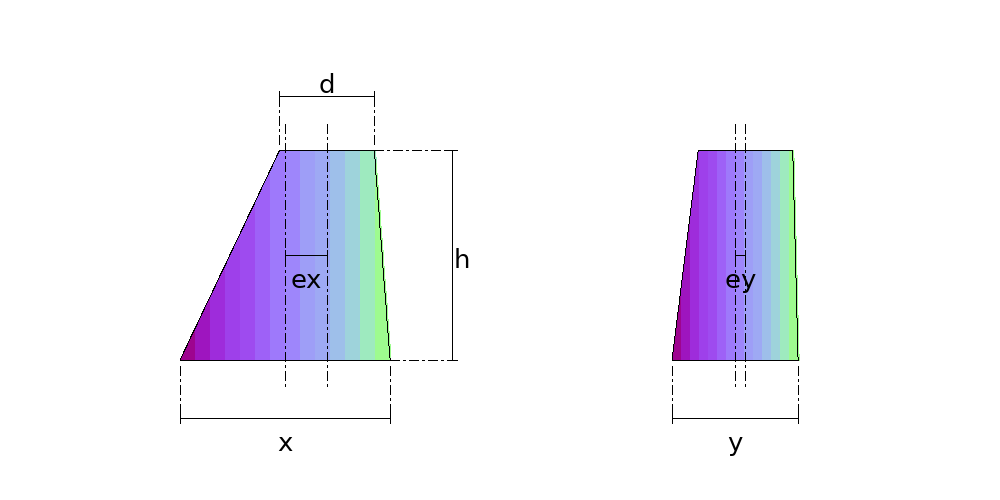
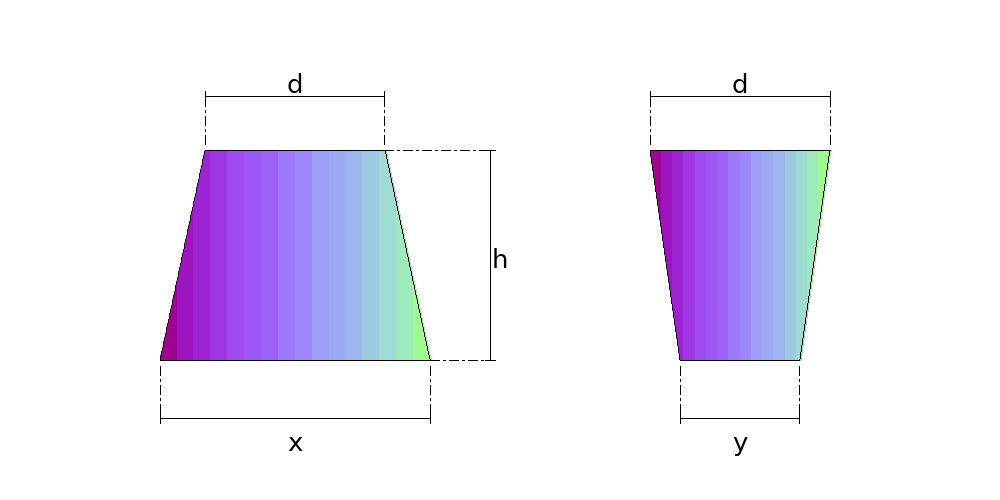
D is the diameter of the round opening, X and Y the sides of the rectangular one, h the vertical height between the openings and t the plate thickness. All three opening dimensions are outside dimensions, and all three lose one thickness: the layout is on the mean surface.
In the example: D = 450 mm, X = 1000 mm, Y = 600 mm, h = 1000 mm and 3 mm plate. On the mean surface, r = 223.5, a = X/2 − t/2 = 498.5 and b = Y/2 − t/2 = 298.5 mm. Planichapa divides the circle into 12 parts, three per corner.
Why triangulation
A rolled shell opens along parallel lines and a cone along radial lines, because both surfaces are developable in a simple way. On the square to round the four corners are pieces of oblique cones and the four sides are flat triangles: the only exact way to open that is to divide the surface into triangles, find the true length of every side and rebuild the triangles, one by one, on the plate.
The point that stops most people is that no line appears at true length in the drawing views: all are inclined in three axes. The true length comes from Pythagoras in three dimensions, and it is the only figure that works.
The formulas
- Mean-surface dimensions
r = (D − t)/2 ; a = (X − t)/2 ; b = (Y − t)/2223.5, 498.5 and 298.5 mm in the example.
- True length of a line
ℓ = √( h² + (a − r × cos φ)² + (b − r × sin φ)² )From the corner (a, b) to the point of the circle at angle φ. Δx and Δy are the plan projections; h the height. Pythagoras twice.
- Chord of each circle division
c = 2 × π × r / 12117.0 mm in the example. It is the side that closes each triangle of the conical fan.
- Line from the middle of each side
ℓ0 = √( h² + (a − r)² ) on side Y ; √( h² + (b − r)² ) on side XJoins the middle of the side to the nearest point of the circle. It is the axis of the flat triangle.
Worked example
With r = 223.5, a = 498.5, b = 298.5 and h = 1000, the lines of one corner fan, every 30°, and the one from the middle of side Y:
| Line | Δx | Δy | True length |
|---|---|---|---|
| Middle of side Y to circle (φ = 0) | 275.0 | 0.0 | 1037.1 mm |
| Corner to circle, φ = 0° | 275.0 | 298.5 | 1079.2 mm |
| Corner to circle, φ = 30° | 304.9 | 186.8 | 1062.0 mm |
| Corner to circle, φ = 60° | 386.8 | 104.9 | 1077.3 mm |
| Corner to circle, φ = 90° | 498.5 | 75.0 | 1119.9 mm |
By symmetry all four corners use the same five values, and the chord is 117.0 mm throughout. The whole plate of the example measures 2111 × 1889 mm, with the seam in the middle of side Y.
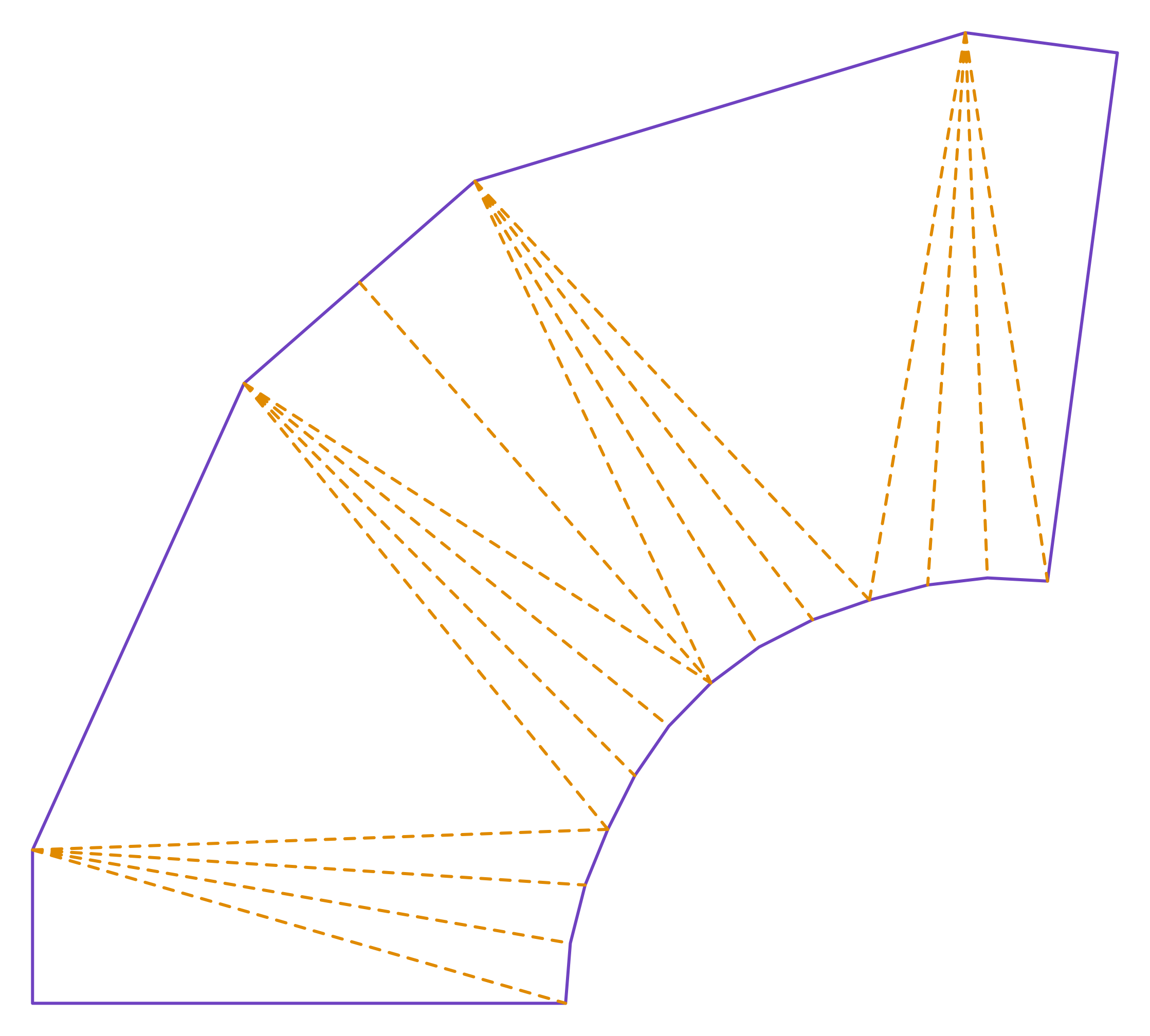
Marking out on the plate
- Work out the true lengths and the chord, or copy them from the calculator's table. Note the mean circumference of the circle (12 chords) and the sides of the rectangle as well: they are the final check.
- Start at the seam, in the middle of side Y: mark the half edge b = 298.5 mm and, at its end, the corner. From the middle of the edge, with compasses, strike ℓ0 = 1037.1; from the corner, strike ℓ = 1079.2; where the two arcs cross is the first point of the circle.
- From the first circle point strike the chord c = 117.0; from the corner strike the next line, 1062.0. The intersection is the second circle point. Repeat with 1077.3 and then 1119.9: the corner fan has four lines and three chords.
- From the last corner line open the flat triangle of side X: base X − t = 997 mm to the next corner, and the line 1119.9 again, mirrored. The apex is the same circle point.
- Carry on through the second corner, side Y and the third corner until the half pattern closes; mirror for the other half, or mark it whole if the plate allows.
- Check before cutting: the circle must close with 12 chords of 117.0 and the rectangle with X − t and Y − t. If it does not, one triangle went wrong and everything after it is shifted.
- Cut, crease the four corner lines (the real folds) and form the fans on the rolls or in the press a little at a time; the part closes at the seam with a single weld.
A trammel is more accurate than a rule for marking the true lengths: they are arcs of over a metre, and a millimetre per line becomes ten round the pattern.
Mistakes that stop the part closing
- Measuring a line off the view. None appears at true length; only √(h² + Δx² + Δy²) will do.
- Getting one triangle wrong and carrying on. Triangulation is a chain: every point comes from two arcs. One error shifts everything after it. Check by the circle circumference when you finish.
- Forgetting the thickness on one of the three openings. D, X and Y each lose t once. Without that the round opening comes out π × t long and the rectangle 2t larger per side.
- Too few circle divisions. With 12, the 117 mm chord on a 447 circle already shows as a facet at the opening; on thin plate and large diameters form the fans with more care.
- Creasing the chords. The real folds are the four corner lines, between flat triangle and fan. The other lines are construction lines; the fan is formed, not folded.
When the round opening is off centre
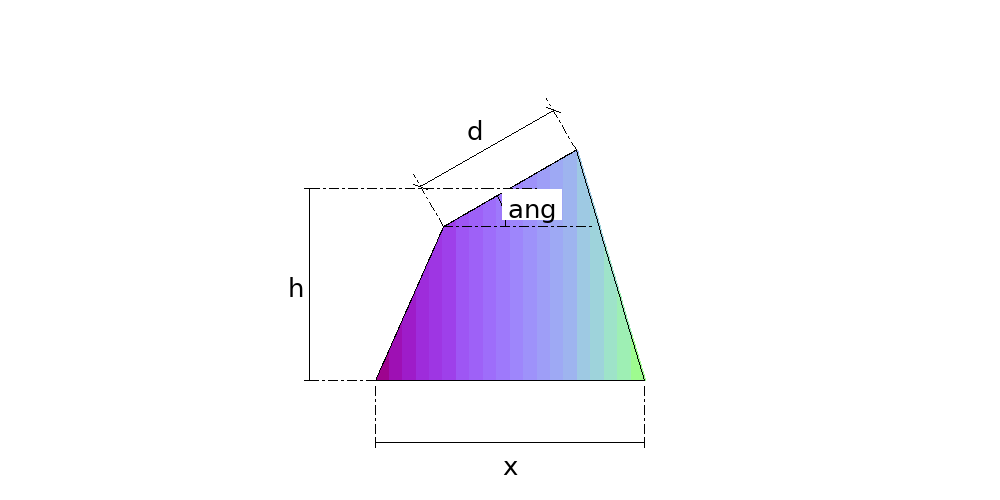
If the round is shifted relative to the rectangle, the part is the eccentric rectangle to round: the symmetry is gone and the pattern has to be walked right round, corner by corner. If the round opening is tilted, it is the inclined square to round. And if the lower opening is a flat oval rather than a circle, it is the round to oval, with the same structure of fans and triangulated strips.
Frequently asked questions
- How do I develop a square to round?
- By triangulation: divide the circle into 12 parts, work out the true length of every line joining a corner of the rectangle to a point on the circle, √(h² + Δx² + Δy²), and rebuild the triangles on the plate with compasses, alternating line and chord. The four sides of the rectangle are flat triangles; the corners are conical fans.
- What is the formula for a square to round transition?
- There is no closed formula for the whole plate. What exists is the formula for each line, ℓ = √(h² + (a − r cos φ)² + (b − r sin φ)²), and the chord c = 2πr/12. The template is the sum of the triangles.
- Where does the seam go?
- In the middle of one side, cutting the flat triangle in half: a straight line, the shortest weld and the easiest to close. Planichapa puts the seam in the middle of side Y.
- Does thickness matter?
- On all three openings: D, X and Y each lose one thickness, because the layout is on the mean surface. In 3 mm plate it is little; in 10 mm plate it is 31 mm on the circle circumference.
- Can it be done without calculating, by rotating lines on the drawing?
- Yes, it is the classic textbook method: each line is rotated into a view to find its true length. It works, but every rotation is a chance of half a millimetre of error, and there are twenty lines. Calculating is faster and the result is checked by the circumference.