Round to Oval development
What it is
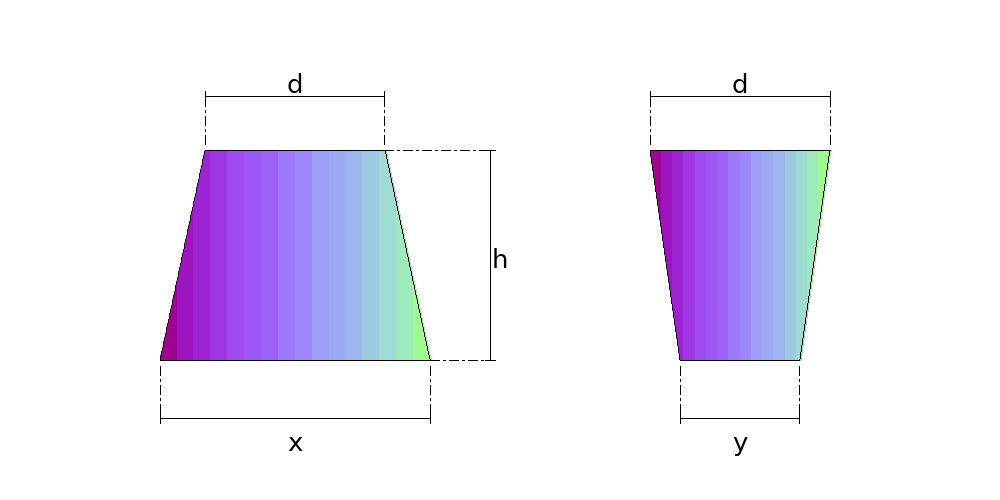
A round opening on top, a flat oval below — the round duct that has to get through a shallow space. The oval is the sheet-metal one: two semicircles joined by two straight runs. The surface has the same structure as the rectangle-to-round, with one swap: there the corners are points and the fans spring from them; here the corners are arcs, and a triangulated strip runs between each bottom arc and its half of the circle above.
Where it is used
Ventilation and extraction ducts through shallow voids, round pipe to flat-oval duct, plant-room transitions, bench hoods.
Measurements the calculation needs
- X Length of the oval (base)
- Y Width of the oval (base)
- D Diameter of the round mouth (top)
- H Height between the mouths
- DV Divisions
- THK Plate thickness
Worked example
The values the form comes pre-filled with, run through the tool itself:
| Length of the oval (base) | 900 mm |
|---|---|
| Width of the oval (base) | 400 mm |
| Diameter of the round mouth (top) | 600 mm |
| Height between the mouths | 700 mm |
| Divisions | 16 |
| Plate thickness | 3 mm |
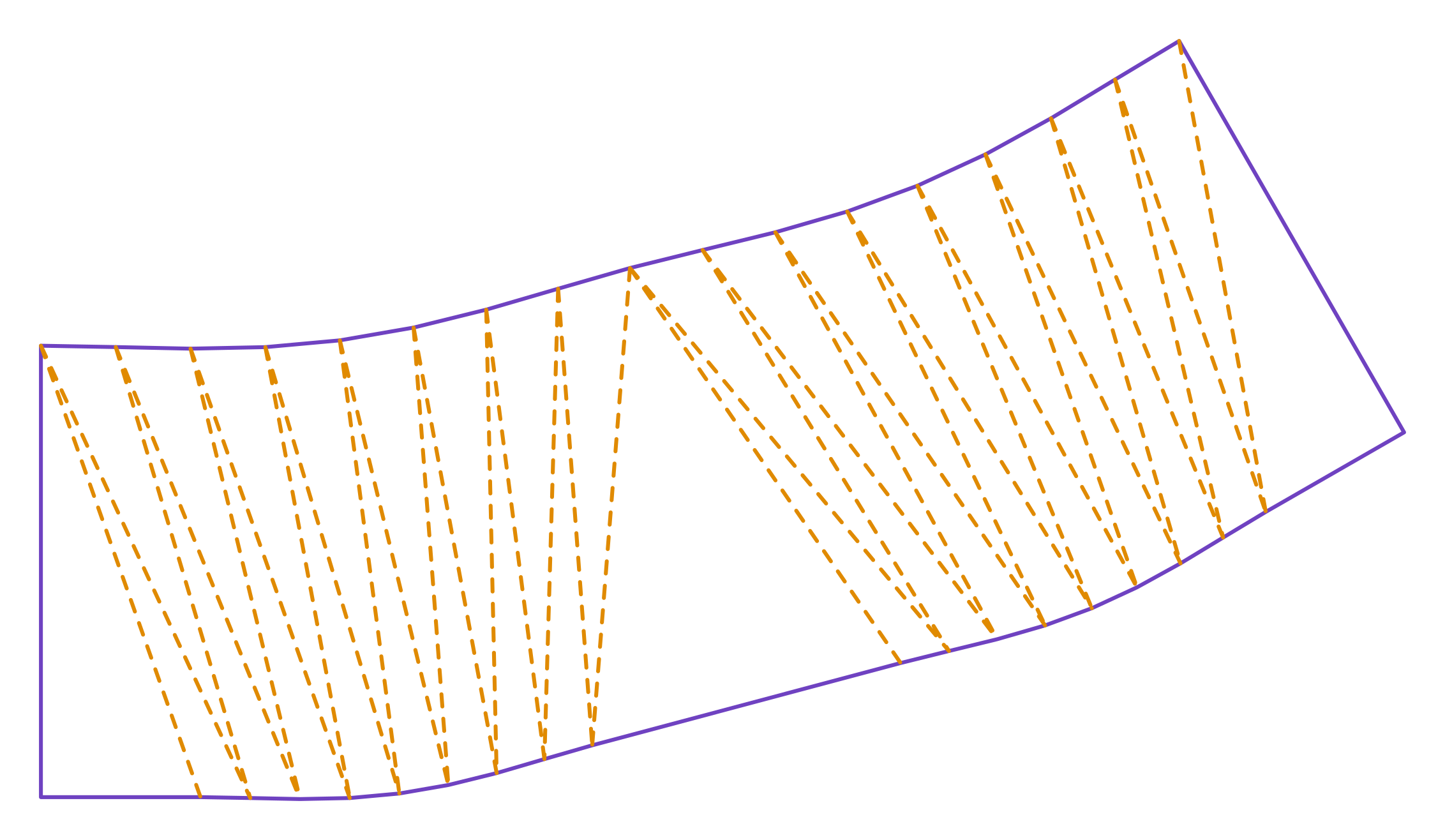
| The flat pattern fits a plate of | 2135 × 1187 mm |
Result of the example
| Plate | 2135 × 1187 mm |
|---|
Guides about this part
Frequently asked questions
- Can the round opening be wider than the oval?
- Wider than its WIDTH, yes, and it usually is: a round duct becomes a longer, shallower oval of the same area. The part then flares out before closing in, which is normal. What it cannot exceed is the oval's LENGTH.
- Why must the length exceed the width by at least a millimetre?
- Because at equal length and width the straight runs vanish, the oval becomes a circle, and the flat triangle on each run degenerates — the pattern would come out with invalid values. In that condition the part is a cone, and there is a cone in this catalogue. It is the same guard the cone has for its minimum taper.
- Where does the seam go?
- In the middle of one of the straight runs, cutting it in half. A weld closes better on a straight line than in the middle of an arc.
- Do the divisions change the pattern?
- They do. Both arcs are approximated by segments, and each extra division approximates them more closely. The divisions are taken along the arc and not the chord, so the openings do not come out short.