Angular Boot, Rectangle to Round development
What it is
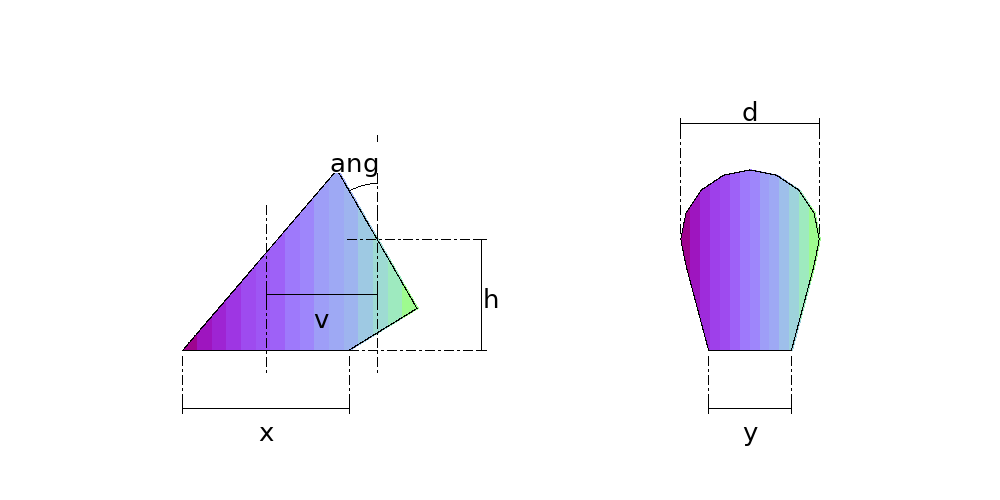
The boot: a rectangular mouth below and a round pipe leaving SIDEWAYS, horizontal, at mid height. Its round mouth is not a circle — it is the angled cut of the pipe, an ellipse of axes d by d/cos(ang) — and that is what separates it from the other transitions here.
Where it is used
Floor and wall registers in air conditioning, exhaust collectors, side take-offs on fan boxes, suction mouths on round duct, any job where the pipe leaves sideways rather than upward.
Measurements the calculation needs
- D Diameter of the round pipe
- X Side of the rectangle along the pipe
- Y Side of the rectangle across the pipe
- ANG Cut angle of the pipe (0 = square)
- H Height from base to the pipe axis
- V Offset from the rectangle centre to the mouth centre
- DV Divisions
- THK Plate thickness
Worked example
The values the form comes pre-filled with, run through the tool itself:
| Diameter of the round pipe | 250 mm |
|---|---|
| Side of the rectangle along the pipe | 300 mm |
| Side of the rectangle across the pipe | 150 mm |
| Cut angle of the pipe (0 = square) | 30° |
| Height from base to the pipe axis | 200 mm |
| Offset from the rectangle centre to the mouth centre | 200 mm |
| Divisions | 16 |
| Plate thickness | 3 mm |
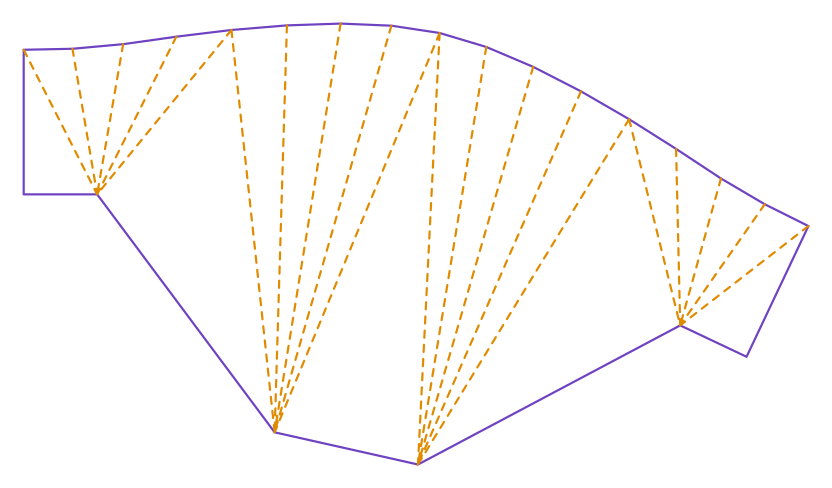
| The flat pattern fits a plate of | 785 × 441 mm |
Result of the example
| Plate | 785 × 441 mm |
|---|
Assembly notes
Mark the TWO CREASES, one on each side of length x, on the line running from the flat triangle's apex to the mouth. They are part of the piece, not a defect: on those two sides no point of the mouth has a tangent parallel to the side, so the meeting is not smooth and no pattern can make it so. On the two sides of length y the meeting is tangent and nothing is marked.
The pattern develops the SHARP CORNER, on the mean line — the theoretical layout, which is what gets delivered. If you fold it on a press brake with an inside radius, the blank comes out LONG: each fold needs the deduction 2*(r+t)*tan(a/2) − a*(r + k*t), with r the inside radius, a the bend angle in radians, and your tooling's k. On a 500x300 tube in 1.5 mm sheet with four 90° folds that is 3.5 mm at radius 0.75 and 9.0 mm at radius 4.5 — always to be taken off. A welded corner from separate plates needs no deduction at all.
The angle between faces VARIES from crease to crease on this part, and along each one: the mouth is not parallel to the base, so none of the walls is flat. Check it on the 3D model, crease by crease, and form to fit.
Frequently asked questions
- How is this different from the eccentric rectangle-to-round?
- There the top mouth is a flat CIRCLE and the pipe goes up. Here the pipe runs horizontally and the mouth is its angled cut, which is an ellipse. Welding a circular mouth to a pipe cut at 30° leaves a gap that grows with the angle: on a 250 pipe at 30° the major axis of the cut measures 289, not 250.
- Where do I measure h and v from?
- From the plane of the rectangular mouth to the pipe's AXIS, and from the centre of the rectangle to where the cutting plane crosses that axis. That point is the centre of the ellipse, and it is the only datum that still means the same thing when the angle is zero.
- Can I enter a zero angle?
- You can, and it is a legitimate case — the pipe is then straight and the mouth is an upright circle. What disappears is the collar: with a square cut it becomes straight pipe and needs no pattern at all.
- Why does the drawing have creases on the long sides?
- Because on those two sides no point of the mouth has a tangent parallel to the side, and no choice of apex avoids it. On the two sides of length y the tangent is parallel and the meeting is smooth. The two creases are part of the piece, and the printed sheet says to mark them.
- Can the round mouth be larger than the rectangle?
- It can, and on both classic plates used as tests it is. This part deliberately does not carry the eccentric transition's guards — they would reject both pieces from both books.
An account is required. The free tier covers 20 calculations a month.