Regular Pyramid Frustum development
What it is
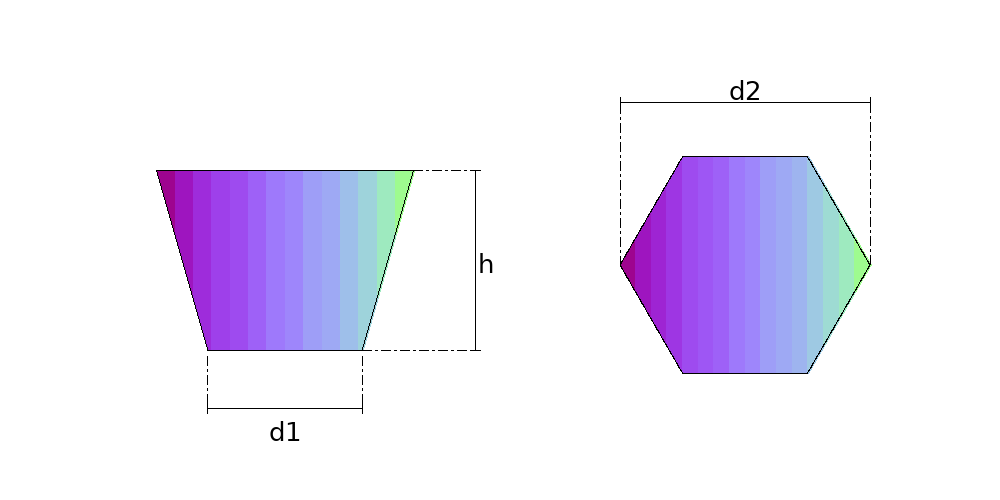
The frustum of a regular s-sided pyramid: two coaxial regular polygons and s identical flat facets. It is the part behind polygonal chimney caps, polygonal hoppers, hexagonal duct and cyclone baskets.
Where it is used
Polygonal chimneys and caps, silo hoppers, hexagonal and octagonal duct, cyclone baskets, oven hoods, any reduction between two regular polygonal mouths.
Measurements the calculation needs
- D1 Diameter of the base (corner to corner)
- D2 Diameter of the top (corner to corner)
- H Vertical height between the mouths
- S Number of sides
- THK Plate thickness
- R Bend radius
Worked example
The values the form comes pre-filled with, run through the tool itself:
| Diameter of the base (corner to corner) | 600 mm |
|---|---|
| Diameter of the top (corner to corner) | 1000 mm |
| Vertical height between the mouths | 700 mm |
| Number of sides | 6 |
| Plate thickness | 3 mm |
| Bend radius | 0 mm |
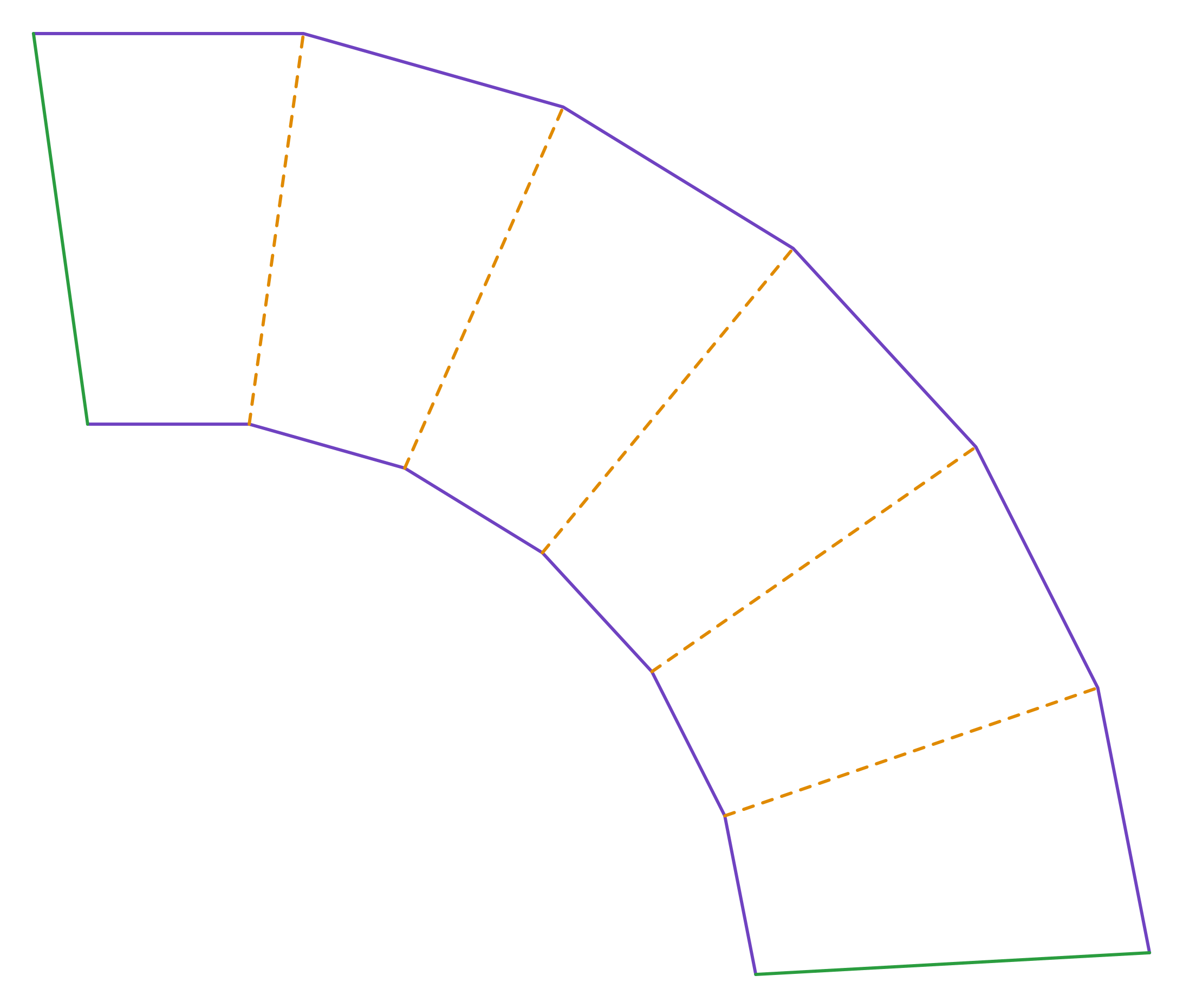
| The flat pattern fits a plate of | 2060 × 1737 mm |
Result of the example
| Plate | 2060 × 1737 mm |
|---|
Assembly notes
The pattern develops the SHARP CORNER, on the mean line — the theoretical layout, which is what gets delivered. If you fold it on a press brake with an inside radius, the blank comes out LONG: each fold needs the deduction 2*(r+t)*tan(a/2) − a*(r + k*t), with r the inside radius, a the bend angle in radians, and your tooling's k. On a 500x300 tube in 1.5 mm sheet with four 90° folds that is 3.5 mm at radius 0.75 and 9.0 mm at radius 4.5 — always to be taken off. A welded corner from separate plates needs no deduction at all.
Fold to an angle of 121.9° BETWEEN THE TWO FACES — what a protractor reads on the finished part, not the press stroke angle. Every crease on this part has the same angle.
Frequently asked questions
- Are the diameters across corners or across flats?
- Across corners — the CIRCUMSCRIBED circle, through the vertices. It is the same measure as the cone in this catalogue, deliberately: swap a cone for a polygonal one and you type the same two numbers. Across flats, which is what a caliper gives on a finished hexagon, is d times the cosine of 180/s: on a 600 circumscribed hexagon that is 519.6.
- Why does this part not ask for divisions?
- Because there is nothing to approximate. Each face has its bottom edge parallel to its top edge, so the face is a flat trapezoid and its development is itself, exactly. The absence of a division count is the proof of it.
- Can I make a straight prism, with no reduction?
- You can — enter the same diameter twice. The part is then straight polygonal duct, hexagonal or octagonal, and that is a real part rather than a degenerate case.
- What if I want four sides?
- It works, and gives exactly the same pattern as the Rectangular Transition in the square case — the spec checks it edge by edge. For a rectangular reduction with different proportions at the two mouths, use that part, which takes all four figures separately.
- Does thickness come off as it does on a cylinder?
- It does not. The mean surface lies half a thickness inside each FACE, which shrinks the apothem by half the thickness and the circumscribed radius by rather more. On a triangle the difference is large, and that is why this part's thickness guard is on the apothem.
An account is required. The free tier covers 20 calculations a month.