How to develop a cone (frustum) in sheet metal: formula, sector radii and angle, step by step
Updated on 15 September 2026
The truncated cone, or frustum, is the concentric reducer of pipe fabrication: the part that joins two round openings of different diameters on one axis. Developed, it becomes a sector of an annulus, and after the rolled shell it is the most laid-out part in the shop. This guide gives the complete formula, a worked example run through the Planichapa calculator, and the trammel layout.
Everything here is worked on the neutral axis, at mid-thickness of the plate. That is the detail that separates a cone that closes from one that overlaps at the seam, and it is also where most textbooks stop.
What you need to measure
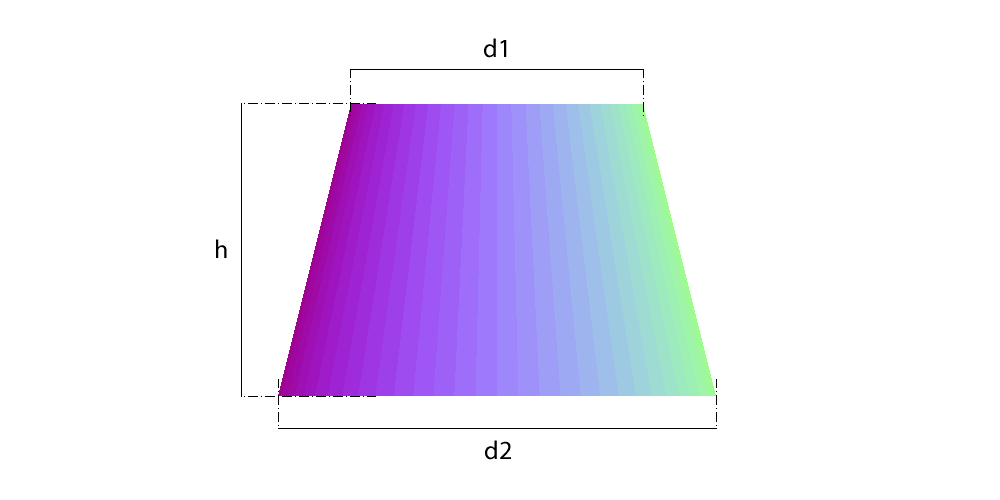
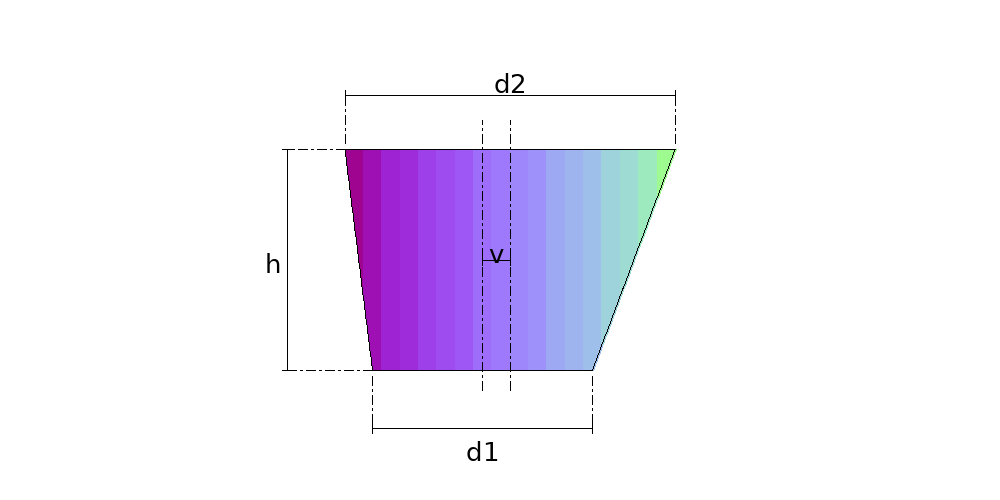
Four dimensions: the large diameter D2, the small diameter D1, the vertical height h between the two openings, and the plate thickness t. Diameters are outside diameters. The height is the vertical distance on the axis, not the slant; the slant comes out of the arithmetic.
In the example of this guide: D1 = 800 mm, D2 = 1200 mm, h = 800 mm and 3 mm plate. Those are the values the cone page comes pre-filled with, and every figure below comes from them.
The cone development formula
- Slant height
g = √( h² + ((D2 − D1) / 2)² )The hypotenuse of the triangle made by the height and the difference in radii. In the example: g = √(800² + 200²) = 824.6 mm.
- Half-angle
tan α = (D2 − D1) / (2 × h)In the example, tan α = 200/800 and α = 14.0°. It is needed for the thickness offset.
- Thickness offset
δ = (t / 2) × cos α = (t / 2) × h / gThe mean surface sits half a thickness inside the outer one, measured along the NORMAL to the plate. On a cone the normal is inclined, so the offset on the radius is less than t/2. In the example: δ = 1.5 × 800 / 824.6 = 1.46 mm.
- Mean-surface radii of the openings
r1 = D1/2 − δ ; r2 = D2/2 − δ398.54 mm and 598.54 mm. The difference r2 − r1 is still 200 mm: both openings step in by the same amount, so the slant and the angle do not change with thickness, only the radii.
- Inner sector radius
Ri = g × r1 / (r2 − r1)The distance from the trammel centre to the small opening: 824.6 × 398.54 / 200 = 1643.2 mm.
- Outer sector radius
Re = Ri + g1643.2 + 824.6 = 2467.9 mm. Both arcs are struck from the same centre.
- Sector angle
θ = 360° × (r2 − r1) / g360 × 200 / 824.6 = 87.3°. It equals 360° × r1 / Ri, the form most textbooks give.
- Arc lengths, for checking
small arc = 2π × r1 ; large arc = 2π × r22504.1 mm and 3760.8 mm in the example. Each arc must measure the mean circumference of its opening. If it does not, the trammel centre moved.
Worked example
| Quantity | Formula | Value in the example |
|---|---|---|
| Slant height g | √(h² + ((D2 − D1)/2)²) | 824.6 mm |
| Offset δ | (t/2) × h / g | 1.46 mm |
| Inner radius Ri | g × r1 / (r2 − r1) | 1643.2 mm |
| Outer radius Re | Ri + g | 2467.9 mm |
| Sector angle θ | 360° × (r2 − r1) / g | 87.3° |
| Plate required | measured on the flat pattern | 3407 × 1279 mm |
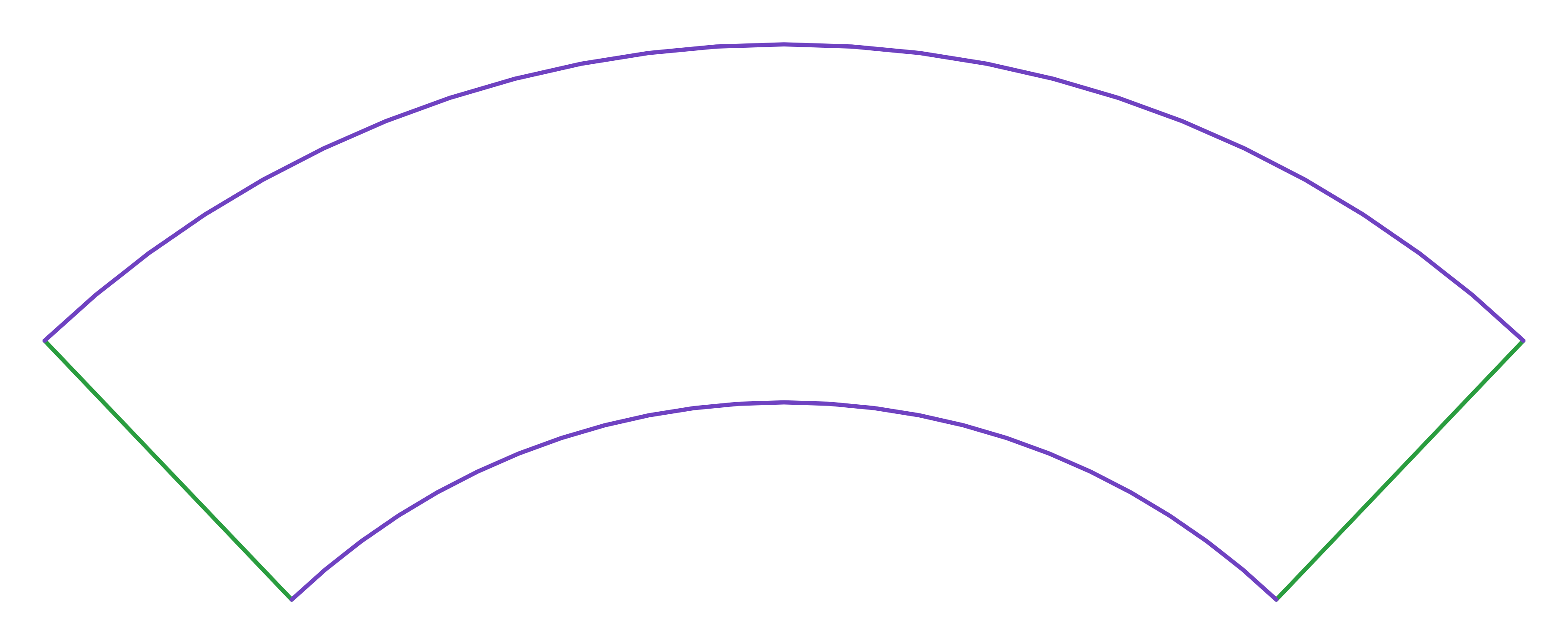
Note that the plate is much smaller than the radii: the trammel centre sits 1643 mm from the small opening, off the plate. That is normal, and it is why cone layout calls for a trammel and a fixed point on the floor or on an offcut.
Marking out with a trammel
- Work out g, Ri, Re and θ, or copy the figures from the cone page. Note the mean circumferences of both openings as well, 2π × r1 and 2π × r2: they are the check.
- Choose the trammel centre off the plate, on a tacked offcut or marked on the floor, so that both arcs fall on the plate. In the example the centre is 1643 mm from the edge of the small opening.
- Strike the small arc with radius Ri and the large arc with radius Re, without moving the centre.
- Scribe the first side: a straight line from the centre to beyond the large arc. It is a generator and measures g between the arcs.
- Along the large arc, with a flexible tape, mark the length 2π × r2 from the first side. Scribe the second side from the centre to that point.
- Check: between the two sides the small arc must measure 2π × r1. If it is long or short, the centre moved between arcs or the tape slipped.
- Cut along both arcs and both sides. Mark intermediate generators if you will form in passes: a cone does not come off the rolls in one pass.
- Roll with the top roll tilted, or in crossed passes, and close the seam along a generator. The weld is straight, of length g.
Marking the angle θ with a protractor is harder and less accurate than marking the arc length with a tape. The angle is for checking; the layout is done by arc length.
Thickness and the neutral axis
Plate neither stretches nor compresses on the neutral axis, at mid-thickness. Every development is worked there. On a rolled shell that gives the familiar π × (D − t). On a cone the offset is not t/2 taken off the radius: it is (t/2) × cos α, because the surface normal is inclined.
The proof is in the limit. At zero height the cone is a flat ring, and the blank for a washer is the washer itself: no offset, and cos α = 0. On a very tall cone α tends to zero and the offset tends to t/2, the shell value. In between, cos α.
| Part | t/2 off the radius | (t/2) × cos α | Difference |
|---|---|---|---|
| Reducer 800/1200/800 in 3 mm | 1.50 mm | 1.46 mm | 0.04 mm: irrelevant |
| Cone 200/1000/300 in 10 mm | 5.00 mm | 3.00 mm | 4 mm on both diameters |
| Conical cap 800 × 60 in 20 mm | 10.0 mm | 1.48 mm | 17 mm on the diameter, over 50 mm on the arc |
On an ordinary thin-wall reducer the difference is a tenth of a millimetre and nobody notices. In thick plate and a shallow cone, a conical cap or an open hopper, the wrong offset takes tens of millimetres off the circumference and the part comes out smaller than the drawing.
Mistakes that stop the seam closing
- Using the slant as the height. Measuring the sloping side and entering it as h gives a taller, tighter cone: in the example, 824.6 in place of 800 gives a sector of 84.8° instead of 87.3°.
- Using π × D on the arc. The opening comes out π × t too long: 9.4 mm on 1200 mm in 3 mm plate, 31.4 mm in 10 mm. The seam overlaps.
- Moving the trammel centre between arcs. The arcs stop being concentric and the slant changes along the sector. Check by the circumference of the small opening.
- Marking the angle with a protractor instead of the arc with a tape. Half a degree of error at 2468 mm radius is 21 mm on the large arc.
- Forgetting the weld allowance. The template is the finished part on the neutral axis: bevel, root gap and stock go on top, to suit the process.
- Rolling in one pass. A cone has converging generators: the rolls need to be tilted, or the part is formed in crossed passes and checked against a template.
When the cone is not concentric
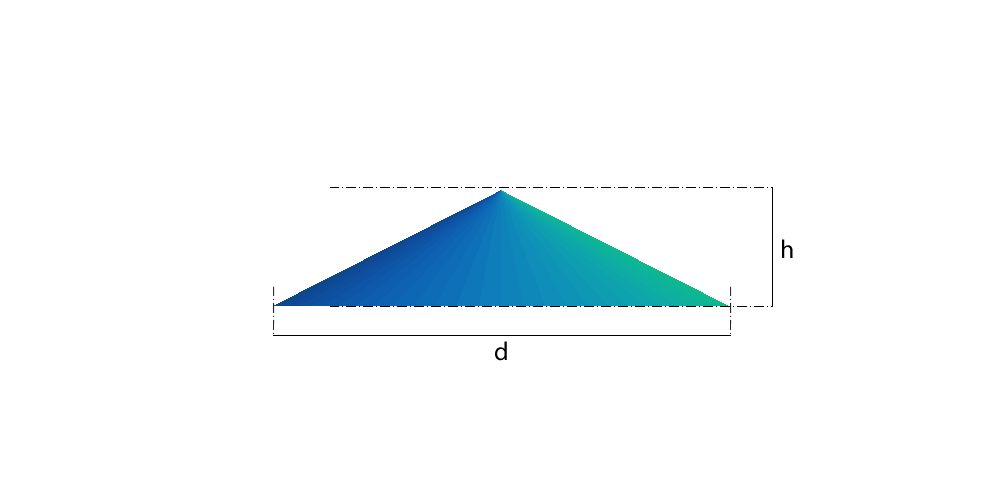
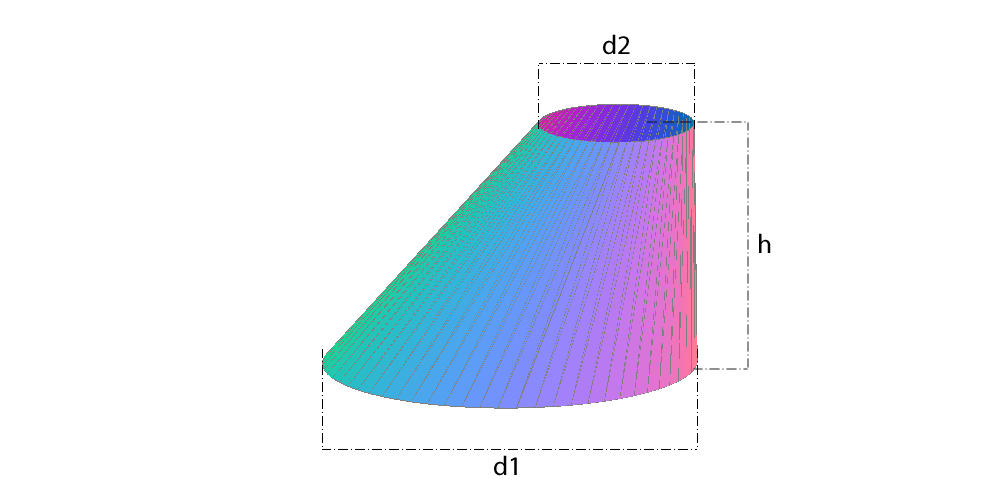
The sector formula only holds for the right cone, with both openings on one axis. If one opening is shifted, the part is the offset cone or the oblique cone, and the development comes by triangulation: every generator has its own true length and the template is built triangle by triangle. If the cone has no small opening, it is the conical cap, and the sector becomes a sector of a disc.
Frequently asked questions
- How do I work out the sector angle of a cone?
- θ = 360° × (r2 − r1) / g, with r1 and r2 the mean-surface radii of the openings and g the slant height. It equals 360° × r1 / Ri. For 800/1200/800 it is 87.3°.
- Why are the sector radii so much larger than the part?
- Because the sector is a piece of the complete cone, whose apex sits above the small opening. The distance from the apex to the small opening is Ri = g × r1 / (r2 − r1): the smaller the difference in diameters, the farther the apex. A nearly cylindrical cone has enormous radii, which is why the calculation requires D2 − D1 ≥ 1 mm.
- Does plate thickness matter on a cone?
- It does, and not as on a rolled shell. The offset on the radius is (t/2) × cos α, with α the half-angle. On thin plate it is irrelevant; on a shallow conical cap in 20 mm plate it is over 50 mm of arc.
- Can I lay out a cone without a trammel?
- Yes, by points: divide the angle θ into equal parts and mark each generator by coordinates from the centre, or use the PDF template the calculator produces. But the trammel remains the fastest and most accurate method in the shop.
- How many passes through the rolls does a cone take?
- It depends on the machine. On rolls with a tilting top roll a cone comes off in one or two passes; on plain rolls it is formed in crossed passes, one per marked generator, and checked against a circumference template.