Cone development
What it is
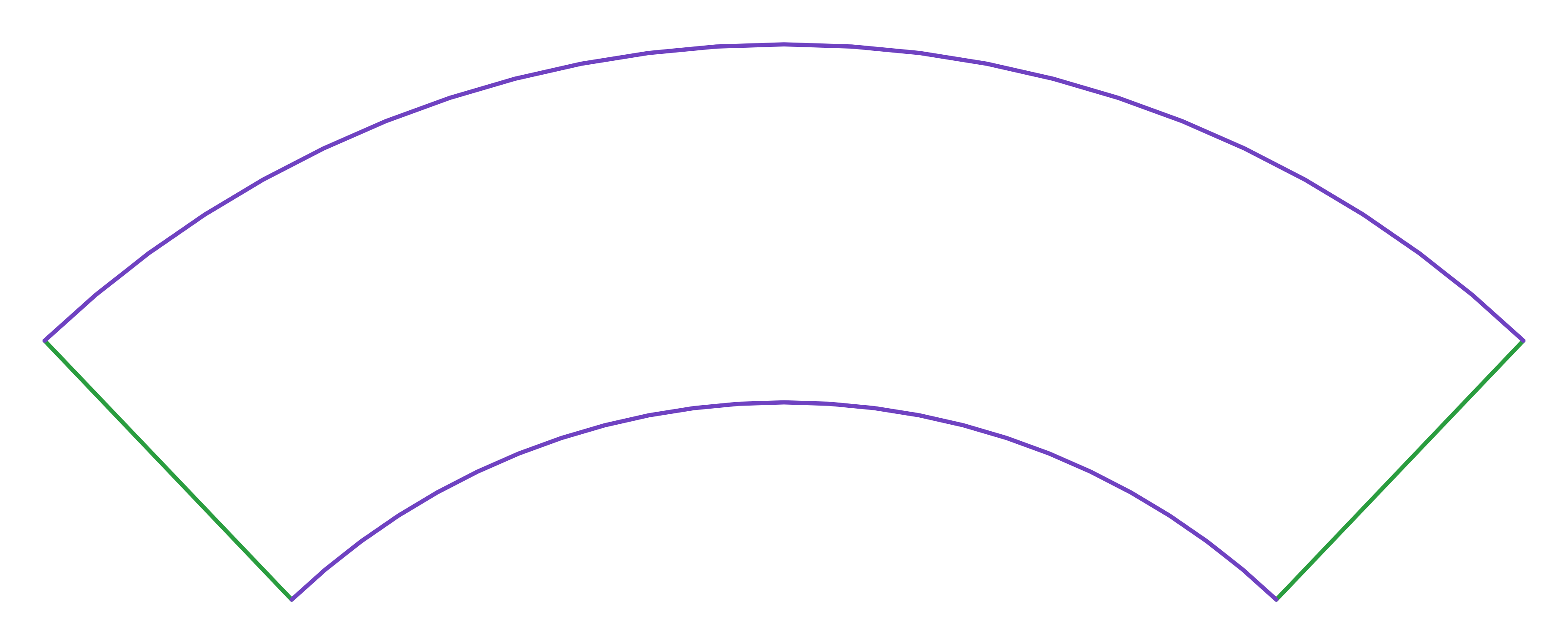
The truncated cone — the frustum, the concentric reducer — is the transition between two diameters on the same axis. Developed, it becomes an annular sector: two concentric arcs closed by two straight sides. The formula gives the slant height, both radii and the sector angle; it is marked out with a trammel from the centre.
Where it is used
Pipe reducers, funnels, hoppers, stack transitions, silo and cyclone outlets.
Measurements the calculation needs
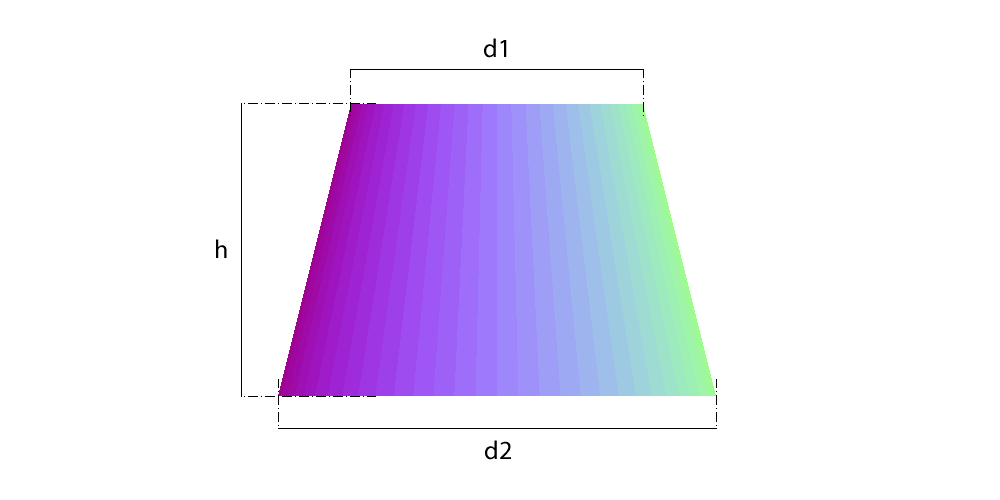
- D1 Smaller diameter
- D2 Larger diameter
- H Vertical height between the openings
- THK Plate thickness
Calculate with your own measurements
No account needed: enter the measurements in millimetres and get the figures and the drawing. The scaled PDF template, the DXF for the cutting table and the 3D model take a free account.
How it develops: the formulas
- Slant height
g = √( h² + ((D2 − D1) / 2)² )h is the vertical height between the openings, not the slant. For D1 = 800, D2 = 1200 and h = 800: g = 824.6 mm.- Thickness offset, normal to the surface
δ = (t / 2) × h / g = (t / 2) × cos αα is the half-angle, tan α = (D2 − D1) / (2h). The mean-surface radii are r1 = D1/2 − δ and r2 = D2/2 − δ. In the example, in 3 mm plate: δ = 1.46 mm.- Inner sector radius
Ri = g × r1 / (r2 − r1)The distance from the trammel centre to the small opening. In the example: 1643.2 mm.- Outer sector radius
Re = Ri + g = g × r2 / (r2 − r1)In the example: 2467.9 mm. Both arcs are concentric: one trammel centre.- Sector angle
θ = 360° × (r2 − r1) / g = 360° × r1 / RiIn the example: 87.3°. The shallower the cone, the larger the angle; a flat disc gives 360°.- Arc lengths
small arc = π × (D1 − 2δ) ; large arc = π × (D2 − 2δ)For checking the layout: each arc must measure the circumference of its opening on the mean surface.
Worked example
The values the form comes pre-filled with, run through the tool itself:
| Smaller diameter | 800 mm |
|---|---|
| Larger diameter | 1200 mm |
| Vertical height between the openings | 800 mm |
| Plate thickness | 3 mm |
| The flat pattern fits a plate of | 3407 × 1279 mm |
Result of the example
| Plate | 3407 × 1279 mm |
|---|---|
| Arc radii | 1,643.2 mm · 2,467.9 mm |
| Sector angle | 87.3° |
How to mark it out on the plate
- Work out g, Ri, Re and θ from the formulas above, or with the calculator, and note the mean circumference of both openings for checking.
- Fix the trammel centre off the plate, on an offcut or the floor, in line with the edge: the radii are usually longer than the plate (1643 and 2468 mm in the example).
- Scribe the two arcs: the small one with Ri and the large one with Re.
- Mark the arc length π × (D2 − 2δ) along the large arc with a flexible tape and scribe the second side from the centre to that point. Both sides are generators and measure g.
- Check the small arc: it must measure π × (D1 − 2δ) between the two sides. If not, the centre moved between one arc and the other.
- Cut, roll in crossed passes (a cone does not come off in one pass) and close the seam along a generator.
Common mistakes and tolerances
- Entering the slant height as the height
- The calculation wants the vertical h. Entering the slant instead gives a taller, tighter cone: in the example, 824.6 in place of 800 gives a sector of 84.8° instead of 87.3°.
- Taking the thickness off the radius instead of the normal
- Taking t/2 off the radius is right for a cylinder and wrong for a shallow cone. The correct offset is (t/2) × cos α: on an 800 conical cap in 20 mm plate the difference is over 50 mm of arc. On an ordinary thin-wall reducer it is a tenth of a millimetre.
- Not taking the thickness off at all
- π × D2 on the large arc is the rolled-shell mistake: the large opening comes out π × t long. On 1200 mm in 3 mm plate that is 9.4 mm; in 10 mm plate, 31.4 mm.
- Trammel centre moved
- Both arcs must come from one centre. If the small arc does not measure π × (D1 − 2δ) between the sides, the centre shifted between arcs.
- Minimum taper
- The calculation requires D2 − D1 ≥ 1 mm. Below that the sector radii run to infinity and the part is, for all purposes, a rolled shell: use the cylinder page.
Guides about this part
- How to develop a cone (frustum) in sheet metal: formula, sector radii and angle, step by step
- How we check the Planichapa calculations, and who is behind them
Frequently asked questions
- Which diameter goes in D1 and which in D2?
- D1 is always the smaller and D2 the larger — the calculation rejects the opposite. The height is the vertical distance between the two openings, not the slant length.
- How do I mark the sector out without CAD?
- With a trammel. The result gives both radii and the sector angle: fix the centre off the plate, scribe the two arcs and close with the straight sides. It is the traditional layout method, with the numbers checked.
- Why is the blank slightly smaller than another calculator's?
- Because the plate develops on the MEAN surface, and on a cone that sits half a thickness away measured along the surface NORMAL — not along the radius. The reduction on the radius is (t/2) times cos(alpha), smaller than t/2, and smaller still the shallower the cone. Taking off t/2 is right for a cylinder and wrong for a shallow cone: on an 800 Chinese hat in 20 mm plate the difference is over 50 mm of arc. The proof is the limit: at zero height a cone becomes a flat ring, and the blank for a washer is the washer — no reduction at all. On an ordinary thin-wall reducer the difference is a tenth of a millimetre.
You can work out the figures right here, with no account. PDF, DXF, 3D and history take an account; the free tier covers 20 calculations a month.