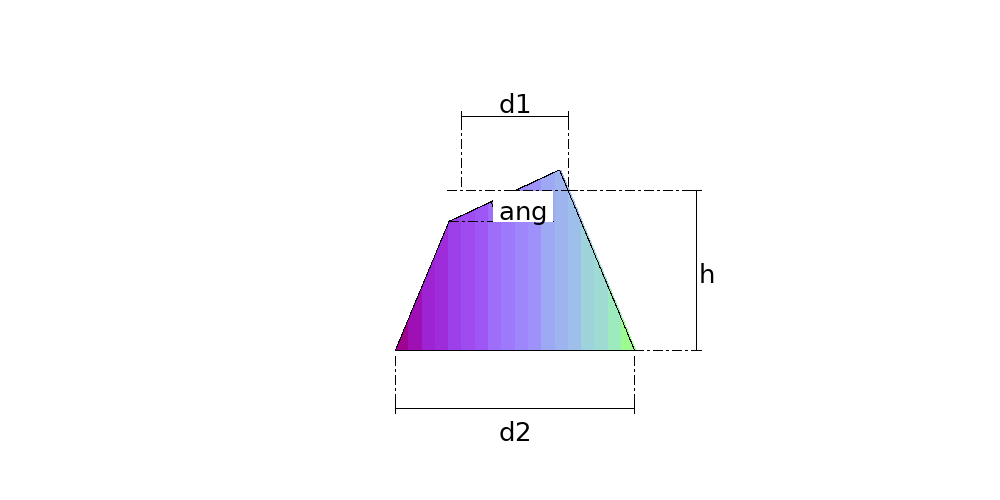
Angle Cut Cone development
What it is
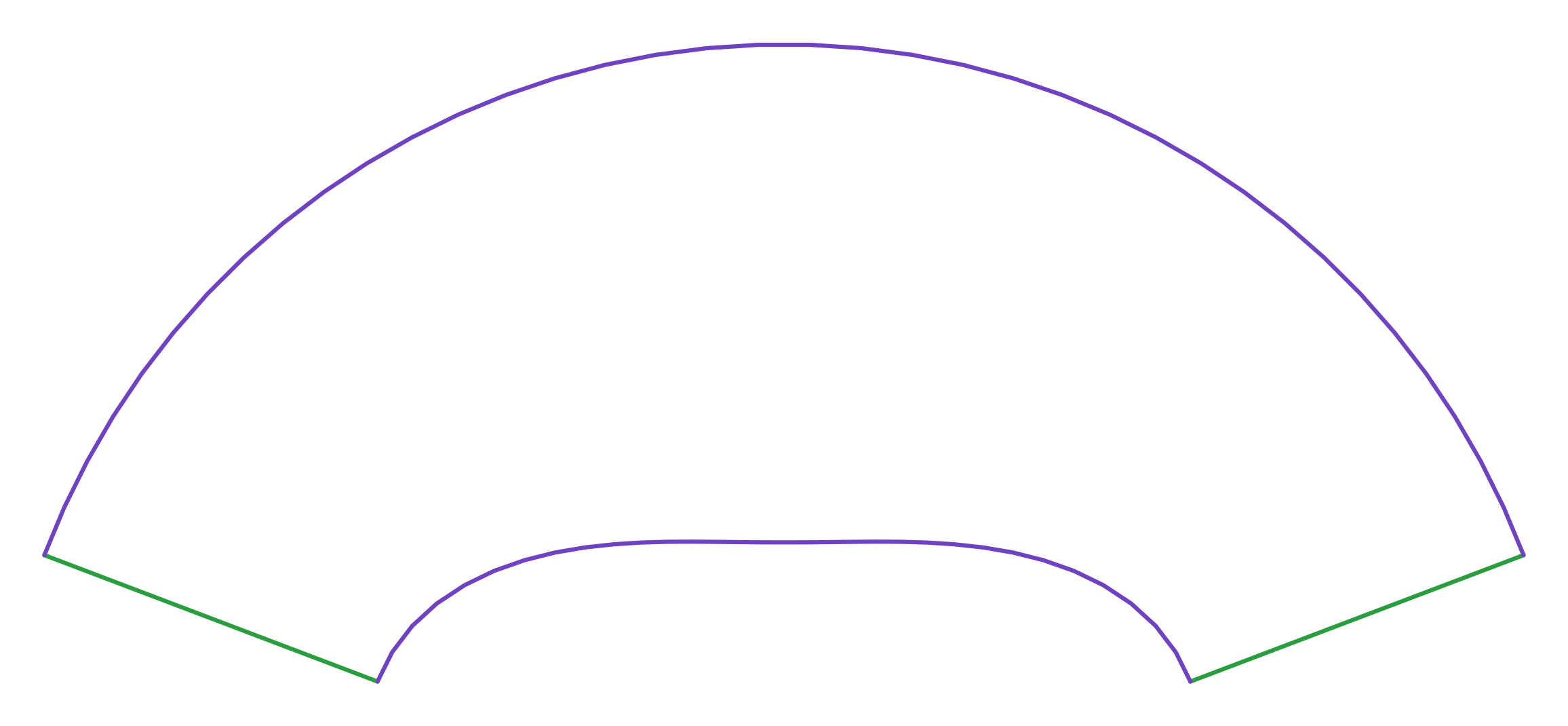
A conical shell with its top opening on a tilted plane. It is the cone in this catalogue with one change: instead of lying flat, the opening pivots about the point where the plane crosses the axis. Rolled flat it is still a sector — but the cut edge is no longer an arc, it is an ellipse projected onto the cone.
Where it is used
Extraction hoods against a wall, conical hoppers with a tilted outlet, chimney cowls, cone-to-duct connections where the duct does not rise vertically.
Measurements the calculation needs
- D1 Diameter of the cone at height h
- D2 Diameter of the base (larger)
- H Height of the cut, on the axis
- ANG Angle of the cut from horizontal
- DV Divisions
- THK Plate thickness
Worked example
The values the form comes pre-filled with, run through the tool itself:
| Diameter of the cone at height h | 400 mm |
|---|---|
| Diameter of the base (larger) | 900 mm |
| Height of the cut, on the axis | 600 mm |
| Angle of the cut from horizontal | 25° |
| Divisions | 32 |
| Plate thickness | 3 mm |
| The flat pattern fits a plate of | 2181 × 939 mm |
Result of the example
| Plate | 2181 × 939 mm |
|---|---|
| Arc radii | 1,166.4 mm |
| Sector angle | 138.5° |
Frequently asked questions
- Is the top edge struck with a compass?
- No, and that is what separates this part from the cone. The base is still an arc of constant radius, struck with the compass at the apex of the sector. The cut edge has a different radius at every station, and is marked point by point.
- Where is the height measured to?
- To the point where the cutting plane crosses the AXIS of the cone. The opening pivots about it, so that is what sits at the height given, and the two edges rise and fall around it.
- Is there a maximum angle?
- There is, and it depends on the cone: the plane has to be less steep than the generator. Past that it stops cutting the cone in an ellipse and cuts it in an open curve, which closes no opening at all. The calculation refuses that, and refuses a cut that would drop below the base or rise past the apex.
- And with the angle at zero?
- The opening lies flat and the part is exactly the cone in this same catalogue — same sector radius, same sweep. The calculation accepts it, and it doubles as a check.