Cone with Branch Hole development
What it is
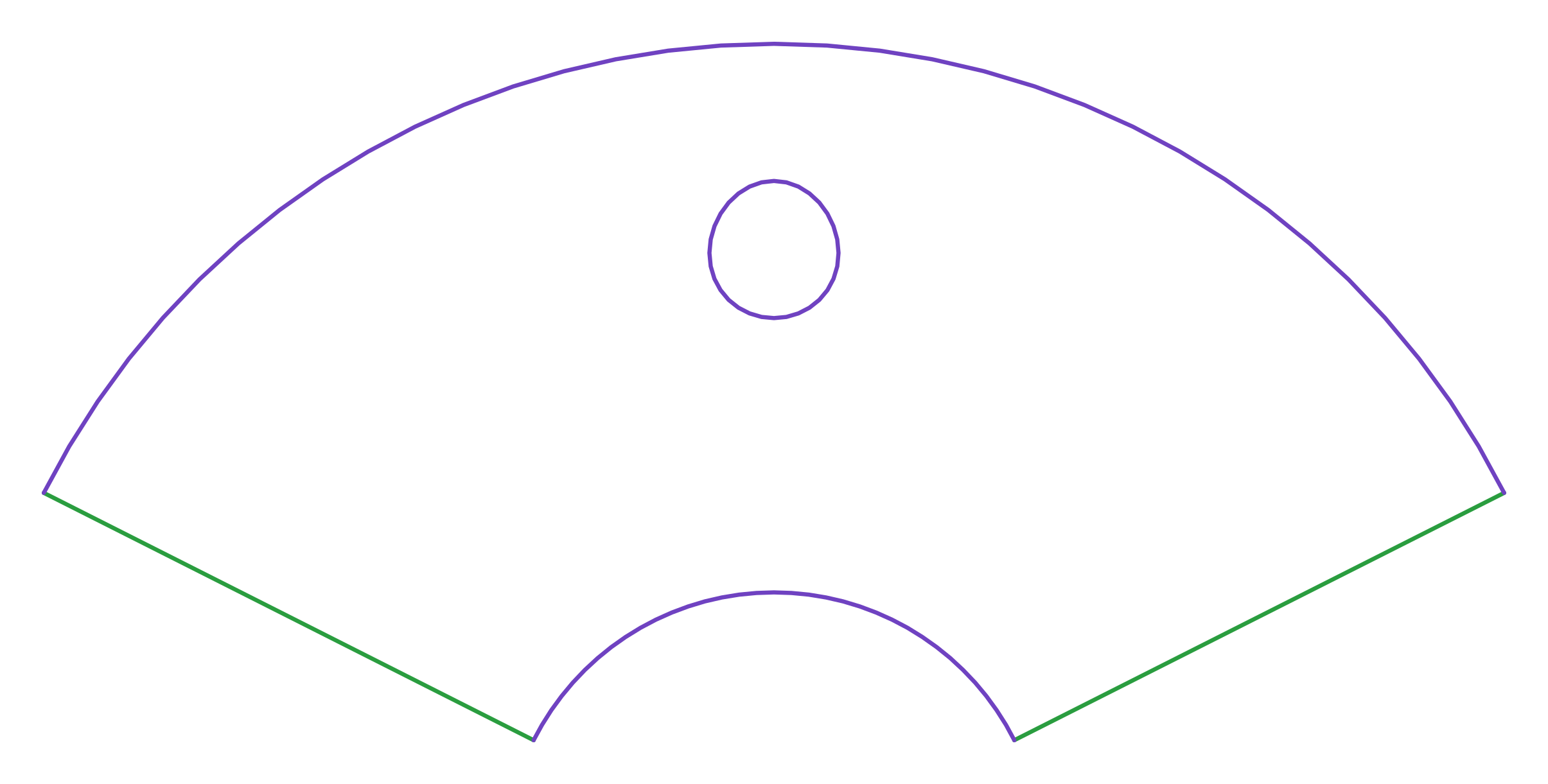
The cone with the nozzle hole already marked — the mate of the cone branch, as the holed shell is the mate of the pipe branch. And here it matters more than on a pipe: marking a hole on a cone by hand is far worse than on a cylinder, because the surface does not open into a rectangle. It opens into a sector, and the hole's curve has to be carried into it.
Where it is used
Conical hoppers and silos with a nozzle, conical vessel bottoms with a take-off, cyclone inlets, bins with a side discharge.
Measurements the calculation needs
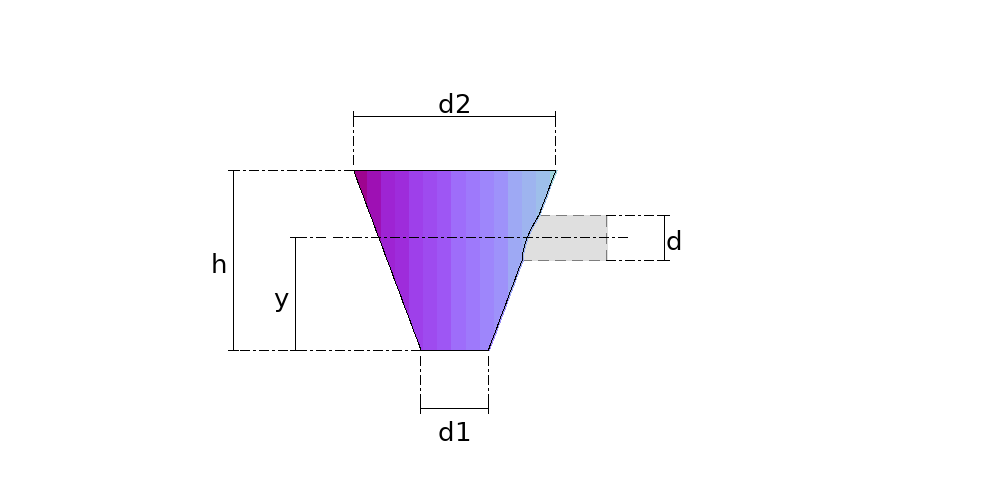
- D1 Smaller diameter (bottom mouth)
- D2 Larger diameter (top mouth)
- H Height of the cone
- D Diameter of the nozzle hole
- Y Height of the hole centre (from the bottom mouth)
- DV Divisions
- THK Plate thickness
Worked example
The values the form comes pre-filled with, run through the tool itself:
| Smaller diameter (bottom mouth) | 300 mm |
|---|---|
| Larger diameter (top mouth) | 900 mm |
| Height of the cone | 800 mm |
| Diameter of the nozzle hole | 200 mm |
| Height of the hole centre (from the bottom mouth) | 500 mm |
| Divisions | 32 |
| Plate thickness | 6 mm |
| The flat pattern fits a plate of | 2274 × 1085 mm |
Result of the example
| Plate | 2274 × 1085 mm |
|---|---|
| Arc radii | 419.2 mm · 1,273.6 mm |
| Sector angle | 126.4° |
Frequently asked questions
- Why isn't the hole symmetric in the sector?
- Because the cone flares. At the top the nozzle meets the wall where it is wider and further from the apex; at the bottom, narrower and nearer. In the sector that becomes a curve pulled outward on one side — nothing like the nearly symmetric hole on a shell.
- Which diameter do I enter?
- The HOLE, as on the holed shell — for a nozzle set on top of the cone it goes at the nozzle's bore, for one set in, at its outside diameter. The welder decides.
- Where does the cone's seam go?
- Diametrically opposite the hole. A longitudinal weld does not run through a cut-out, and on a cone it is already the most critical joint in the part.
- Does this hole match the cone branch in this catalogue?
- It does, and it is its mate. Enter the same cone, the same height and the same diameter in both parts and you have both patterns for the job — the branch and the cone.
Calculate a Cone with Branch Hole
An account is required. The free tier covers 20 calculations a month.