Cone with Parallel-Axis Nozzle Hole development
What it is
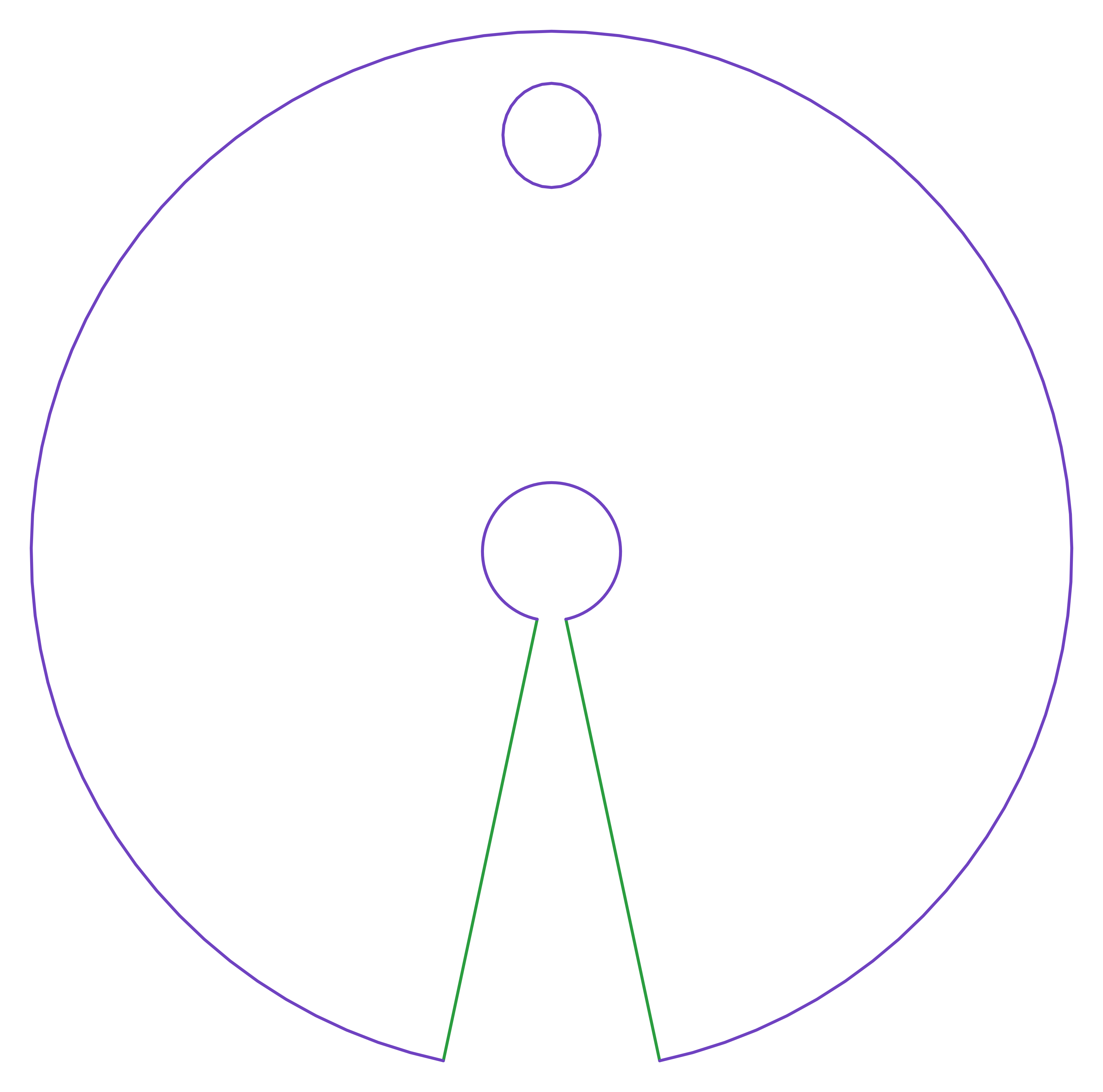
The cone with the upright nozzle's hole already marked — the mate of the parallel-axis nozzle. Marking a hole on a cone by hand is far worse than on a cylinder, because the surface does not open into a rectangle and no tape will do.
Where it is used
The other half of the upright-nozzle job — hoppers, silos, cyclones, conical tank roofs.
Measurements the calculation needs
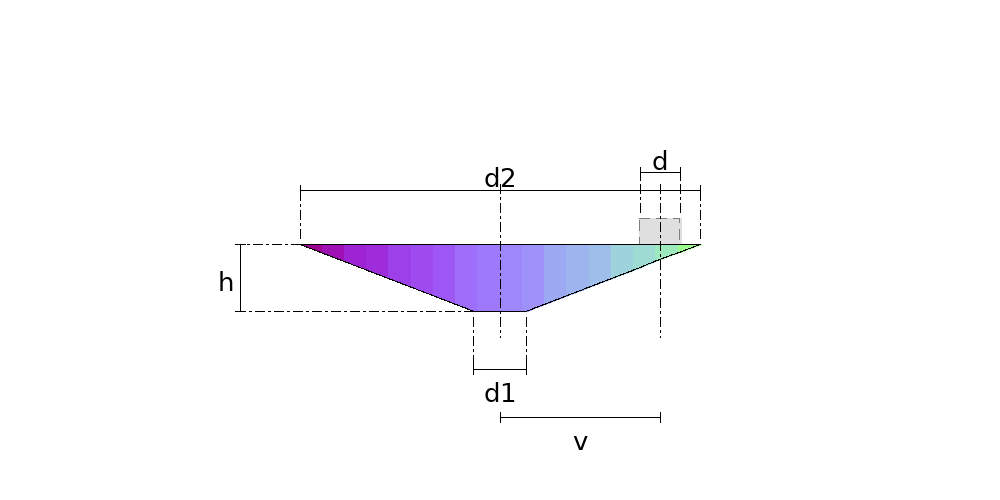
- D1 Diameter of the smaller mouth (bottom)
- D2 Diameter of the larger mouth (top)
- H Height of the cone
- D Outside diameter of the nozzle
- V Offset from the nozzle axis to the cone axis
- DV Divisions
- THK Plate thickness
Worked example
The values the form comes pre-filled with, run through the tool itself:
| Diameter of the smaller mouth (bottom) | 400 mm |
|---|---|
| Diameter of the larger mouth (top) | 3000 mm |
| Height of the cone | 500 mm |
| Outside diameter of the nozzle | 300 mm |
| Offset from the nozzle axis to the cone axis | 1200 mm |
| Divisions | 32 |
| Plate thickness | 6 mm |
| The flat pattern fits a plate of | 3212 × 3177 mm |
Result of the example
| Plate | 3212 × 3177 mm |
|---|---|
| Arc radii | 213.1 mm · 1,606 mm |
| Sector angle | 336° |
Frequently asked questions
- Why do I need this part and not just the nozzle?
- Because the hole on the cone is neither a circle nor an ellipse on the flat pattern. It comes from the same intersection as the nozzle, mapped into the sector, and there is no way to mark it without the drawing.
- Is the hole worked out the same way as the nozzle's mouth?
- It is the same calculation, in the same place in the code. Both parts ask Base::BranchHole where one meets the other, and the spec checks it point by point — if they disagreed the hole would not match the mouth and no pattern would save it.
- Where does the cone's seam go?
- Diametrically opposite the hole. A longitudinal weld does not run through a cut-out.
- Why is the hole larger than the nozzle's diameter?
- Because the nozzle meets the cone obliquely, and the shallower the cone the more oblique the meeting. The hole is the cylinder projected onto the sloping surface, and it stretches along the slope.
Calculate a Cone with Parallel-Axis Nozzle Hole
An account is required. The free tier covers 20 calculations a month.