Cone Branch development
What it is
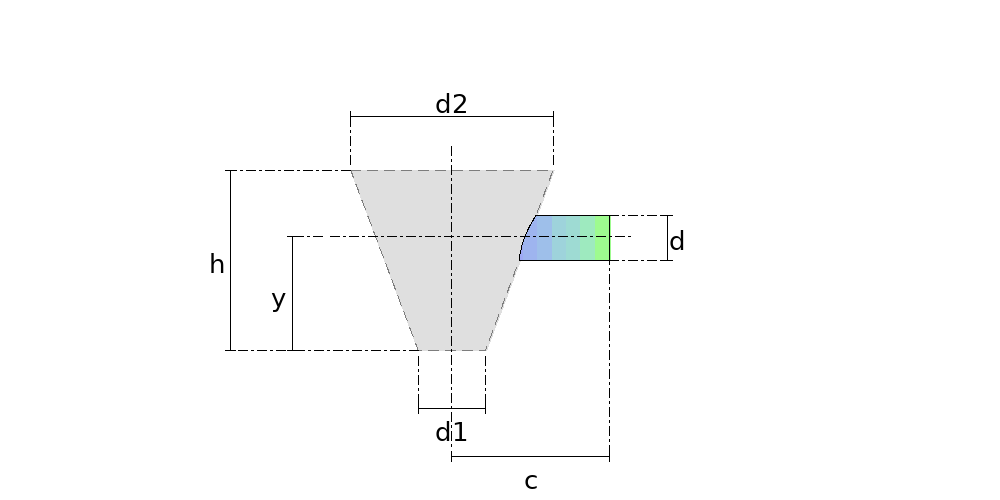
The branch entering a conical hopper, horizontally. The pipe branch handles a branch entering a PIPE; this one handles a branch entering a CONE, and the cut curve is different: there the branch meets a surface of constant radius and the mouth comes out nearly symmetric; here it meets a surface whose radius changes with height, and the mouth comes out deeper at the top than at the bottom.
Where it is used
Hopper and conical silo nozzles, cyclone inlets, take-offs in conical vessel bottoms, side discharges on bins.
Measurements the calculation needs
- D1 Smaller diameter, at the bottom
- D2 Larger diameter, at the top
- H Height of the cone
- D Diameter of the nozzle
- Y Height of the nozzle axis (from the bottom)
- C Length of the branch (from the cone axis)
- DV Divisions
- THK Plate thickness
Worked example
The values the form comes pre-filled with, run through the tool itself:
| Smaller diameter, at the bottom | 300 mm |
|---|---|
| Larger diameter, at the top | 900 mm |
| Height of the cone | 800 mm |
| Diameter of the nozzle | 200 mm |
| Height of the nozzle axis (from the bottom) | 500 mm |
| Length of the branch (from the cone axis) | 700 mm |
| Divisions | 16 |
| Plate thickness | 6 mm |
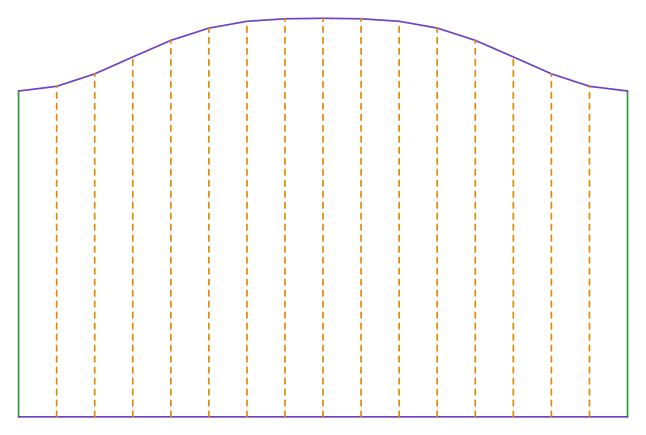
| The flat pattern fits a plate of | 609 × 399 mm |
Result of the example
| Plate | 609 × 399 mm |
|---|
Frequently asked questions
- Is the mouth symmetric?
- No, and that is what sets this part apart from the pipe branch. At the top the branch meets the cone where it is wider, and the mouth is deeper there; at the bottom the cone is narrower and the mouth is shallower. The pattern comes out with one asymmetric wave, not two equal troughs.
- Does the branch enter perpendicular to the cone's axis or to its surface?
- To the AXIS — the nozzle runs horizontally, which is the usual case for a side discharge. A nozzle perpendicular to the sloping surface is a different part, with a different cut curve.
- Where do I measure the branch length from?
- From the AXIS of the cone to the end of the branch — the centre-to-face dimension, the same convention as the pipe branch. Measuring from the cone's surface would give a different number depending on the height.
- What size of nozzle fits?
- The branch's radius must be less than the distance from its axis to the cone's surface measured PERPENDICULAR to that surface. The guard falls out of the arithmetic: it is where the intersection's radicand stops being positive. And the whole mouth has to sit between the base and the top of the frustum.