Pipe Branch (Tee) development
What it is
A pipe branch is the mouth cut into the end of one pipe so it seats onto another — the tee, the saddle. Only the branch comes out of this sheet: the main pipe already exists, and all it takes is the hole. Rolled flat, the branch is a rectangle with one edge cut to the intersection curve between the two cylinders.
Where it is used
Tees and branches in industrial piping, nozzles on vessels and tanks, headers, exhaust and compressed-air runouts, manifold take-offs.
Measurements the calculation needs
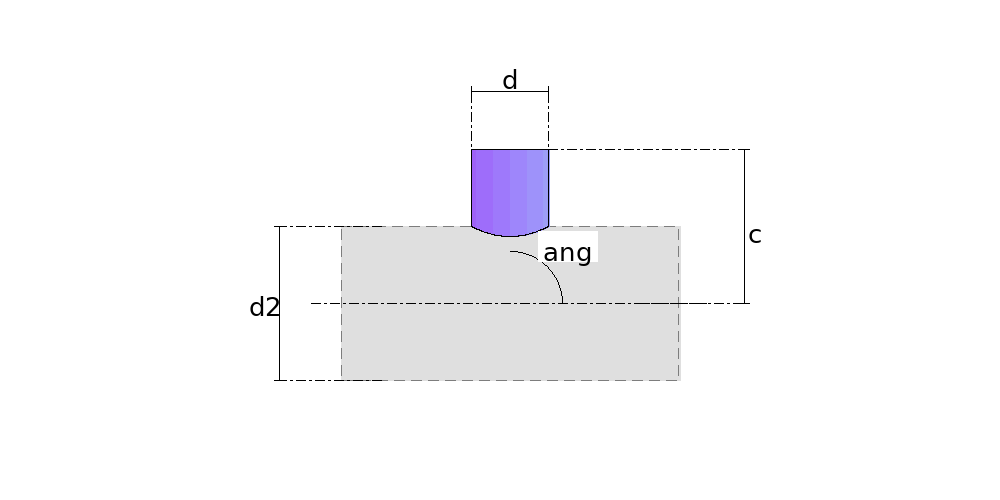
- D Diameter of the branch
- D2 Diameter of the main pipe
- C Length of the branch (centre to face)
- ANG Angle between the axes
- DV Divisions
- THK Plate thickness
Calculate with your own measurements
No account needed: enter the measurements in millimetres and get the figures and the drawing. The scaled PDF template, the DXF for the cutting table and the 3D model take a free account.
How it develops: the formulas
- Radii and plate length
r = (d − t) / 2 ; R = D2 / 2 ; L = π × (d − t)d is the branch and D2 the main pipe. In the example, d = 200 in 6 mm plate: r = 97 mm and L = 609.5 mm.- Length of each branch element, with angle α between the axes
ℓ(φ) = c − [ √(R² − (r × sin φ)²) − r × cos φ × cos α ] / sin αc is the centre-to-face length and φ the angle round the branch, φ = 0 at the flank. It is the intersection of two cylinders, not a sine wave.- The 90° case
ℓ(φ) = c − √(R² − (r × sin φ)²)In the example (c = 400, R = 200): ℓ = 200 mm at the flanks (φ = 0 and 180°) and 225.1 mm at top and bottom (φ = 90° and 270°).- Saddle depth at 90°
p = R − √(R² − r²)25.1 mm in the example. For branch and main of equal diameter, the full-bore tee, p = R: the mouth drops to the axis.
Worked example
The values the form comes pre-filled with, run through the tool itself:
| Diameter of the branch | 200 mm |
|---|---|
| Diameter of the main pipe | 400 mm |
| Length of the branch (centre to face) | 400 mm |
| Angle between the axes | 90° |
| Divisions | 16 |
| Plate thickness | 6 mm |
| The flat pattern fits a plate of | 609 × 225 mm |
Result of the example
| Plate | 609 × 225 mm |
|---|
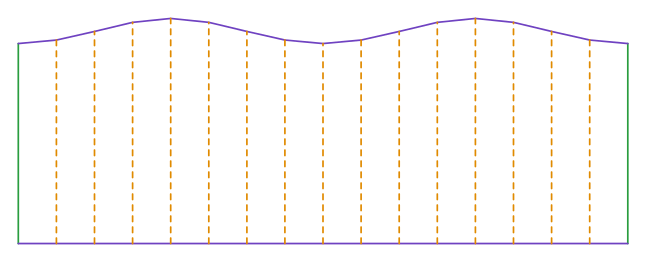
How to mark it out on the plate
- Mark the rectangle of L by c (the end of the branch is square) and divide L into dv elements (16 in the example).
- Work out ℓ(φ) for each element, or copy it from the calculator table, and mark from the square end.
- Join the points with a flexible rule. At 90° the curve has two equal troughs (top and bottom) and two crests (the flanks); at 45° it is asymmetric, deep on the acute side.
- Cut, roll and weld the seam on a crest, which is the longest element and stays clear of the weld to the main pipe.
- For the hole in the main pipe use the cylinder with branch hole: the main pipe's plate comes from there, with the cut-out already placed.
Common mistakes and tolerances
- Measuring c from the surface of the main pipe
- c runs from the AXIS of the main pipe to the end of the branch, the way piping is dimensioned. From the surface the figure changes with angle and side.
- Marking the mouth as a sine wave
- The sine wave is the plane cut. The saddle is the intersection of two cylinders and only approaches a sine wave when the main pipe is much larger than the branch; with R = 2r the difference already shows.
- Branch larger than the main pipe
- With d > D2 the branch does not seat, it wraps the main pipe, and the mouth stops being a closed curve. The calculation accepts up to d = D2, the full-bore tee.
- Length too short
- c must pass the point where the branch still touches the main pipe, or the mouth does not close and the calculation refuses it. At 90° the minimum is c > R.
Frequently asked questions
- Where do I measure the branch length from?
- From the AXIS of the main pipe to the end of the branch — the centre-to-face dimension, which is how piping is dimensioned on a drawing. Measuring from the surface of the main pipe would give a different number for every angle, because the mouth is deeper on one side than on the other.
- Why isn't the cut edge a sine wave?
- Because the branch does not meet a plane, it meets another cylinder. On an angled cut every point of the mouth sits at a height that varies as a sine; here the height comes from two curved surfaces intersecting, and the resulting curve only approaches a sine in the limiting case where the main pipe is much larger than the branch.
- Can the branch be larger than the main pipe?
- Not in this calculation. A branch fatter than the main pipe no longer seats onto it but wraps around it, which is a different part: the mouth stops being a closed curve on the branch. Equal diameters do work, and that is the full-bore tee.
- What changes when the angle is not 90 degrees?
- The mouth becomes asymmetric — very deep on the acute side and shallow on the opposite one. That is the 45-degree branch, used where the flow should enter along the main pipe's stream rather than across it.
- Is a saddle cut the same as a fish mouth?
- No. The saddle is the cut on the end of the branch so it seats on the main pipe — this part. The fish mouth is the cut on the trunk of a Y piece, where two legs meet; that is the Y piece trunk in this catalogue.
You can work out the figures right here, with no account. PDF, DXF, 3D and history take an account; the free tier covers 20 calculations a month.