Pipe saddle development: how to lay out a pipe-to-pipe branch (tee) at 90 and 45 degrees
Updated on 17 September 2026
The pipe saddle is the cut made on the end of a pipe so it wraps round the wall of another pipe: the tee, the set-on branch, the saddle. The developed part is the branch only; the main gets the hole. The layout is the intersection of two cylinders, and it is the classic exercise of the parallel-line method.
This guide gives the exact formula, the ordinate table of the example worked by Planichapa, the 45° case and the hole in the main.
The dimensions
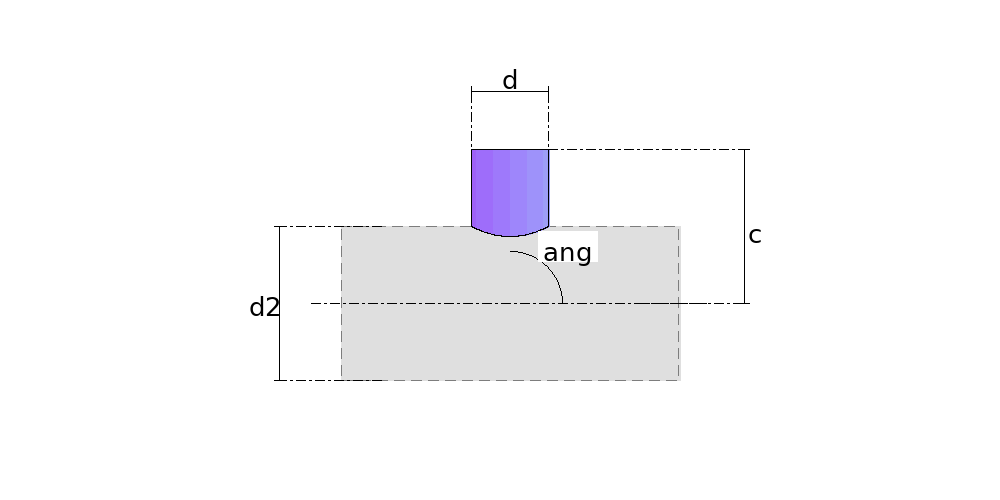
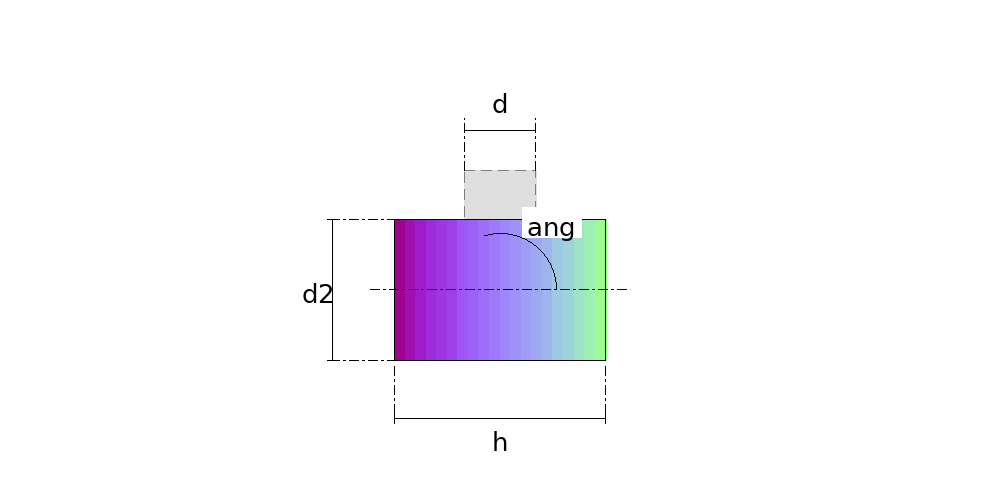
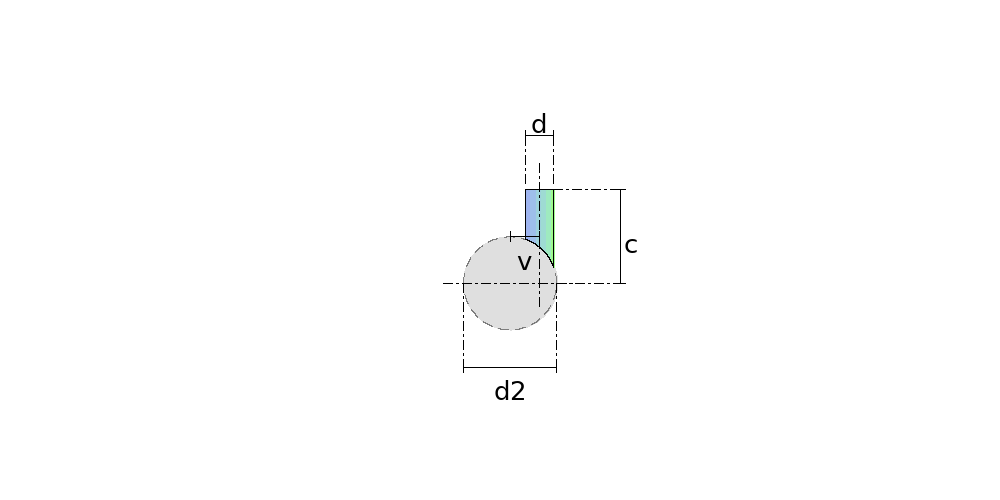
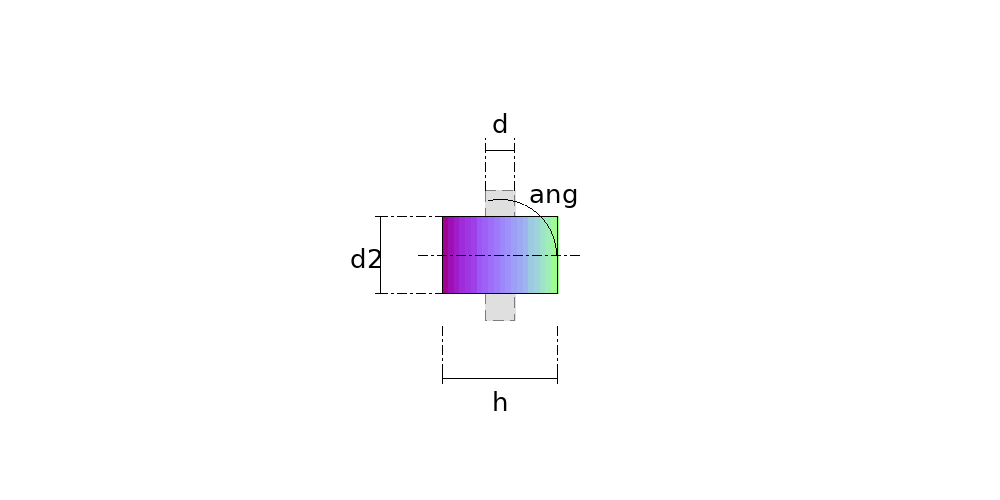
d is the outside diameter of the branch, D2 that of the main, c the distance from the AXIS of the main to the end of the branch (the centre-to-face dimension, as pipework is dimensioned), α the angle between the two axes (90° for the straight tee) and t the plate thickness. The calculation divides the branch into dv elements.
In the example: d = 200 mm, D2 = 400 mm, c = 400 mm, α = 90°, 16 elements and 6 mm plate. The branch cannot be larger than the main; with the two equal it is the equal tee, where the cut drops right down to the axis.
The pipe saddle formula
- Radii and plate length
r = (d − t) / 2 ; R = D2 / 2 ; L = π × (d − t)r is the mean radius of the branch, 97 mm in the example; R is the outside radius of the main, 200 mm; the branch plate is L = 609.5 mm long.
- Length of each branch element, angle α between the axes
ℓ(φ) = c − [ √(R² − (r × sin φ)²) − r × cos φ × cos α ] / sin αφ is the angle round the branch, with φ = 0 at the flank. The term in brackets is the distance from the axis of the main to its surface, along the branch element.
- The 90° case
ℓ(φ) = c − √(R² − (r × sin φ)²)At the flanks (φ = 0 and 180°) the element measures c − R; at the top and bottom (φ = 90° and 270°) it measures c − √(R² − r²).
- Depth of the saddle at 90°
p = R − √(R² − r²)How far the cut drops between flank and top. In the example: 200 − 174.9 = 25.1 mm. With r = R, p = R: the equal tee.
Worked example: ordinate table at 90°
| φ (from the flank) | r × sin φ | √(R² − (r sin φ)²) | Element ℓ = c − … |
|---|---|---|---|
| 0° (flank) | 0.0 | 200.0 | 200.0 mm |
| 22.5° | 37.1 | 196.5 | 203.5 mm |
| 45° | 68.6 | 187.9 | 212.1 mm |
| 67.5° | 89.6 | 178.8 | 221.2 mm |
| 90° (top) | 97.0 | 174.9 | 225.1 mm |
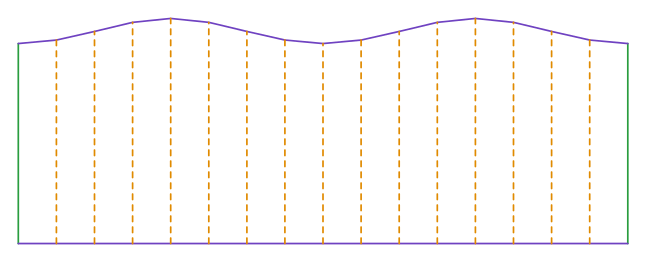
The curve is symmetrical: from 90° to 180° it runs back through the same values, and the second half of the branch repeats the first. The plate of the example measures 609 × 225 mm.
Marking out on the plate
- Mark the rectangle L = π × (d − t) by c, with the end of the branch on one of the long edges, cut square.
- Divide the length into dv elements (16 in the example, one every 38.1 mm). Number them from the flank, where the seam will go.
- On each element mark the length ℓ(φ) from the square end, using the table above or the calculator's.
- Join the points with a flexible rule. At 90° the curve has two valleys (the flanks, the shortest element, c − R) and two crests (top and bottom, the longest). It is not a sine wave: the curvature changes along the way.
- Cut, roll and close the seam in a valley: it is the shortest element, and it meets the main on the crown, away from the deep part of the saddle weld.
- Offer the branch up to the main and check the seating before welding. A gap of 1 to 2 mm where the cut dips deepest, on the sides of the main, is normal if the main has a seam or is out of round.
The 45° branch
With α = 45° the term r × cos φ × cos α is no longer zero and the cut becomes asymmetrical: very deep on the acute side, where the branch meets the main at a grazing angle, and shallow on the obtuse side. The formula is the same, with sin α = cos α = 0.7071, and c is still the dimension from the axis of the main to the end of the branch, measured along the axis of the branch.
In the shop the 45° branch, the lateral, is the one used where the flow has to enter with the current of the main instead of hitting it side-on. The branch comes out longer on the acute side, which is why measuring c from the surface of the main gives a different figure for each side: only the axis serves as a datum.
The hole in the main
The saddle is half the job. The hole in the main is not a circle of diameter d: developed, it comes out wider than the branch, because the plate of the main is flat and the pipe is round. For a 200 hole in a 400 shell in 6 mm plate, the hole on the flat plate comes out 206.3 mm wide, a little over 3% more, and its length along the pipe is d / sin α: d itself at 90°, 41% more at 45°.
That plate is the cylinder with branch hole: it gives the shell of the main with the cut-out already positioned relative to the seam. For a cross, with two opposite holes, it is the 4-way cross shell, which gives the relative position of the two. And for the tangential inlet, the branch that enters at the side instead of on the axis, it is the offset pipe branch.
Common mistakes
- Measuring c from the surface of the main. c runs from the AXIS; from the surface the figure changes with the angle and with the side of the cut.
- Laying out the saddle as a sine wave. The sine wave is the cut by a plane, the truncated cylinder. The saddle is the intersection of two cylinders and only approaches a sine wave when the main is much larger than the branch; at R = 2r the difference is already visible to the eye.
- Branch larger than the main. With d > D2 the branch does not seat, it wraps round the main, and the cut stops being a closed curve. The calculation accepts up to d = D2.
- Branch too short. c must go past the point where the branch still touches the main; at 90° the minimum is c > R. Below that the cut does not close.
- Hole in the main at the branch diameter. The hole on the flat plate is wider than d, and on a 45° branch it is d / sin α long. Use the cylinder with branch hole instead of scribing a circle.
- Calling the breeches cut a saddle. The breeches cut is the cut on the trunk of a Y piece, where the two legs meet; that is the Y piece trunk, a different part.
Frequently asked questions
- What is a pipe saddle in plate fabrication?
- It is the curved cut on the end of a pipe so it seats on the wall of another pipe, making a tee or a branch. The name comes from the shape of the cut, which sits on the main like a saddle, with two low points and two high points. The developed part is the branch; the main gets the hole.
- How do I lay out a pipe saddle at 90 degrees?
- Divide the branch circumference, π × (d − t), into elements; on each one mark the length c − √(R² − (r × sin φ)²), with R the radius of the main and r the mean radius of the branch; join the points. The cut drops R − √(R² − r²) from flank to top.
- Is the pipe saddle the same as the breeches (Y piece) cut?
- No. The saddle is the cut on the branch that wraps round the main. The breeches cut is the cut on the trunk of a Y piece, where the two legs meet.
- How do I make the hole in the main?
- With the development of the cylinder with branch hole, which gives the shell of the main with the cut-out already positioned. The hole on the flat plate is wider than the branch diameter, because the plate is flat and the pipe is round.
- Can I use the same saddle for pipes of equal diameter?
- Yes, that is the equal tee: the cut drops to the axis of the main and the flanks come to a point. The calculation accepts d = D2; above that the branch would wrap round the main.
Parts in this guide
Other guides
- How to develop a cone (frustum) in sheet metal: formula, sector radii and angle, step by step
- Lobster back bend (segmented 90° elbow): gore angles, cut heights and how many plates
- Square to round transition: development by triangulation, step by step
- The neutral axis of plate: why every development uses D − t, and the bend deduction
- Sheet metal glossary: the terms of marking out and pattern development in plate fabrication
- How we check the Planichapa calculations, and who is behind them
- How to lay out a mitre-cut pipe: paper template, sine wave and ordinate table
- Plate 'n' Sheet alternative: Planichapa develops sheet metal parts in the browser, with the price on the page
- Steel plate weight per m², gauges and stock plate sizes: weight table and formula
- Sheet metal pattern development software: how to choose, and what changes between a desktop program, a phone app and an online calculator
- Eccentric and concentric reducers: which one to use and how each one develops on plate