Pipe template, printable at full size: tee saddle, 45° lateral and mitre cut for every pipe size from NPS 1/2 to 12
Updated on 28 October 2026
A pipe template is the paper you wrap round a pipe to mark a cut: the saddle of a tee, a 45° lateral, the mitre of an elbow. For standard pipe, NPS 1/2 to NPS 12, the site has them ready, one page per size, free and with no account: the 2 in pipe templates print the tee saddle, the lateral and the mitre at full size. For any other pipe, angle or branch, the Pipe Branch (Tee) page works in inches: set it to inches and every result comes in fractions to the nearest 1/16 in, the thickness field takes a gauge from a list for thin-wall tube, and a free account adds the full-size template on Letter sheets and the DXF.
The usual reason a pipe template does not fit is the size typed into it: nominal pipe size is not the outside diameter. The table below gives the real one for every size, and the wrap the template has to close on.
Printable pipe templates by size
Each size page draws three templates for two pipes of the same size: the 90° tee saddle, the 45° lateral and the 45° mitre (miter) cut of a two-piece 90° elbow, each with a table of heights for marking by hand. They are drawn on the outside of the pipe, where the paper sits, and print on Letter sheets when the site is set to inches. The wrap is the outside circumference, the stretch-out the template has to close round the pipe.
| Pipe size | Outside diameter | Wrap, π × OD | Letter sheets for the tee |
|---|---|---|---|
| NPS 1/2 | 0.840 in (21.3 mm) | 2.64 in (66.9 mm) | 1 |
| NPS 3/4 | 1.050 in (26.7 mm) | 3.30 in (83.8 mm) | 1 |
| NPS 1 | 1.315 in (33.4 mm) | 4.13 in (104.9 mm) | 1 |
| NPS 1-1/4 | 1.660 in (42.2 mm) | 5.22 in (132.5 mm) | 1 |
| NPS 1-1/2 | 1.900 in (48.3 mm) | 5.97 in (151.7 mm) | 1 |
| NPS 2 | 2.375 in (60.3 mm) | 7.46 in (189.4 mm) | 1 |
| NPS 2-1/2 | 2.875 in (73.0 mm) | 9.03 in (229.3 mm) | 2 |
| NPS 3 | 3.500 in (88.9 mm) | 11.00 in (279.3 mm) | 2 |
| NPS 3-1/2 | 4.000 in (101.6 mm) | 12.57 in (319.2 mm) | 2 |
| NPS 4 | 4.500 in (114.3 mm) | 14.14 in (359.1 mm) | 2 |
| NPS 5 | 5.563 in (141.3 mm) | 17.48 in (443.9 mm) | 3 |
| NPS 6 | 6.625 in (168.3 mm) | 20.81 in (528.7 mm) | 3 |
| NPS 8 | 8.625 in (219.1 mm) | 27.10 in (688.3 mm) | 4 |
| NPS 10 | 10.750 in (273.0 mm) | 33.77 in (857.6 mm) | 10 |
| NPS 12 | 12.750 in (323.8 mm) | 40.06 in (1017.2 mm) | 12 |
A template wider than one sheet is tiled, the sheets lapped 10 mm, about 3/8 in, on a repeated strip with crosses to line up. The size pages stop at NPS 12; for bigger pipe, the Pipe Branch page gives the table of ordinates for marking the cut with a tape, and the full-size template with a free account.
NPS is not the outside diameter
Nominal pipe size is a name, not a measurement. Up to NPS 12 the outside diameter is larger than the number: 2 in pipe is 2.375 in outside (60.3 mm), 4 in pipe 4.500 in, 6 in pipe 6.625 in. From NPS 14 up the two agree: 14 in pipe is 14.000 in outside.
Type 2 for 2 in pipe and the template is drawn for a tube 2.000 in across: its wrap comes out 6.28 in instead of 7.46, 1.18 in short (30 mm), nearly 1-3/16 in, and it will not close round the pipe. The saddle comes out too shallow as well, so the branch rocks on the header. When in doubt, measure the pipe with a caliper or a pi tape and type the outside diameter.
The schedule does not change a wrap-around template. Schedule 40 and schedule 80 pipe of one size have the same outside diameter and differ in the bore, and the paper sits on the outside. Schedule 40 and 80 PVC share the steel pipe diameters, so the same templates fit them. Copper tube does not: its outside diameter is 1/8 in over its size, 2.125 in for 2 in copper.
Round tube is another system again: it is sold by its outside diameter, so 1-3/4 in tube is 1.750 in outside. Its coping templates, for roll cages, frames and handrails, are in the tube notching template generator.
Which template for which joint
| Joint | Template |
|---|---|
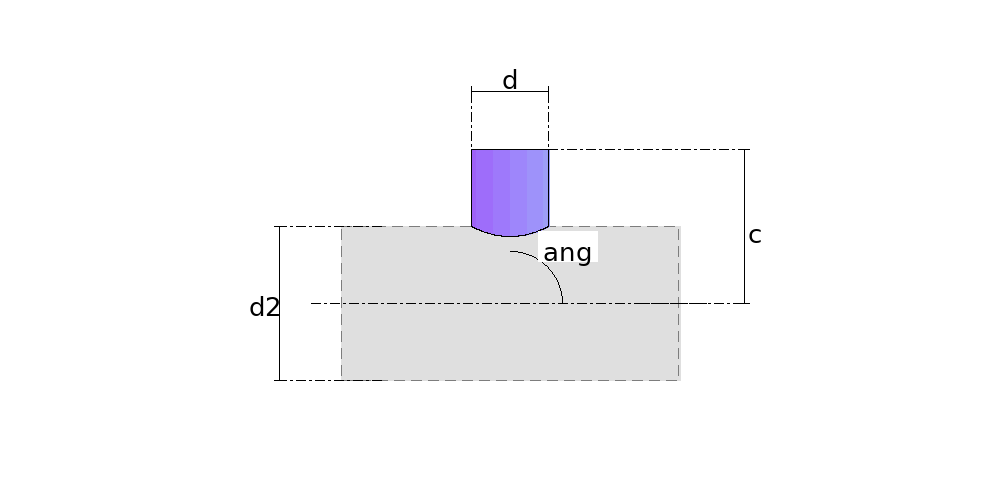
| Tee, the branch the same size as the header, at 90° | The size page: 90° tee saddle |
| Lateral, the same size, at 45° | The size page: 45° lateral |
| Two-piece 90° elbow | The size page: 45° mitre cut, the same on both pieces, one turned half a turn |
| Reducing tee, or a branch at any angle up to 90° | The tube notching template generator, in the browser with no account, or the Pipe Branch (Tee) page |
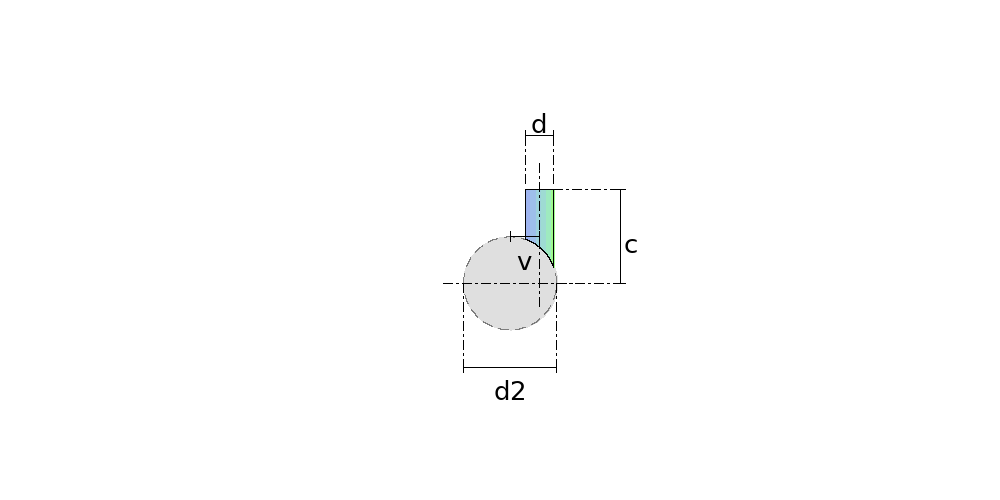
| Branch off the centre line, up to tangent | Offset Pipe Branch; the generator takes an offset too |
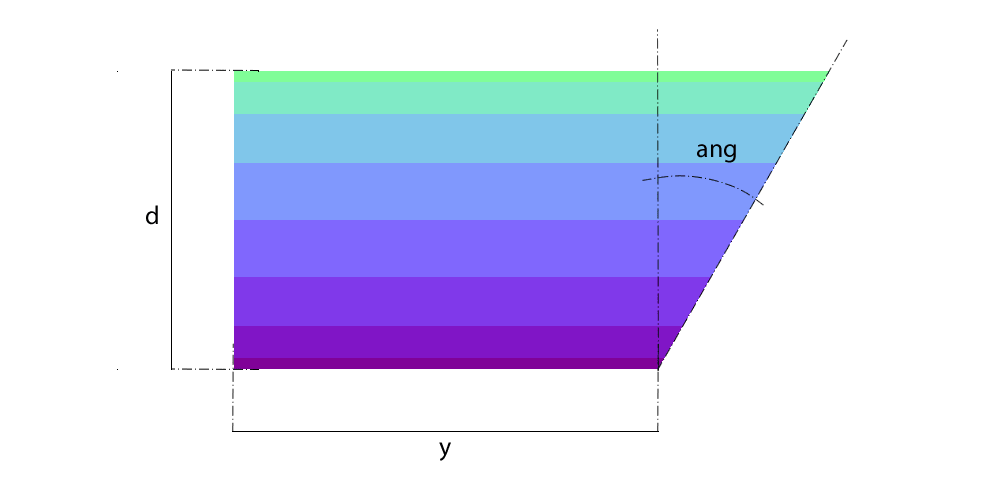
| Mitre at another angle, or a two-piece elbow at another angle | Truncated Cylinder: both pieces cut at half the turn, 30° for a 60° elbow |
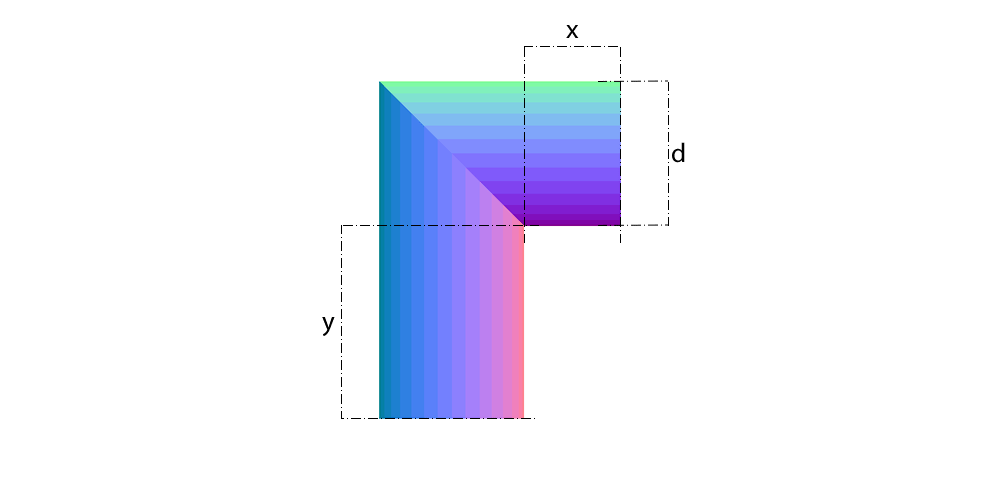
| Two-piece 90° elbow with set leg lengths | Elbow |
| Elbow in three or more pieces | The pie cut calculator |
| The hole in the header | Scribe it from the cut branch set on the header; for a header rolled from plate, the Cylinder with Branch Hole marks it on the flat |
On the Pipe Branch page, a template to wrap round bought pipe takes a thickness of 0.001 in, so that it is drawn on the outside of the pipe. The real wall thickness is for a branch rolled from plate, whose pattern is worked on the mean line.
Using a wrap-around template
- Print at 100 %, actual size, with fit to page off, and measure the ruler on the sheet: it must read 4 in on Letter. If it does not, the printer scaled the page.
- Cut the template along the curve, join the sheets on the crosses if it took more than one, and wrap it round the pipe with the straight edge square to the pipe.
- The two ends must just meet. A gap or an overlap means the wrong diameter or a scaled print: find which before cutting any pipe.
- Mark along the curve with soapstone or a paint marker, take the template off and cut outside the line, then grind to it.
- Grind the weld bevel after the cut: the template marks the line on the outside of the pipe, and the bevel is taken from there.
What is free
The size pages print their three templates with no account at all. On the part pages the figures and the drawing need no account either, and the full-size template of a custom job takes a free one. For plasma cutting, the free account exports 1 part a month in DXF; unlimited DXF export is the paid full access.
Frequently asked questions
- What is the outside diameter of 2 inch pipe?
- 2.375 in (60.3 mm), whatever the schedule. Nominal pipe size and outside diameter only agree from 14 in up.
- Where can I print a pipe saddle template?
- For two pipes of the same standard size, on the size pages listed above, free and with no account: the 90° tee, the 45° lateral and the mitre, at full size on Letter or A4. For a reducing tee or another angle, use the tube notching template generator.
- Why does my pipe template not wrap around the pipe?
- Usually the nominal size was typed instead of the outside diameter: 2 for 2 in pipe makes the wrap 1.18 in short. The other cause is a scaled print: print at 100 % and check the 4 in ruler on the sheet.
- Does schedule 40 or 80 change the template?
- No. A wrap-around template sits on the outside of the pipe, and both schedules of a size have the same outside diameter.
- Do the templates fit PVC pipe?
- Schedule 40 and 80 PVC, yes: they share the steel pipe outside diameters. Copper tube, no: 2 in copper is 2.125 in outside.
- How do I make a template for a reducing tee?
- Type both outside diameters, the angle and the offset in the tube notching template generator, which prints it at full size with no account, or on the Pipe Branch page with the thickness at 0.001 in.
Parts in this guide
Other guides
- How to develop a cone (frustum) in sheet metal: formula, sector radii and angle, step by step
- Lobster back bend calculator (segmented 90° elbow): gore angles, cut heights and how many plates
- Pipe saddle calculator and development: how to lay out a pipe-to-pipe branch (tee) at 90 and 45 degrees
- Square to round transition: development by triangulation, step by step
- The neutral axis of plate: why every development uses D − t, and the bend deduction
- Sheet metal glossary: the terms of marking out and pattern development in plate fabrication
- How we check the Planichapa calculations, and who is behind them
- LITIO alternative: Planichapa develops sheet metal parts in the browser, nothing to install, now that LITIO2 is no longer sold
- How to lay out a mitre-cut pipe: paper template, sine wave and ordinate table
- Plate 'n' Sheet alternative: Planichapa develops sheet metal parts in the browser, with the price on the page
- Steel plate weight calculator, weight per m², gauges and stock plate sizes: table and formula
- Pipe ovality: a calculator, the formula, a worked example, the limits the codes use and how to measure it in the shop
- Sheet metal pattern development software: how to choose, and what changes between a desktop program, a phone app and an online calculator
- Eccentric and concentric reducers: which one to use and how each one develops on plate
- Roller chain size chart: ANSI, ISO 606, motorcycle and bicycle chain pitch and roller diameter
- Sprocket dimensions: pitch diameter, outside and root diameter, tooth form and a pitch diameter chart
- Bolt circle layout: the position of each hole, the chord between holes and a chord chart
- Chain length and sprocket ratio: the formulas, a worked example and how many links to cut
- Screw flight calculator: the flat blank of a screw conveyor flight (auger), with the formula and a worked example
- Plate rolling calculator: the blank length of a rolled shell, with the formula, a chart and a worked example
- Tube notching template generator: a printable coping template for any tube, angle and offset
- Dished head calculator: depth, volume, blank diameter and weight of torispherical, 2:1 elliptical and hemispherical heads
- Cone template generator: a printable full-size cone template for hoppers, funnels and reducers
- Pie cut calculator for exhaust and tube bends: saw angle, pie lengths and a wrap-around template
- Duct transition layout: square to round duct, centred, offset or flat on one side
- Register boot layout: from a floor, wall or ceiling register to a round duct, in inches
- Plenum box and plenum transition layout: the sides, the offset and the round outlet