Dished head calculator: depth, volume, blank diameter and weight of torispherical, 2:1 elliptical and hemispherical heads
Updated on 23 October 2026
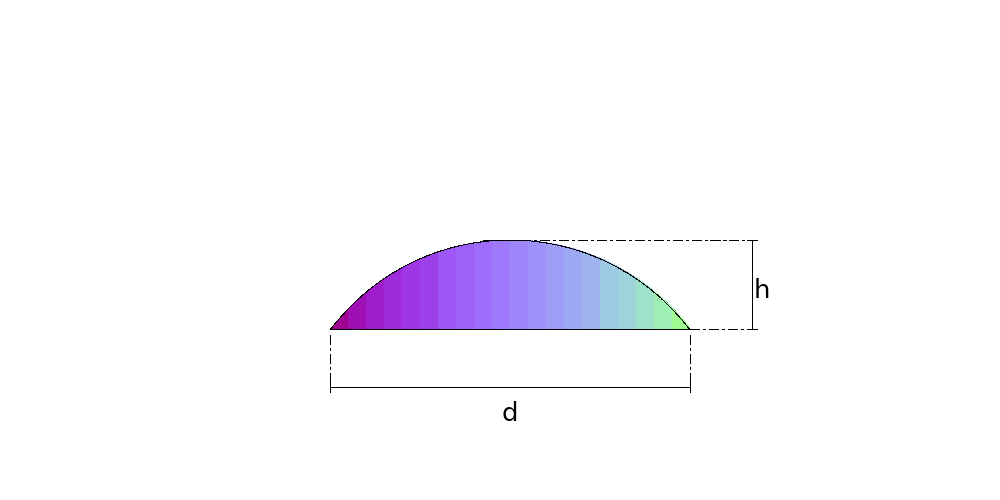
Every tank and pressure vessel ends in two heads, and the questions are always the same: how deep is it, what does it hold, what disc does it start from and what does it weigh. This page answers them for the standard shapes -- the Klöpper and Korbbogen torispherical heads of DIN 28011 and 28013, the ASME flanged and dished head, the 2:1 semi-ellipsoidal head and the hemisphere -- with a calculator, the formulas and worked examples in millimetres and inches.
Dished head calculator
Pick the head type, type the outside diameter of the shell and the head thickness. The straight flange is optional: left empty, the DIN heads take the DIN minimum, 3.5 times the thickness, and the others none.
| Inside radii | – |
|---|---|
| Straight flange | – |
| Inside depth of dish | – |
| Overall height, outside | – |
| Inside volume, with the straight flange | – |
| Blank diameter (equal area) | – |
| Head weight | – |
Radii are inside radii, from the shell outside diameter, as the standards give them. The blank is the flat disc with the same area as the head at mid-thickness: the geometric minimum, before the spinner's or the press shop's allowance. A fraction is read as inches. Nothing is sent anywhere: the sums run in your browser.
The standard heads
All the radii are inside radii and are given as a fraction of the OUTSIDE diameter Da of the shell, which is how the standards define them. The depth and the volume below are for thin wall; the calculator takes the thickness into account.
| Head | Crown radius | Knuckle radius | Inside depth of dish | Inside volume of dish |
|---|---|---|---|---|
| Klöpper, DIN 28011 | Da | 0.1 Da | 0.1935 Da − 0.455 s | ≈ 0.099 Da³ |
| Korbbogen, DIN 28013 | 0.8 Da | 0.154 Da | 0.255 Da − 0.635 s | ≈ 0.131 Da³ |
| ASME F&D | OD | 6 % of OD, at least 3 t | ≈ 0.169 OD | ≈ 0.081 OD³ |
| 2:1 semi-ellipsoidal | – | – | ID / 4 | π × ID³ / 24 = 0.1309 ID³ |
| Hemispherical | ID / 2 | – | ID / 2 | π × ID³ / 12 = 0.2618 ID³ |
The Korbbogen is the European stand-in for the 2:1 elliptical head: its volume comes within a fraction of a percent of the ellipse and its depth within 2 %, with a shape that is easier to press. The Klöpper is shallower and holds about a quarter less.
The formulas
- Inside depth of a torispherical head
h2 = R − √((R − r)² − (a − r)²)R is the inside crown radius, r the inside knuckle radius and a the inside radius of the shell, Da / 2 − s. The DIN formulas, 0.1935 Da − 0.455 s for the Klöpper and 0.255 Da − 0.635 s for the Korbbogen, are its straight-line approximation: on a 1000 × 10 Klöpper the exact depth is 188.89 mm and the DIN one 188.95.
- Overall height
H = h1 + h2 + sh1 is the straight flange, the short cylinder that is welded to the shell; DIN asks for at least 3.5 s.
- Blank diameter
D = √(4 × A / π)A is the area of the head at mid-thickness, dish and straight flange: the flat disc with the same area. It is the geometric minimum; spinners and press shops add their own allowance for trimming and thinning.
- Weight
kg = A (m²) × s (mm) × 7.857.85 kg/dm³ is carbon steel; austenitic stainless is 7.93.
Worked examples
A Klöpper head for a 1000 mm outside diameter shell, 10 mm thick, with the 35 mm DIN straight flange, in carbon steel:
- Inside radii: crown 1000 mm, knuckle 100 mm; inside radius of the shell, 490 mm.
- Inside depth of dish: 1000 − √(900² − 390²) = 188.89 mm. Overall height: 35 + 188.89 + 10 = 233.89 mm.
- Inside volume: 93.30 L in the dish, 119.71 L with the straight flange.
- Area at mid-thickness: 1.0869 m², so the blank is √(4 × 1.0869 / π) = 1176.4 mm across and the head weighs 85.3 kg.
In inches, for a 48 in outside diameter tank in 1/2 in plate with a 2 in straight flange:
| Head | Inside depth | Overall height | Volume | Blank | Weight |
|---|---|---|---|---|---|
| 2:1 semi-ellipsoidal | 11.750 in | 14.250 in | 73.85 gal | 59.222 in | 390.6 lb |
| ASME F&D, 2.880 in knuckle | 7.867 in | 10.367 in | 51.24 gal | 55.447 in | 342.4 lb |
What the calculator does not do
- It does not size the thickness. The wall of a pressure vessel head comes from the design code -- ASME VIII, EN 13445, AD 2000 -- for the pressure, the material and the joint efficiency, and the knuckle thins in forming.
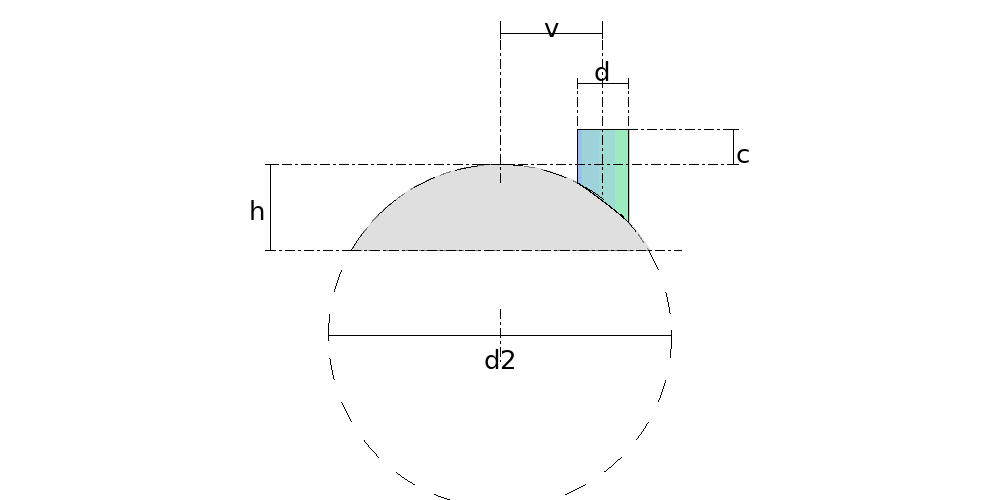
- It does not draw a head made from flat plate. A dished head is formed from a disc and cannot be developed; a large spherical head can be built from flat petals, and the sphere gore calculator develops those.
- Holes in the head are marked on the formed head. A nozzle on a spherical head develops on the nozzle side: see the nozzle on a spherical head.
Frequently asked questions
- How do you calculate the volume of a dished head?
- For a 2:1 elliptical head, π × ID³ / 24; for a hemisphere, π × ID³ / 12; for torispherical heads, roughly 0.099 Da³ for a Klöpper, 0.131 Da³ for a Korbbogen and 0.081 OD³ for an ASME F&D head, plus π × a² × h1 for the straight flange. The calculator above integrates the exact profile.
- What is the depth of a 2:1 elliptical head?
- A quarter of the inside diameter, plus the straight flange and the thickness for the overall height: a 48 in OD head in 1/2 in plate is 11.75 in deep inside and 14.25 in high overall with a 2 in flange.
- What is a Klöpper head?
- The torispherical head of DIN 28011: inside crown radius equal to the outside diameter of the shell and inside knuckle radius of one tenth of it. It is shallow, about 0.19 Da deep, and the usual head for atmospheric and low-pressure tanks in Europe.
- How do you calculate the blank size for a dished head?
- Take the area of the head at mid-thickness, dish plus straight flange, and find the disc with the same area: D = √(4A / π). A 1000 × 10 Klöpper with a 35 mm flange needs a 1176 mm disc before the forming allowance.
Parts in this guide
Other guides
- How to develop a cone (frustum) in sheet metal: formula, sector radii and angle, step by step
- Lobster back bend calculator (segmented 90° elbow): gore angles, cut heights and how many plates
- Pipe saddle calculator and development: how to lay out a pipe-to-pipe branch (tee) at 90 and 45 degrees
- Square to round transition: development by triangulation, step by step
- The neutral axis of plate: why every development uses D − t, and the bend deduction
- Sheet metal glossary: the terms of marking out and pattern development in plate fabrication
- How we check the Planichapa calculations, and who is behind them
- LITIO alternative: Planichapa develops sheet metal parts in the browser, nothing to install, now that LITIO2 is no longer sold
- How to lay out a mitre-cut pipe: paper template, sine wave and ordinate table
- Plate 'n' Sheet alternative: Planichapa develops sheet metal parts in the browser, with the price on the page
- Steel plate weight calculator, weight per m², gauges and stock plate sizes: table and formula
- Pipe ovality: a calculator, the formula, a worked example, the limits the codes use and how to measure it in the shop
- Sheet metal pattern development software: how to choose, and what changes between a desktop program, a phone app and an online calculator
- Eccentric and concentric reducers: which one to use and how each one develops on plate
- Roller chain size chart: ANSI, ISO 606, motorcycle and bicycle chain pitch and roller diameter
- Sprocket dimensions: pitch diameter, outside and root diameter, tooth form and a pitch diameter chart
- Bolt circle layout: the position of each hole, the chord between holes and a chord chart
- Chain length and sprocket ratio: the formulas, a worked example and how many links to cut
- Screw flight calculator: the flat blank of a screw conveyor flight (auger), with the formula and a worked example
- Plate rolling calculator: the blank length of a rolled shell, with the formula, a chart and a worked example
- Tube notching template generator: a printable coping template for any tube, angle and offset
- Cone template generator: a printable full-size cone template for hoppers, funnels and reducers
- Pie cut calculator for exhaust and tube bends: saw angle, pie lengths and a wrap-around template
- Duct transition layout: square to round duct, centred, offset or flat on one side
- Pipe template, printable at full size: tee saddle, 45° lateral and mitre cut for every pipe size from NPS 1/2 to 12
- Register boot layout: from a floor, wall or ceiling register to a round duct, in inches
- Plenum box and plenum transition layout: the sides, the offset and the round outlet