Sphere Gore (Dished Head Petal) development
What it is
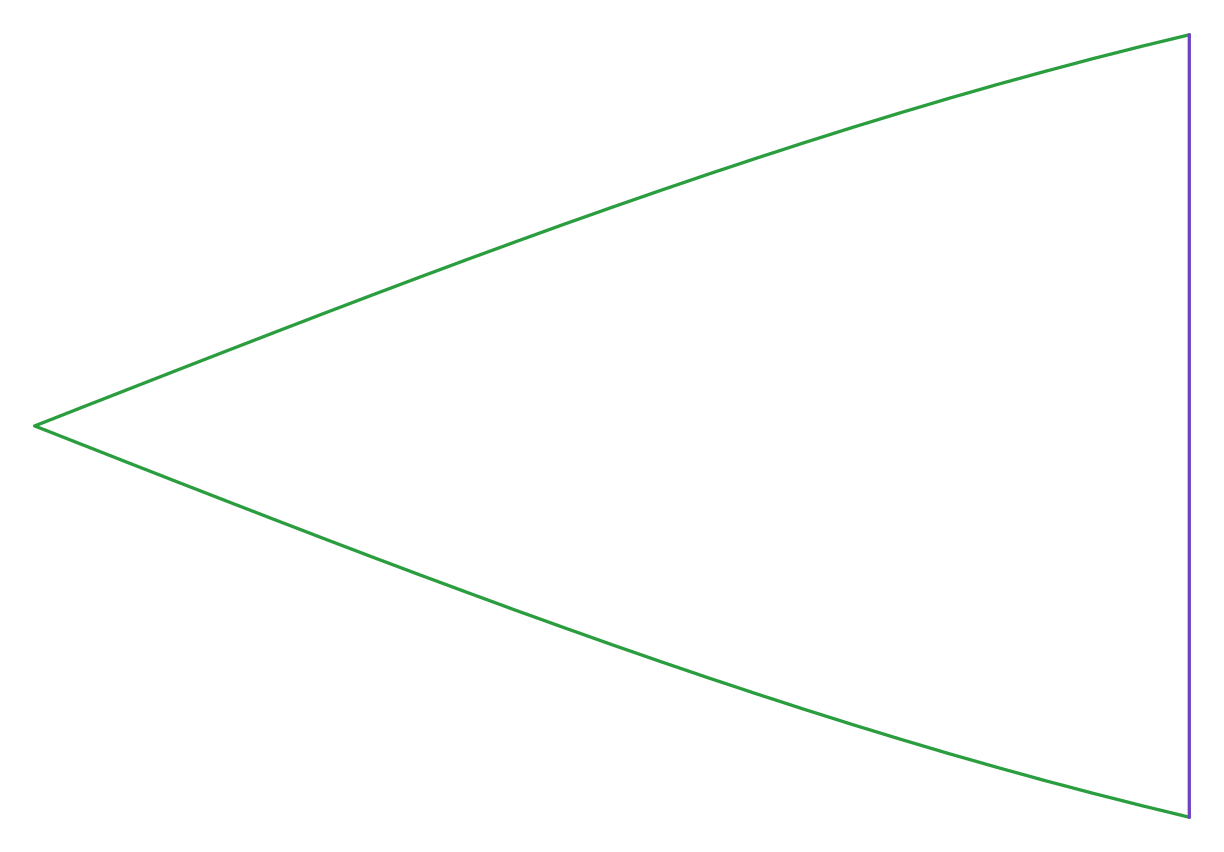
One gore of a spherical head, and as many as the head takes. It is the only part in this catalogue that is NOT an exact development, and the calculation says so: a sphere is not developable, no flat sheet becomes a cap without stretching. What comes out here is the shop layout — true length along the meridian, half-width from the parallel at each station — and the gore is formed afterwards, in a press or hot.
Where it is used
Tank and silo heads, vessel caps, reservoir domes, spherical equipment bottoms.
Measurements the calculation needs
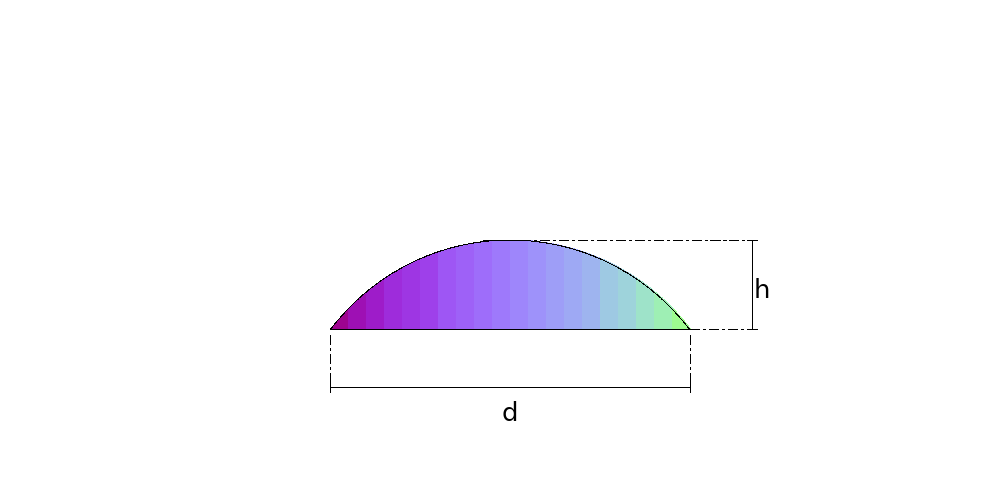
- D Diameter of the opening
- H Rise (height of the head)
- S Number of gores
- DV Divisions
- THK Plate thickness
How it develops: the formulas
- Sphere radius
R = (D²/4 + h²) / (2 × h)D is the mouth diameter and h the rise. For D = 2000 and h = 500: R = 1250 mm.- Meridian angle and length
φ0 = arcsin( D / (2R) ) ; meridian = R × φ0φ0 = 53.13° = 0.927 rad; the gore measures about 1159 mm along the meridian in the example (1154 in the station layout).- Half width of the gore at each station
w(φ) = π × R × sin φ / ss is the number of gores and φ the angle from the pole. At the mouth, for 8 gores: w = π × 1000 / 8 = 392.7 mm of half width.
Worked example
The values the form comes pre-filled with, run through the tool itself:
| Diameter of the opening | 2000 mm |
|---|---|
| Rise (height of the head) | 500 mm |
| Number of gores | 8 |
| Divisions | 24 |
| Plate thickness | 10 mm |
| The flat pattern fits a plate of | 1154 × 782 mm |
Result of the example
| Plate | 1154 × 782 mm, cut 8 times |
|---|
Assembly notes
A sphere is NOT developable: no flat sheet becomes a cap without stretching. This pattern is the shop layout — true length along the meridian and half-width from the parallel at each station — and the gore has to be formed, in a press or hot. The AREA of the pattern is exact; the shape is approximate, and the approximation improves with more gores.
Weld the sheets with the longitudinal seams 180° apart, not lined up. Lined up, the piece assembles into a different shape — and the longitudinal seam crosses the circumferential one.
Frequently asked questions
- If a sphere is not developable, what does this pattern guarantee?
- The AREA, exactly. The gore's area is the integral of the parallel divided by the number of gores, which comes to exactly one s-th of the cap's area — added up, the gores have the area of the part, with nothing over and nothing missing, so the material ordered is right. What is approximate is the SHAPE, and forming is what settles that.
- How many gores?
- The more the better — the shape error falls with the width of the gore. Eight to twelve is usual. Below three the flat sheet would have to stretch a large fraction of its own length, and the calculation refuses.
- Can the rise exceed half the diameter?
- No. At half the diameter the head is a hemisphere, and past that the mouth stops being the widest parallel: the gore starts to belly, and a layout by meridian and parallel no longer describes the part.
- And the sphere's radius, where does that come from?
- From the mouth and the rise, which is what you have in hand. It is (d²/4 + h²) over 2h. The calculation does the arithmetic; you give the two dimensions of the head.
An account is required. The free tier covers 20 calculations a month.