Screw Flight (Helicoid) development
What it is
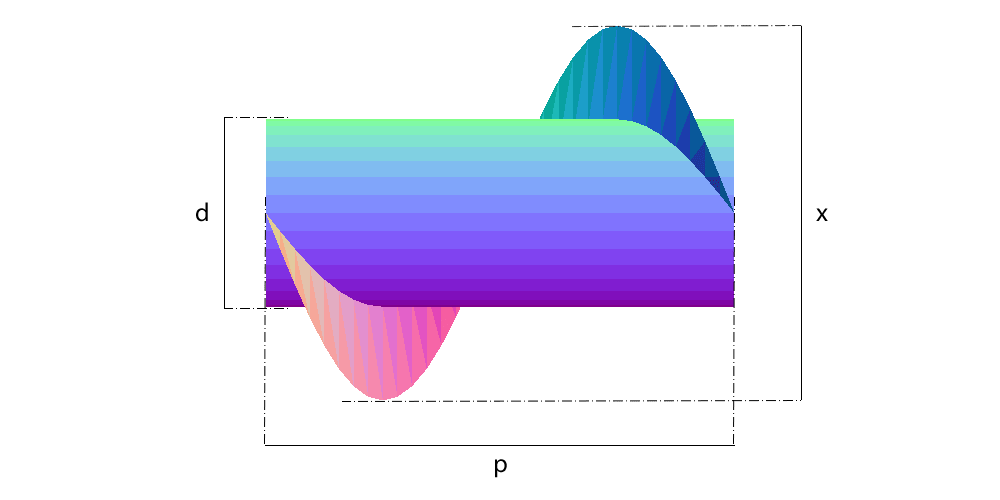
The helicoid is the flat helix — the flight of a screw conveyor. Each turn is developed as a ring with a gap: stretched and twisted, the ring rises exactly one pitch. The calculation returns the outer and inner radii of that ring and the gap required.
Where it is used
Screw conveyors and augers, mixers, silo feeders, grain and bulk material handling.
Measurements the calculation needs
- D Inside diameter of the flight
- X Outside diameter of the flight
- P Pitch (rise per turn)
- THK Plate thickness
How it develops: the formulas
- Inner and outer helix length, one turn
Li = √( (π × d)² + p² ) ; Lo = √( (π × x)² + p² )d is the shaft (inner) diameter, x the outer diameter and p the pitch. For d = 100, x = 200 and p = 250: Li = 401.5 mm and Lo = 676.2 mm.- Flight width
w = (x − d) / 250 mm in the example.- Ring sweep
ω = (Lo − Li) / wIn radians. In the example: 5.495 rad = 314.8°. The wedge to remove is 360° − 314.8° = 45.2°.- Ring radii
Ri = Li / ω ; Ro = Ri + wIn the example: Ri = 73.1 mm and Ro = 123.1 mm. The blank is a ring 246 mm across with a 45.2° wedge out.
Worked example
The values the form comes pre-filled with, run through the tool itself:
| Inside diameter of the flight | 100 mm |
|---|---|
| Outside diameter of the flight | 200 mm |
| Pitch (rise per turn) | 250 mm |
| Plate thickness | 10 mm |
| The flat pattern fits a plate of | 246 × 246 mm |
Result of the example
| Plate | 246 × 246 mm |
|---|---|
| Arc radii | 73.1 mm · 123.1 mm |
| Sector angle | 314.8° |

Assembly notes
The flight is NOT developable: a helicoid has negative Gaussian curvature, and no flat plate seats on it without stretching. This is the classic development, and what it gets exactly right are the two EDGES -- each measures the true length of its own helix, and that is what the bench checks. Its AREA is 0.7% over at these dimensions, and that surplus is what forming absorbs as the blank is opened and pulled to pitch. A blank larger than the finished flight is expected, not an error.
How to mark it out on the plate
- Work out Li, Lo, ω, Ri and Ro. Scribe two concentric circles with Ri and Ro.
- Mark the 360° − ω wedge and scribe the two radii that close it: those are the cuts.
- Cut the ring and the wedge. Open the two ends in opposite directions until the gap between them is the pitch p, measured along the axis.
- Check both edges: the inner must measure Li and the outer Lo, which is what the calculation guarantees. The area is slightly over and forming absorbs it.
Common mistakes and tolerances
- Confusing the sweep with the wedge
- ω is what STAYS of the ring (314.8° in the example); the wedge that comes out is 360° − ω. Cutting 314.8° leaves a ring far too short.
- Expecting the flat blank to fit without stretching
- The helicoid is not developable. The blank gets both edges right; the area is 0.7% over in the example and forming absorbs it. A blank larger than the finished flight is expected.
- Pitch too large
- The calculation accepts up to p = 10 × x. A pitch far larger than the outer diameter gives an almost straight flight, and the ring no longer represents the helix.
Frequently asked questions
- What is the pitch?
- The distance the helix advances along the axis in one full turn. It sets the gap in the ring: the greater the pitch, the wider the gap.
- Why does the ring have to be cut open and twisted?
- Because a flat, closed ring does not rise. Opening the calculated wedge and pulling the ends in opposite directions lets the material follow the helix without stretching.
- What wedge comes out in the example?
- For a 100 shaft, 200 flight and 250 pitch: the ring has radii of 73.1 and 123.1 mm and a sweep of 314.8°, so the wedge is 45.2°.
An account is required. The free tier covers 20 calculations a month.