Tapered Segmented Bend development
What it is
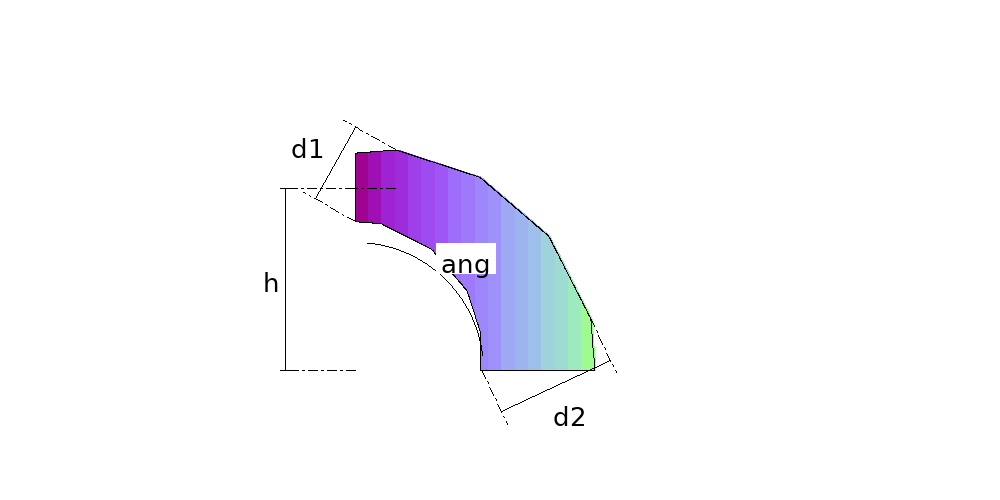
The mitred bend that also reduces: it goes in at one diameter and comes out at another, along the same arc. It is the part nobody wants to mark out by hand, because here the gores are ALL DIFFERENT — s + 1 patterns instead of the two a constant-diameter bend takes.
Where it is used
Flues and extraction ducts that taper as they rise, curved transitions in process piping, dust collection, fan outlets that change size through the bend.
Measurements the calculation needs
- D1 Smaller diameter (inlet mouth)
- D2 Larger diameter (outlet mouth)
- H Bend radius (on the axis)
- ANG Angle of the bend
- S Number of gores
- DV Divisions
- THK Plate thickness
Worked example
The values the form comes pre-filled with, run through the tool itself:
| Smaller diameter (inlet mouth) | 300 mm |
|---|---|
| Larger diameter (outlet mouth) | 500 mm |
| Bend radius (on the axis) | 800 mm |
| Angle of the bend | 90° |
| Number of gores | 4 |
| Divisions | 32 |
| Plate thickness | 6 mm |
| The flat pattern fits a plate of | 1490 × 579 mm |
| Flat patterns produced | 5 |
Result of the example
| Plate 1 | 941 × 358 mm |
|---|---|
| Plate 2 | 1089 × 516 mm |
| Plate 3 | 1237 × 547 mm |
| Plate 4 | 1384 × 579 mm |
| Plate 5 | 1490 × 490 mm |

Assembly notes
The gores are ALL DIFFERENT and go in the order they come out, smallest to largest. Assembled out of order the bend does not close — and there is no way to tell from the patterns, because each one closes on its own.
Weld the sheets with the longitudinal seams 180° apart, not lined up. Lined up, the piece assembles into a different shape — and the longitudinal seam crosses the circumferential one.
Frequently asked questions
- Why is every gore a different pattern?
- Because the diameter grows along the bend. On a constant-diameter bend the middle gores are all alike and come on one sheet cut s − 1 times; here each has its own size. That is why the gore count is capped at twelve — twelve gores is already thirteen sheets.
- Does the assembly order matter?
- Very much. The gores go in the order they come out, smallest to largest. Assembled out of order the bend does not close — and there is no telling from the patterns, because each one closes on its own. The printed sheet carries that warning.
- How is the part built geometrically?
- By inscribed spheres: one sphere at each joint, on the same tangent polygon the ordinary bend uses, with growing radii. Each gore is the frustum of the cone circumscribed about two neighbouring spheres — and it is that construction which makes the joints plane ellipses, which is what lets the mitre close.
- Are the two diameters given the openings?
- They are — circles perpendicular to the axis, which is what you measure and what meets the next pipe. Worth saying because it changes the arithmetic: with that definition the taper enters through the tangent of the cone's angle, not the sine, which is what you get if the diameters are taken at the joints.
An account is required. The free tier covers 20 calculations a month.