Screw flight development
The flight of a screw conveyor: each turn is an open ring which, twisted, rises one pitch.
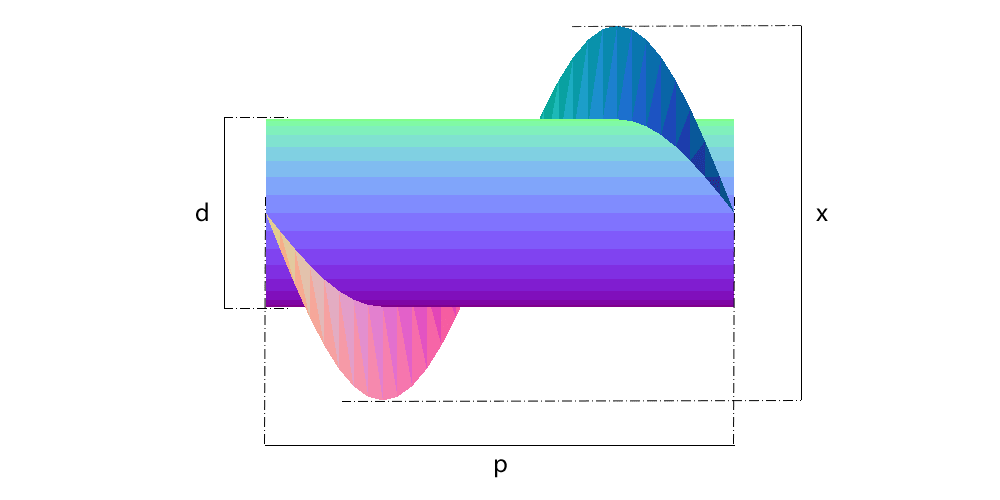
Screw Flight (Helicoid)
The flat helix — the flight of a screw conveyor. Each turn develops as a ring with a gap: stretched and twisted, it rises exactly one pitch.
Which part to use
- A screw conveyor flight, or the spiral of a stair or a mixer: Screw Flight (Helicoid).
- A pipe coil is not a helicoid: it is bent pipe, and it comes from the bending machine, not from plate.
How it is calculated
Each turn of the flight is an open annulus: its radii come from the length of the inner and outer helices per turn, √((π × d)² + p²) and √((π × D)² + p²), with D the outside diameter, d the shaft diameter and p the pitch. The annulus, cut and twisted, rises one pitch per turn, and the gap between its ends is what allows the twist.
The dimensions are the outside diameter, the shaft diameter, the pitch and the thickness. The result comes with the radii of the annulus and its gap, the PDF template at 1:1, the DXF and the 3D view.
Frequently asked questions
- How do I work out a screw conveyor flight?
- From the length of the two helices per turn: √((π × D)² + p²) on the outside and √((π × d)² + p²) on the inside, with D the outside diameter, d the shaft diameter and p the pitch. The difference between the two sets the radii of the flat annulus and its gap. The Screw Flight (Helicoid) page does the sum.
- Continuous flight or in sections?
- The open annulus is one turn; a continuous flight is made by welding turn after turn onto the shaft, after stretching each annulus to the pitch. For large pitches relative to the diameter the twist is greater, and it is worth checking in the 3D view.
- Why is the flat annulus larger than the finished flight?
- Because stretching the annulus to the pitch spends part of its length on height: the outer radius of the flat annulus is larger than the radius of the flight, and the difference grows with the pitch.