Pie cut calculator for exhaust and tube bends: saw angle, pie lengths and a wrap-around template
Updated on 28 October 2026
Pie cuts bend exhaust, turbo and intercooler tube without a bender: short wedges cut from straight tube and welded back together round the radius, at any angle and at any centreline radius over half the tube's diameter. The arithmetic is short, and the classic mistake is the saw: it is set to half the angle each pie turns.
The calculator below works in millimetres or inches. It gives the saw angle, how many pieces to cut, the length of each pie on the long side, the centreline and the short side, and the heights for a wrap-around template. Its link opens the same bend, drawn, on the part page; a free account adds the 1:1 template and the DXF for plasma or laser.
Pie cut calculator
The calculator speaks plate shop, so here is the translation: the number of pies goes in Gores, the CLR in Bend radius at the axis, and the half-mitre β it returns is the saw angle. On bought tube, enter the thickness as 0.01 mm (0.001 in), so that every length is on the outside of the tube, where the tape and the paper go.
| Half gore plate | – |
|---|---|
| Full gore plate | – |
| Plates to cut | – |
| Half-mitre β | – |
| Element spacing | – |
| Element | From the seam | φ from the heel | Half gore | Full gore |
|---|
All lengths in millimetres. The seam is on the throat, at element 0; past the middle element the heights repeat in reverse order. Nothing is sent anywhere: the sums run in your browser.
It reads millimetres, or inches when the site is set to inches: the mm / inches switch sits above the calculator on every part page, such as the 90° segmented bend, and the site remembers it. The line under the calculator says which unit it is reading. Type decimals, 4.5 for a 4-1/2 in CLR.
Pie cut terms, and what the calculator calls them
| Exhaust shop | Calculator | What it is |
|---|---|---|
| Tube OD | Outside diameter, D | Across the outside of the tube: 76.2 mm for 3 in tube, 63.5 mm for 2-1/2 in. |
| Wall | Plate thickness, t | 0.01 mm (0.001 in) for bought tube. The real thickness only for pies rolled from flat sheet. |
| CLR, centreline radius | Bend radius at the axis, R | From the centre of the bend to the centreline of the tube. It must be more than half the OD. |
| Bend angle | Bend angle | The total turn: 90° for a right angle, 180° for a U-bend. |
| Number of pies | Gores | How many equal steps the bend turns in: each full pie turns angle ÷ gores. |
| Cut angle, saw angle | Half-mitre β | angle ÷ (2 × gores), from square, at each end of a full pie. |
| Long side, short side | Heel, throat | The outside and the inside of the bend: φ = 0° and φ = 180° in the table. |
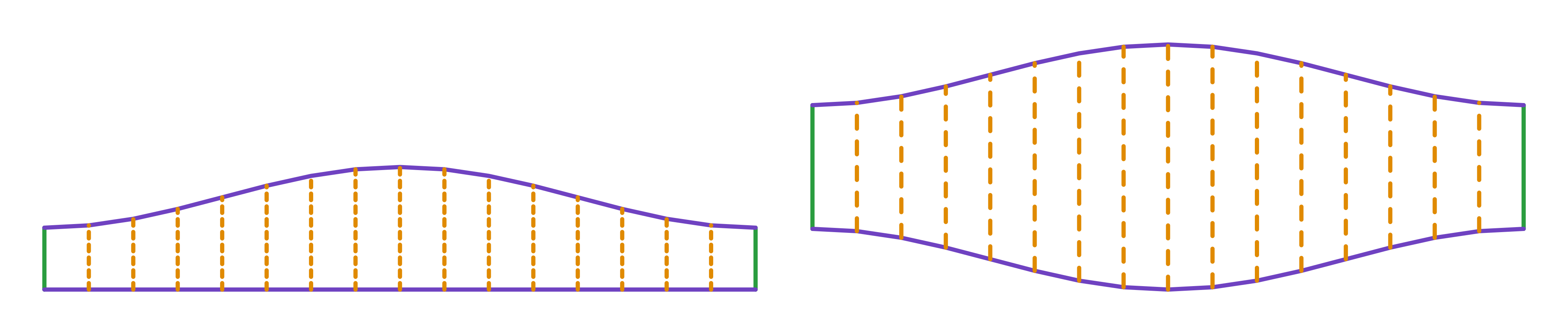
A full pie is cut at β on both ends, so it turns 2β. The bend starts and ends with a half pie, cut at β on one end and square on the other: usually the end of the straight tube on either side, cut at β. A bend of N gores is 2 half pies and N − 1 full pies, and it turns N × 2β, the bend angle.
The pie cut formula
- Saw angle
β = angle / (2 × gores)From square, at each end of a full pie. A 90° bend in 6 gores: β = 7.5°, and each full pie turns 15°.
- Pie length round the tube
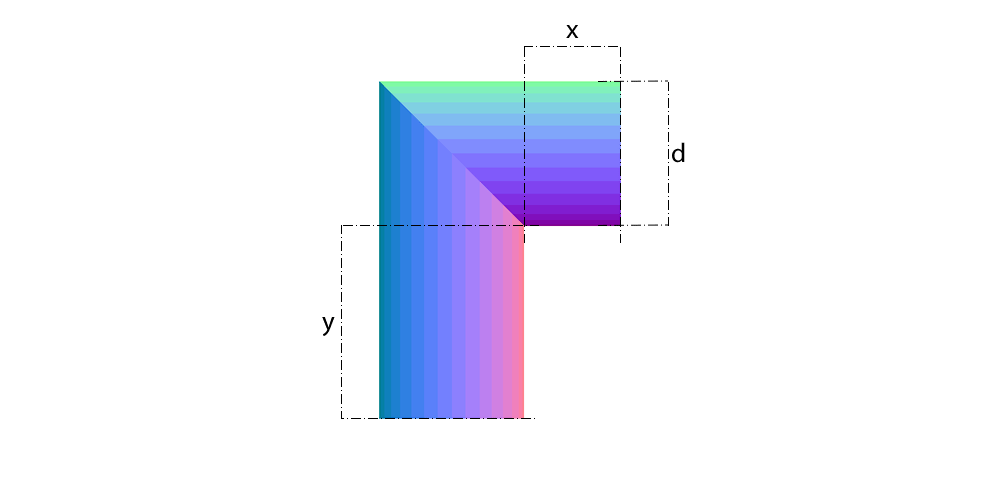
y(φ) = (R + r × cos φ) × tan βThe length of a half pie at the angle φ round the tube, from its square end to the cut: φ = 0° on the long side, 180° on the short side. R is the CLR and r = (D − t) / 2. A full pie is twice y.
- Full pie: long side, centreline, short side
2 × (R + r) × tan β ; 2 × R × tan β ; 2 × (R − r) × tan βThe three lengths to mark with a tape. The centreline length, on the side of the tube, does not depend on the diameter.
- Wrap
L = π × (D − t)The length of the wrap-around template. With t = 0.01 it is the outside circumference of the tube, π × D, and the template closes round it.
Worked example: a 3 in exhaust bend
3 in tube, 76.2 mm outside, bent 90° on a 4.5 in CLR (114.3 mm, 1.5 × OD) in 6 gores, entered with t = 0.01 mm for bought tube. β = 90° / 12 = 7.5°, and tan β = 0.1317.
| mm | in | |
|---|---|---|
| Saw angle β | 7.5° | 7.5° |
| Pieces to cut | 2 half pies and 5 full pies | 2 half pies and 5 full pies |
| Full pie, long side | 40.13 | 1.580 |
| Full pie, centreline | 30.10 | 1.185 |
| Full pie, short side | 20.07 | 0.790 |
| Half pie, long side | 20.06 | 0.790 |
| Half pie, short side | 10.03 | 0.395 |
| Wrap, π × D | 239.36 | 9.42 |
In the calculator these are the Full gore and Half gore columns: 20.07 and 10.03 mm at element 0, the short side, up to 40.13 and 20.06 mm at element 8, the long side. The whole bend takes 2 × 6 × 114.3 × tan 7.5° = 180.6 mm of tube along the centreline (7.11 in), plus a saw kerf for every cut, and it starts and ends at the same points as a smooth bend on the same CLR.
Marking the pies
On a chop saw, a cold saw or a bandsaw, the angle does most of the work and a tape measure is enough.
- Set the saw to β and make the first cut.
- Draw two lines along the tube: one from the long point of the cut, where the end of the tube reaches furthest, and one from the short point, half a turn round. To find the point half a turn round, wrap a strip of paper round the tube, mark where it meets and fold it in half.
- Measuring from the cut, mark the long-side length on the first line and the short-side length on the second: 40.13 and 20.07 mm in the example.
- Roll the tube half a turn, or swing the saw to the other side of square, and cut through the marks. The two cuts lean towards each other, and the piece is a wedge.
- Mark the next pie from the new cut in the same way: its long side is now on the other line. Measure from each fresh cut, not from marks laid out in advance: every cut takes a kerf of 1 to 3 mm, and it would come off every pie.
Cutting by hand, with a cut-off wheel, a hacksaw or a plasma torch, nothing holds the angle, and a wrap-around template is surer. With a free account, enter the same bend in the full calculator and print the 1:1 template: the half pie and the full pie at full size, on A4 or Letter, two sheets each for 3 in tube. Print at 100 %, check the ruler on the sheet, cut the paper along the curves, wrap it round the tube with its ends meeting on the short side and its middle line on the long side, tape it and scribe both curves.
Pies cut one after another from the same tube come off with their long sides alternating: the curve scribed for one pie is the edge of the next, which sits half a turn round. Mark the long side of every pie as it comes off.
Tacking and welding
- Deburr every pie inside and out, and check each face on a flat plate: a face that rocks leaves a gap at the weld.
- Lay the pies out with every long-side mark on the heel, the outside of the bend. Pies cut in a row from one tube come off alternating, so every second one is turned half a turn about its axis. Gores marked one at a time from a plate template, as in the lobster back bend, all come the same way round and are not turned.
- Draw the bend full size on the bench, the CLR arc and the two straight legs, and build the pies on it.
- Tack each joint on the long side and the short side, then on the two flanks, keeping the long-side marks in a straight line so the bend does not twist.
- Check the angle as it grows: halfway through the pies, the bend should have turned half its angle.
- Weld in short runs on opposite sides of each joint, so the shrinkage pulls evenly. Stainless and titanium need a back purge with argon, or the inside of the weld oxidises.
How many pies
More pies follow the radius more closely and flow better, but every extra pie is one more cut and one more weld. For a 90° bend:
| Gores | Pieces to cut | Each full pie turns | Saw angle β |
|---|---|---|---|
| 3 | 2 half + 2 full | 30° | 15° |
| 4 | 2 half + 3 full | 22.5° | 11.25° |
| 5 | 2 half + 4 full | 18° | 9° |
| 6 | 2 half + 5 full | 15° | 7.5° |
| 9 | 2 half + 8 full | 10° | 5° |
| 10 | 2 half + 9 full | 9° | 4.5° |
| 18 | 2 half + 17 full | 5° | 2.5° |
A pie does not depend on the bend angle: on the same tube and CLR, a 45° bend in 3 gores, a 90° in 6 and a 180° U-bend in 12 all use the same 15° pie, cut at 7.5°. The tightest bend has a CLR just over half the OD, where the short side of the pie runs out; at a CLR of 1 × OD the short side is a third of the long side.
The drawn pattern, the template and the DXF
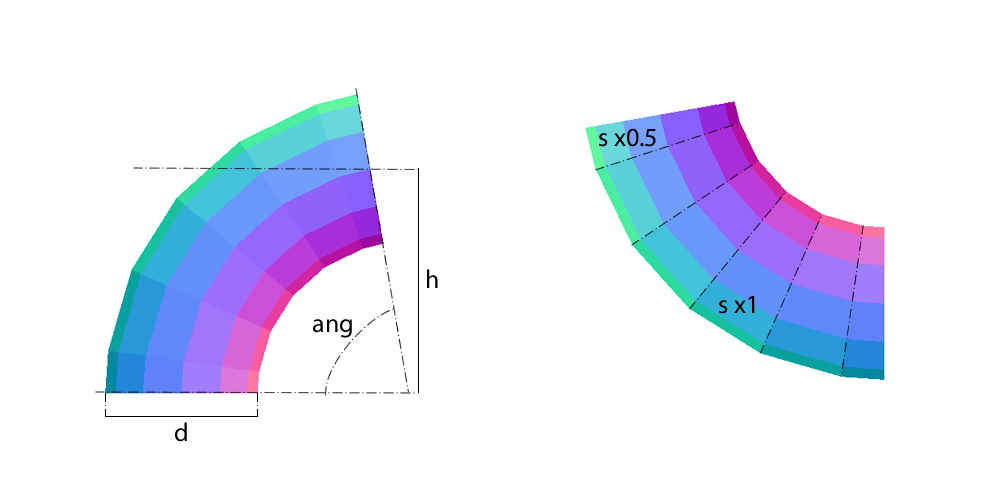
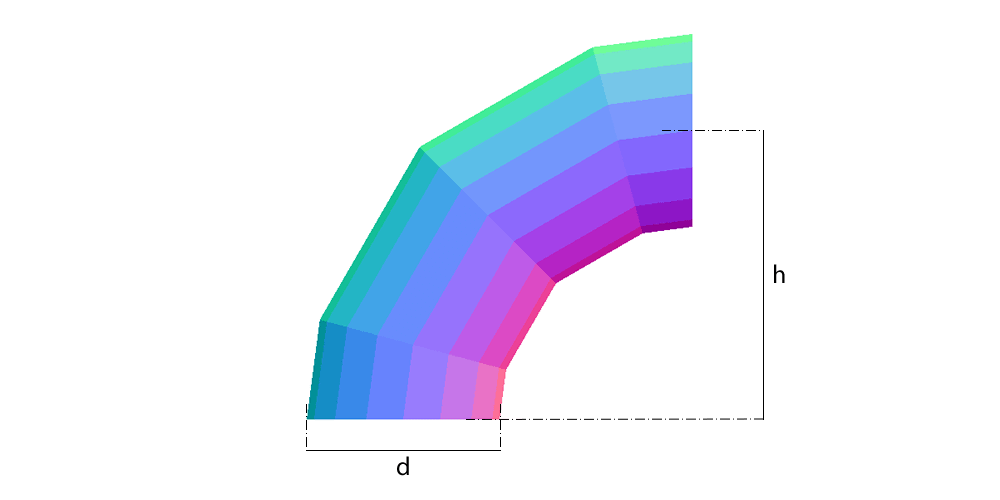
The link under the calculator opens the same bend on the 90° segmented bend page for a 90° bend, and on the segmented bend page for any other angle, with the drawing of the half pie and the full pie and the table of lengths, no account needed. With a free account, the full calculator prints the 1:1 template for wrapping. For plasma or laser, the free account exports 1 part a month in DXF; unlimited DXF export is the paid full access.
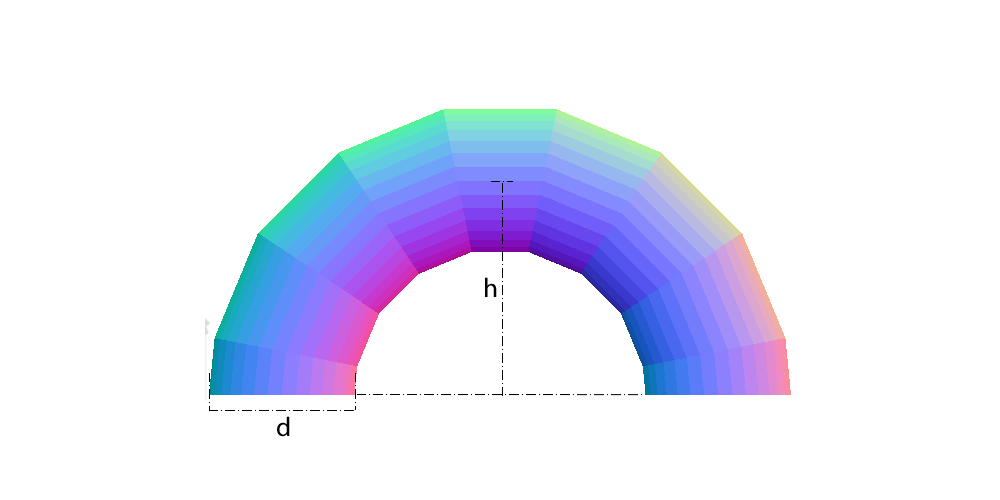
Two related cases have pages of their own: two tubes cut at 45° and welded in one joint are the elbow, and a return of 180° is the 180° segmented bend. Big duct bends rolled from plate use the same formula with the real plate thickness, in the lobster back bend guide.
Frequently asked questions
- How do I calculate pie cuts?
- Divide the bend angle by twice the number of pies for the saw angle β. A full pie is 2 × (R + r) × tan β long on the outside of the bend and 2 × (R − r) × tan β on the inside, with R the CLR and r = (D − t) / 2, half the OD on bought tube. For 3 in tube on a 4.5 in CLR, 90° in 6 pies: β = 7.5°, 1.580 in on the long side and 0.790 in on the short side.
- What angle do I set the saw to for pie cuts?
- Half the angle each pie turns, measured from square: β = bend angle / (2 × pies). 15° pies are cut at 7.5° and 10° pies at 5°. Setting the saw to 15° for a 15° pie doubles the turn of every pie.
- How many pies does a 90° bend need?
- Any number: 6 pies turn 15° each, 9 turn 10° and 18 turn 5°. More pies follow the radius more closely and flow better; fewer mean fewer cuts and welds.
- Why does the calculator give two half pies?
- So that every joint is cut at β on both sides and its two faces meet as the same oval. Two half pies take as much tube as one full pie, and the ends of the straight tubes, cut at β, usually serve as the half pies. Cutting full pies only and butting the end ones against square-cut tube also gives the angle: those two joints turn β each, and the oval face overhangs the round one by a fraction of a millimetre with 15° pies on 3 in tube.
- Does the wall thickness matter?
- Not to the lengths: on 16-gauge tube, 1.65 mm, a 15° pie changes by 0.2 mm. It matters to the wrap-around template, which sits on the outside of the tube: enter 0.01 mm (0.001 in) for bought tube, or the template comes out π × t short, 5 mm on 16-gauge, and does not close.
- Can I work in inches?
- Yes. The calculator reads inches when the site is set to inches, with the mm / inches switch on any part page, and the 1:1 template then prints on Letter sheets. Type decimals: 4.5 for a 4-1/2 in CLR.
Parts in this guide
Other guides
- How to develop a cone (frustum) in sheet metal: formula, sector radii and angle, step by step
- Lobster back bend calculator (segmented 90° elbow): gore angles, cut heights and how many plates
- Pipe saddle calculator and development: how to lay out a pipe-to-pipe branch (tee) at 90 and 45 degrees
- Square to round transition: development by triangulation, step by step
- The neutral axis of plate: why every development uses D − t, and the bend deduction
- Sheet metal glossary: the terms of marking out and pattern development in plate fabrication
- How we check the Planichapa calculations, and who is behind them
- LITIO alternative: Planichapa develops sheet metal parts in the browser, nothing to install, now that LITIO2 is no longer sold
- How to lay out a mitre-cut pipe: paper template, sine wave and ordinate table
- Plate 'n' Sheet alternative: Planichapa develops sheet metal parts in the browser, with the price on the page
- Steel plate weight calculator, weight per m², gauges and stock plate sizes: table and formula
- Pipe ovality: a calculator, the formula, a worked example, the limits the codes use and how to measure it in the shop
- Sheet metal pattern development software: how to choose, and what changes between a desktop program, a phone app and an online calculator
- Eccentric and concentric reducers: which one to use and how each one develops on plate
- Roller chain size chart: ANSI, ISO 606, motorcycle and bicycle chain pitch and roller diameter
- Sprocket dimensions: pitch diameter, outside and root diameter, tooth form and a pitch diameter chart
- Bolt circle layout: the position of each hole, the chord between holes and a chord chart
- Chain length and sprocket ratio: the formulas, a worked example and how many links to cut
- Screw flight calculator: the flat blank of a screw conveyor flight (auger), with the formula and a worked example
- Plate rolling calculator: the blank length of a rolled shell, with the formula, a chart and a worked example
- Tube notching template generator: a printable coping template for any tube, angle and offset
- Dished head calculator: depth, volume, blank diameter and weight of torispherical, 2:1 elliptical and hemispherical heads
- Cone template generator: a printable full-size cone template for hoppers, funnels and reducers
- Duct transition layout: square to round duct, centred, offset or flat on one side
- Pipe template, printable at full size: tee saddle, 45° lateral and mitre cut for every pipe size from NPS 1/2 to 12
- Register boot layout: from a floor, wall or ceiling register to a round duct, in inches
- Plenum box and plenum transition layout: the sides, the offset and the round outlet