Chain sprocket generator
What it is
A roller chain sprocket cut from flat plate: the toothed disc that drives a chain or is driven by it, from the large sprocket to the small one. The calculation draws the ISO 606 tooth for the chain you pick -- the roller seat, the flanks and the tip -- and returns the pitch, outside and root diameters, the template at full size and the DXF for plasma, laser or waterjet. ANSI 25 to 160, ISO 606 B series, motorcycle and bicycle chains fill in with one click.
Where it is used
Conveyor and agricultural machinery drives, go-kart and minibike axles, motorcycle and bicycle sprockets, idler and tensioner sprockets, and the drive of any shop-built machine where the catalogue sprocket does not have the tooth count or the hub you need.
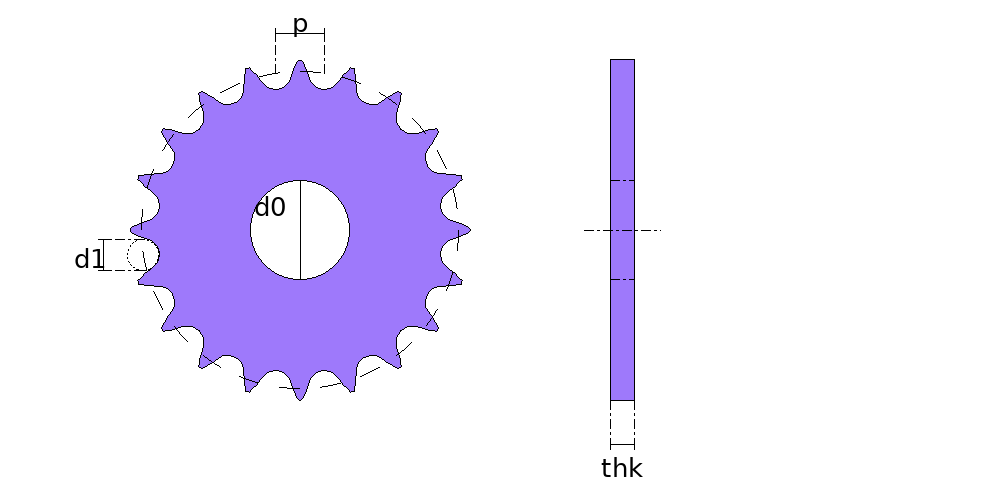
Measurements the calculation needs
- ND Number of teeth
- P Chain pitch
- D1 Roller diameter
- D0 Bore (0 for no bore)
- THK Plate thickness
Calculate with your own measurements
No account needed: enter the measurements in millimetres or inches and get the figures and the drawing. The scaled PDF template, the DXF for the cutting table and the 3D model take a free account.
Inches or millimetres? mm inches
Roller chain sizes
The pitch and roller diameter of the most used chains, to check against or to fill in the calculator in one click.
ANSI B29.1
| Chain | Pitch | Roller Ø | |
|---|---|---|---|
| ANSI 25 | 6.4 | 3.3 | Calculate |
| ANSI 35 | 9.5 | 5.1 | Calculate |
| ANSI 40 | 12.7 | 7.9 | Calculate |
| ANSI 41 | 12.7 | 7.8 | Calculate |
| ANSI 50 | 15.9 | 10.2 | Calculate |
| ANSI 60 | 19.1 | 11.9 | Calculate |
| ANSI 80 | 25.4 | 15.9 | Calculate |
| ANSI 100 | 31.8 | 19.1 | Calculate |
| ANSI 120 | 38.1 | 22.2 | Calculate |
| ANSI 140 | 44.5 | 25.4 | Calculate |
| ANSI 160 | 50.8 | 28.6 | Calculate |
ISO 606 B series
| Chain | Pitch | Roller Ø | |
|---|---|---|---|
| 05B | 8.0 | 5.0 | Calculate |
| 06B | 9.5 | 6.4 | Calculate |
| 08B | 12.7 | 8.5 | Calculate |
| 10B | 15.9 | 10.2 | Calculate |
| 12B | 19.1 | 12.1 | Calculate |
| 16B | 25.4 | 15.9 | Calculate |
| 20B | 31.8 | 19.1 | Calculate |
| 24B | 38.1 | 25.4 | Calculate |
Motorcycle
| Chain | Pitch | Roller Ø | |
|---|---|---|---|
| 415 | 12.7 | 7.8 | Calculate |
| 420 | 12.7 | 7.8 | Calculate |
| 428 | 12.7 | 8.5 | Calculate |
| 520 | 15.9 | 10.2 | Calculate |
| 525 | 15.9 | 10.2 | Calculate |
| 530 | 15.9 | 10.2 | Calculate |
Bicycle
| Chain | Pitch | Roller Ø | |
|---|---|---|---|
| 1/2" × 1/8" | 12.7 | 7.8 | Calculate |
| 1/2" × 3/32" | 12.7 | 7.8 | Calculate |
Dimensions in mm. ANSI and motorcycle chains are in inches and were converted from the decimal the standard prints; ISO 606 and bicycle chains are in millimetres. On the 25 and the 35, which have no rollers, the diameter is the bushing's.
How it develops: the formulas
- Pitch diameter
d = p / sin(180° / z)p is the chain pitch and z the number of teeth. For a 40 chain, p = 12.7 mm, and 20 teeth: d = 81.18 mm (3.196 in).- Outside diameter
da = d − d1 + p × (1.125 − 0.8 / z)The middle of the ISO 606 range, from d + p (1 − 1.6/z) − d1 to d + 1.25 p − d1. In the example: 87.04 mm (3.427 in); ANSI catalogues print 3.457 in, for the tighter ANSI gap.- Root diameter
df = d − d1d1 is the roller diameter. In the example: 81.18 − 7.92 = 73.26 mm.- The tooth gap
ri = 0.505 d1 + 0.0345 ∛d1 ; α = 130° − 90° / z ; re = [0.12 d1 (z + 2) + 0.008 d1 (z² + 180)] / 2The middle of the ISO 606 envelope, between its minimum and maximum gap forms, with d1 in mm. The flank is convex and tangent to the seat. In the example: ri = 4.07 mm, α = 125.5° and re = 28.8 mm.
Worked example
The values the form comes pre-filled with, run through the tool itself:
| Number of teeth | 20 |
|---|---|
| Chain pitch | 12.7 mm |
| Roller diameter | 7.9248 mm |
| Bore (0 for no bore) | 25.4 mm |
| Plate thickness | 6.35 mm |
| The flat pattern fits a plate of | 87 × 87 mm |
Result of the example
| Plate | 87 × 87 mm |
|---|---|
| Area and weight | 0.004 m² · ≈ 0.21 kg in 6.35 mm steel |
| Arc radii | 4.1 mm · 12.7 mm · 28.8 mm · 43.5 mm |
| Sector angle | 125.5 · 360 · 10.2 · 1.2° |

Assembly notes
Pitch diameter 81.2 mm, outside diameter 87 mm and root diameter 73.3 mm, with 20 teeth. With a caliper across the tooth gaps -- opposite ones on an even number of teeth, the pair nearest to opposite on an odd number -- the reading must be 73.3 mm.
A plasma-cut sprocket warps and its bore drifts off centre. Cut it from flat plate, let it cool on the table, cut the bore undersize and finish it on the lathe with the teeth running true; on a fast or heavily loaded drive, harden the teeth or use a wear-resistant plate.
How to mark it out on the plate
- Pick the chain in the selector, or type in the pitch and roller diameter of yours, and the number of teeth.
- Cut from flat, stress-free plate. Cut the bore first and undersize, so the outline is cut while the part is still held by the sheet.
- Let the sprocket cool on the table before moving it: a hot plate pulls out of flat.
- Grip it on the lathe centred on the root diameter, and finish the bore and the hub face so that the teeth run true.
- Check the root diameter and fit the chain: it must sit in every gap, with no tight spot, over a full turn.
Common mistakes and tolerances
- The wrong chain standard
- ANSI 40 and ISO 08B share the 12.7 mm pitch and differ in the roller, 7.92 against 8.51 mm. Measure the roller, or read the chain's side plate, before choosing.
- A plasma-cut bore, to size
- A plasma bore comes out tapered and off centre by a fraction of a millimetre, and a sprocket that runs out throws the chain. Cut the bore undersize and finish it on the lathe.
- Too few teeth
- Below 17 teeth the chain speeds up and slows down on every tooth. Nine to eleven only for slow drives.
- Soft plate on a loaded drive
- Mild steel wears quickly under a chain. For fast or loaded drives use a medium-carbon or wear-resistant plate, or harden the teeth.
Guides about this part
- Roller chain size chart: ANSI, ISO 606, motorcycle and bicycle chain pitch and roller diameter
- Sprocket dimensions: pitch diameter, outside and root diameter, tooth form and a pitch diameter chart
- Chain length and sprocket ratio: the formulas, a worked example and how many links to cut
Frequently asked questions
- What is the pitch diameter of a sprocket?
- The circle the roller centres run on: d = p / sin(180°/z), with p the chain pitch and z the number of teeth. For a 40 chain, p = 12.7 mm, and 20 teeth it is 81.18 mm, 3.196 in.
- Which tooth form does it draw?
- The ISO 606 form: a roller seat a little larger than the roller, two convex flank arcs tangent to it and the tip cut at the outside diameter. The standard accepts any flank between a minimum and a maximum gap form; the generator draws the middle of that envelope, so that the plasma or laser tolerance stays inside the standard on both sides, with the tip in the middle of the ISO range. American catalogues print a slightly larger outside diameter, for the tighter ANSI gap; the pitch and root diameters are the same.
- Can a sprocket be plasma cut?
- Yes, for slow and medium-speed drives, which is what most shop-made sprockets are. Heat warps the plate and pulls the bore off centre, so cut the bore undersize, finish it on the lathe with the teeth running true and check the root diameter before fitting the chain. For fast or heavily loaded drives, laser or waterjet and a plate that can be hardened.
- How do I check a sprocket after cutting it?
- By the root diameter, from one tooth gap to the opposite one: d − d1 on an even number of teeth. On an odd number there is no opposite gap, and the caliper reading across the two gaps nearest to opposite is d × cos(90°/z) − d1. The result gives both numbers.
You can work out the figures right here, with no account. PDF, DXF, 3D and history take an account — free, with unlimited calculations.