Double Cut Cylinder development
What it is
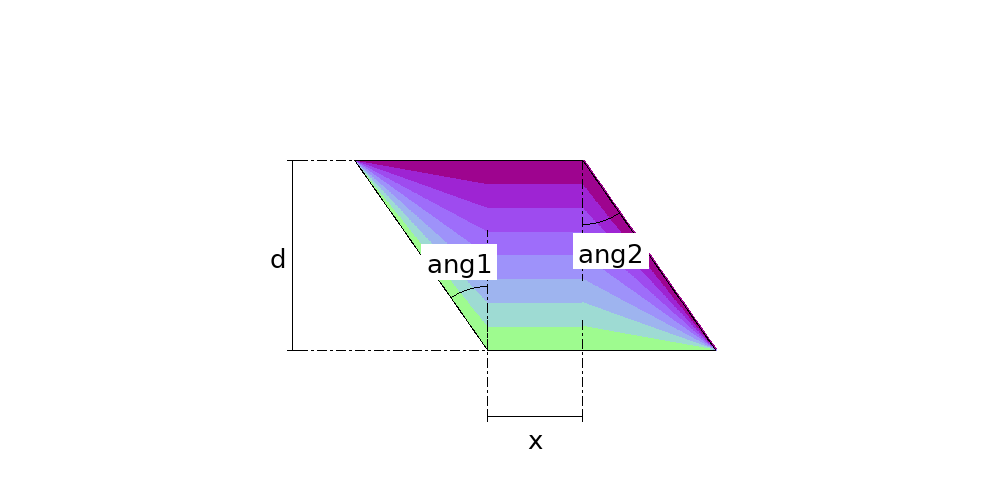
A rolled shell cut at an angle on both ends, each with its own angle. Developed, it gives two waves — one per edge — which can differ in height and phase. It is the part that clears two offsets with a single length of tube.
Where it is used
Connecting runs between misaligned equipment, intermediate gores of field-assembled bends, adaptations to existing pipework.
Measurements the calculation needs
- D Outside diameter of the tube
- X Straight run between the two cuts
- ANG1 Cut angle of the first mouth
- ANG2 Cut angle of the second mouth
- DV Divisions
- THK Plate thickness
Worked example
The values the form comes pre-filled with, run through the tool itself:
| Outside diameter of the tube | 200 mm |
|---|---|
| Straight run between the two cuts | 100 mm |
| Cut angle of the first mouth | 35° |
| Cut angle of the second mouth | 35° |
| Divisions | 16 |
| Plate thickness | 10 mm |
| The flat pattern fits a plate of | 597 × 187 mm |
| Flat patterns produced | 2 |
Result of the example
| Plate 1 | 597 × 187 mm |
|---|---|
| Plate 2 | 597 × 187 mm |

Assembly notes
Weld the sheets with the longitudinal seams 180° apart, not lined up. Lined up, the piece assembles into a different shape — and the longitudinal seam crosses the circumferential one.
Frequently asked questions
- Do both angles have to match?
- No. Each opening takes its own angle, which is the point of the part: solving two different offsets in one cut of plate.
- Why does the result come in two flat patterns?
- The part is delivered as two halves that together close the tube. Each half can be checked separately against the single-cut cylinder.
Calculate a Double Cut Cylinder
An account is required. The free tier covers 20 calculations a month.