Laser and plasma cutting cost calculator: the formula, a worked example and how to measure the cut length
Updated on 02 November 2026
A laser- or plasma-cut part costs the plate and the cutting. The cutting is priced from two numbers of the part: the cut length, the path the torch or the beam travels, and the number of pierces, one for every closed outline, because every hole starts with the machine piercing the plate. A cutting shop charges per length and per pierce; cutting on your own table, you pay machine time, which comes from the same two numbers and the cutting speed. This page does both sums.
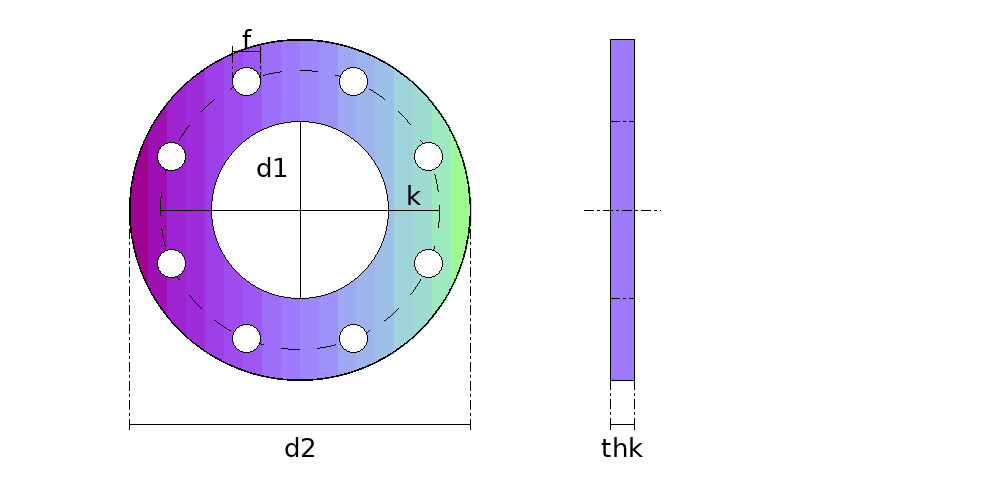
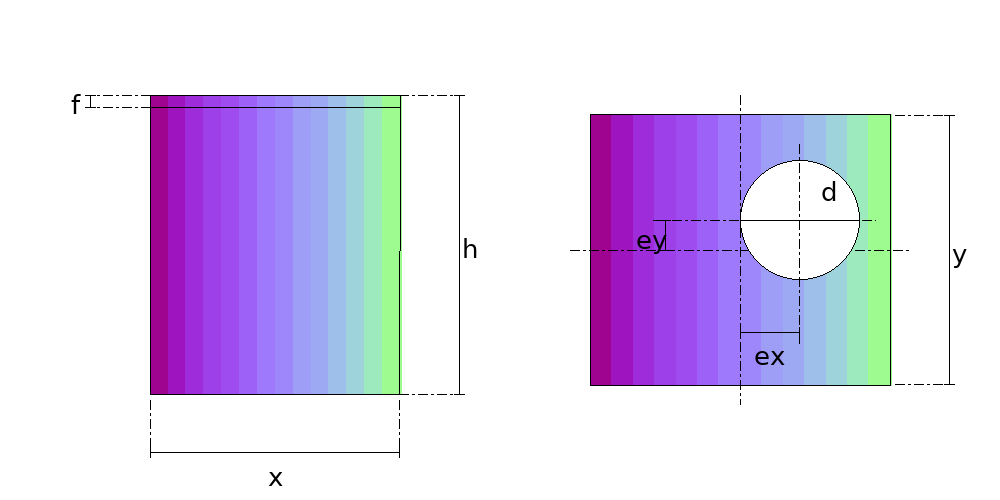
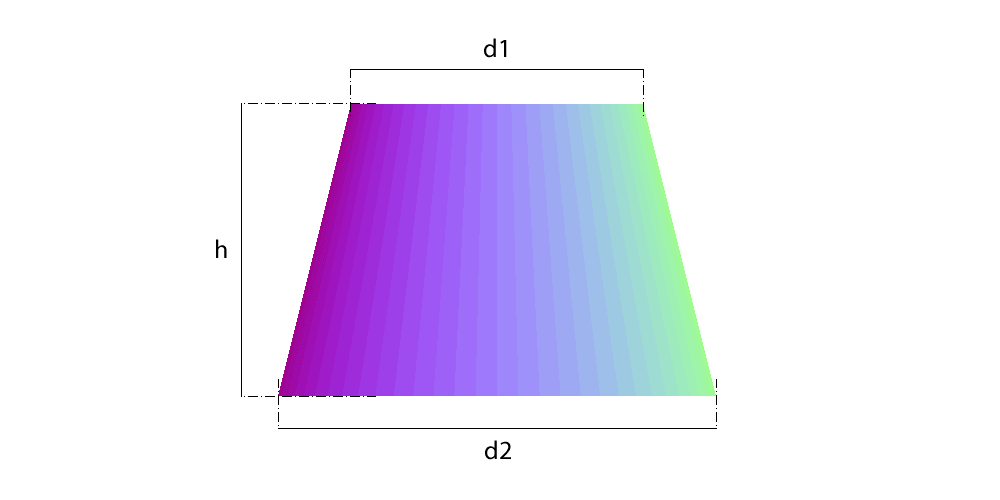
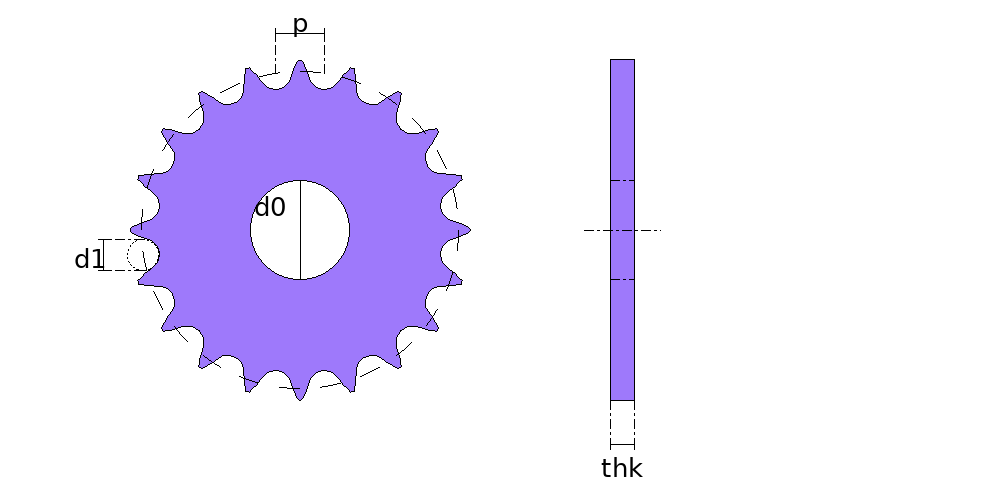
The cut length and the pierces of every part in the catalogue come out in the quick quote on its result, next to the weight and the plate price: try the flange or the cone.
Cutting cost calculator
Pick how the cutting is paid, enter the cut length and the pierces of one part, and the prices. The quantity gives the cost of the batch.
| Cutting time for one part | – |
|---|---|
| Cost per m of cut, from the hourly rate | – |
| Cutting cost of one part | – |
| Cutting cost of the batch | – |
The cut length is the whole outline of the part, holes included, and each hole is one more pierce. The quick quote on every Planichapa part result gives both. Nothing is sent anywhere: the sums run in your browser.
The formulas
- At a cutting shop's price
cost = L × price per length + n × price per pierceL is the cut length, the whole outline of the part including holes; n is the number of pierces, the outside edge plus one per hole.
- By the machine hour
t = L / v + n × tp / 60 ; cost = t / 60 × hourly ratev is the cutting speed, tp the time per pierce in seconds and t the cutting time in minutes. With L in inches, v is in inches per minute (IPM). Speed falls and pierce time rises with thickness.
- The price per length an hourly rate gives
cost per inch = hourly rate / (60 × v)Pierces left out: this is the number to compare with a cutting shop's price per length. Per foot, multiply by 12.
Worked example
A flange 12 in outside diameter with a 6 in bore and eight 7/8 in bolt holes. The prices and the speed below are only for the example, not from a table: use your cutting shop's and your machine's.
- Cut length: π × (12 + 6 + 8 × 0.875) = π × 25 = 78.54 in, 6.54 ft.
- Pierces: the outside edge, the bore and the eight holes, 10.
- At a cutting shop's price of $0.50 per foot and $0.25 per pierce: 6.54 × 0.50 + 10 × 0.25 = $5.77 per flange, $288.62 for 50.
- By the machine hour, at 100 IPM, 1 s per pierce and $150 an hour: t = 78.54 / 100 + 10 × 1 / 60 = 0.95 min, and the cost is 0.95 / 60 × 150 = $2.38 per flange. That rate comes to $0.30 per foot of cut, plus the pierces.
How to measure the cut length
- Add up the whole outline: the outside edge and the circumference of every hole. A round hole is π × d.
- Count one pierce per closed outline: the outside edge and each hole. A slot or a window is an outline too.
- Bend lines are not cut: they are marked, or stay on the drawing. A weld seam is an edge of the plate and is cut.
- In CAD, the total length of the outline entities gives L. On Planichapa, the quick quote on every part result already gives L and n, multiplied by the number of plates.
What goes into the price besides cutting
- The plate. What you buy is the stock plate, the rectangle the part fits in, and the offcut is in the price. The plate weight guide gives the weight per square foot and metre.
- Thickness. Thicker plate cuts slower and takes longer to pierce: the price per length rises with it, and a cutting shop's price list is by thickness and material.
- Material and gas. Stainless steel and aluminium laser-cut with nitrogen usually cost more per foot than carbon steel cut with oxygen.
- Setup and minimum order. Programming and setting up the machine is a fixed cost per order, which weighs more on a small batch.
Frequently asked questions
- How do you calculate laser cutting cost?
- Measure the cut length, the whole outline including holes, and count the pierces, one per closed outline. The cost is the length times the price per length plus the pierces times the price per pierce. A 12 in flange with a 6 in bore and eight 7/8 in holes has 78.54 in of cut and 10 pierces.
- What is a pierce in laser and plasma cutting?
- It is the hole the machine makes in the plate before it starts each outline. It takes time and wears the nozzle, so cutting shops charge it separately. A part has one pierce for the outside edge and one for each hole.
- How do I turn an hourly rate into a price per foot?
- Divide the hourly rate by 60 times the cutting speed. At $150 an hour and 100 inches per minute, a foot of cut costs 150 / (60 × 100 / 12) = $0.30, before the pierces. The calculator does it from your numbers.
Parts in this guide
Other guides
- How to develop a cone (frustum) in sheet metal: formula, sector radii and angle, step by step
- Lobster back bend calculator (segmented 90° elbow): gore angles, cut heights and how many plates
- Pipe saddle calculator and development: how to lay out a pipe-to-pipe branch (tee) at 90 and 45 degrees
- Square to round transition: development by triangulation, step by step
- The neutral axis of plate: why every development uses D − t, and the bend deduction
- Sheet metal glossary: the terms of marking out and pattern development in plate fabrication
- How we check the Planichapa calculations, and who is behind them
- Plate 'n' Sheet alternative: Planichapa develops sheet metal parts in the browser, with the price on the page
- LITIO alternative: Planichapa develops sheet metal parts in the browser, nothing to install, now that LITIO2 is no longer sold
- How to lay out a mitre-cut pipe: paper template, sine wave and ordinate table
- Steel plate weight calculator, weight per m², gauges and stock plate sizes: table and formula
- Pipe ovality: a calculator, the formula, a worked example, the limits the codes use and how to measure it in the shop
- Sheet metal pattern development software: how to choose, and what changes between a desktop program, a phone app and an online calculator
- Eccentric and concentric reducers: which one to use and how each one develops on plate
- Roller chain size chart: ANSI, ISO 606, motorcycle and bicycle chain pitch and roller diameter
- Sprocket dimensions: pitch diameter, outside and root diameter, tooth form and a pitch diameter chart
- Bolt circle layout: the position of each hole, the chord between holes and a chord chart
- Chain length and sprocket ratio: the formulas, a worked example and how many links to cut
- Screw flight calculator: the flat blank of a screw conveyor flight (auger), with the formula and a worked example
- Plate rolling calculator: the blank length of a rolled shell, with the formula, a chart and a worked example
- Tube notching template generator: a printable coping template for any tube, angle and offset
- Dished head calculator: depth, volume, blank diameter and weight of torispherical, 2:1 elliptical and hemispherical heads
- Cone template generator: a printable full-size cone template for hoppers, funnels and reducers
- Pie cut calculator for exhaust and tube bends: saw angle, pie lengths and a wrap-around template
- Duct transition layout: square to round duct, centred, offset or flat on one side
- Pipe template, printable at full size: tee saddle, 45° lateral and mitre cut for every pipe size from NPS 1/2 to 12
- Register boot layout: from a floor, wall or ceiling register to a round duct, in inches
- Plenum box and plenum transition layout: the sides, the end cap, the collar and the transitions
- Smoker stack and firebox templates: the cuts where pipe meets the cook chamber, in inches
- Tank volume calculator and strapping chart: horizontal and vertical tanks with 2:1, torispherical, hemispherical or flat heads