Plenum Box with End Cap flat pattern
What it is
A plenum is the distribution box of a duct system: the rectangular box on the outlet of a furnace, an air handler or a fan box, where the branch runs leave from. This page lays out both sheets of a supply plenum or a return plenum: the sides as one strip, with the three folds and the seam at the fourth corner, and the end cap as a pan, with flanges that slip over the box, relieved corners and the takeoff hole where the round branch leaves.
Where it is used
Supply and return plenums on furnaces, air handlers and fan coils; distribution boxes on air-conditioning ductwork; end caps on rectangular duct with a round takeoff.
Measurements the calculation needs
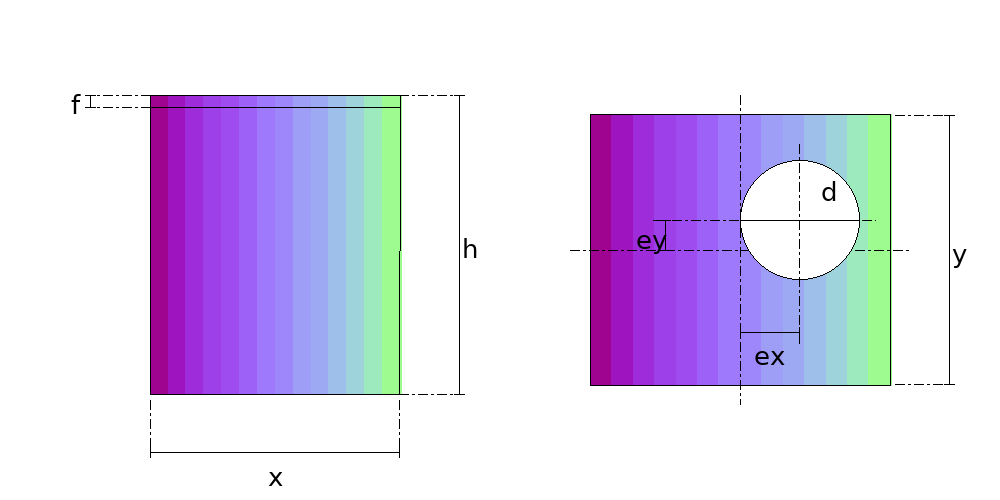
- X Length of the box (outside)
- Y Width of the box (outside)
- H Height of the sides
- F Cap flange (0 = flat cap)
- D Takeoff hole diameter (0 = no hole)
- EX Hole offset along X
- EY Hole offset along Y
- THK Plate thickness
- R Bend radius
Calculate with your own measurements
No account needed: enter the measurements in millimetres or inches and get the figures and the drawing. The scaled PDF template, the DXF for the cutting table and the 3D model take a free account.
Diameters and sides are outside measurements. The flat pattern already allows for the plate thickness, working on the mean line.
Inches or millimetres? mm inches
How it develops: the formulas
- The sides, as one strip
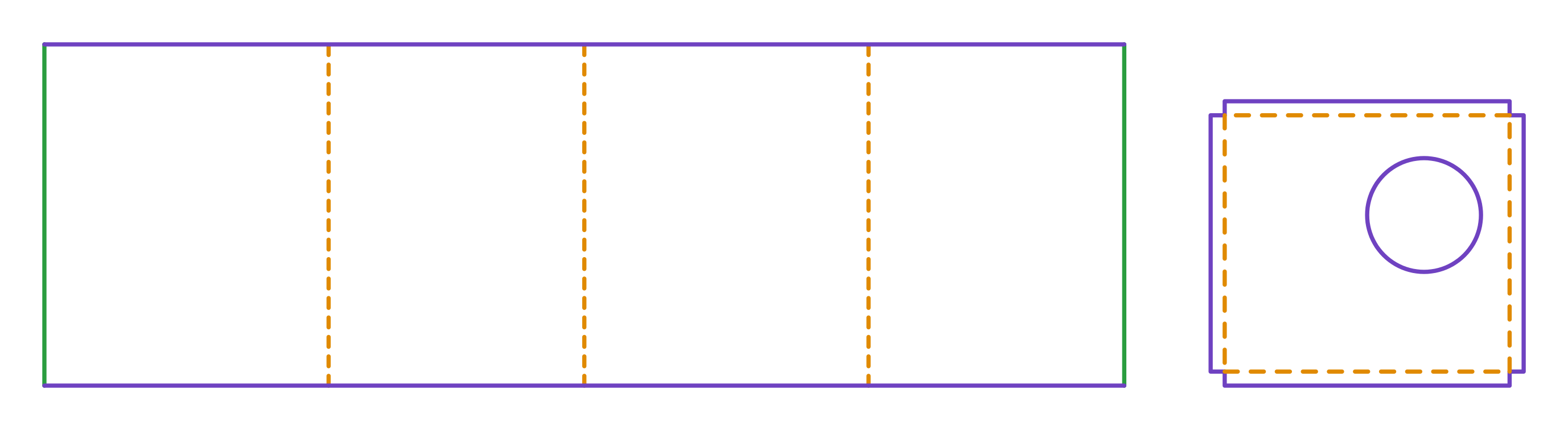
P = 2 × (X + Y) − 4t ; height = HOn the mean line each side loses one thickness: 2 × (500 + 450) − 4 × 0.65 = 1897.4 mm by 600 in the example. The folds sit at X − t, X + Y − 2t and 2X + Y − 3t from the seam.- The face of the cap, between the folds
(X + t) × (Y + t)The cap slips over the box: its opening is the outside of the sides, and the mean line of the face sits half a thickness beyond each side. In the example, 500.65 by 450.65 mm; outside, the cap measures 501.3 by 451.3.- The developed flange
a = F − t/2F measured outside, from the top of the cap to its edge; the sharp corner sits on the mean line. In the example, 25 − 0.325 = 24.7 mm. The corners come out relieved by an a by a square.- The takeoff hole
centre = centre of the face + (EX, EY) ; Ø = DThe centre of the face is where the diagonals between the folds cross. For a tabbed starting collar, D is the collar's outside diameter: 200 mm in the example.
Worked example
The values the form comes pre-filled with, run through the tool itself:
| Length of the box (outside) | 500 mm |
|---|---|
| Width of the box (outside) | 450 mm |
| Height of the sides | 600 mm |
| Cap flange (0 = flat cap) | 25 mm |
| Takeoff hole diameter (0 = no hole) | 200 mm |
| Hole offset along X | 100 mm |
| Hole offset along Y | 50 mm |
| Plate thickness | 0.65 mm |
| Bend radius | 0 mm |
| The flat pattern fits a plate of | 1897 × 600 mm |
| Flat patterns produced | 2 |
Result of the example
| Plate 1 | 1897 × 600 mm |
|---|---|
| Area and weight | 1.14 m² · ≈ 5.8 kg in 0.65 mm steel |
| Plate 2 | 550 × 500 mm |
| Area and weight | 0.24 m² · ≈ 1.2 kg in 0.65 mm steel |
| Arc radii | 100 mm |
| Sector angle | 360° |
Assembly notes
The pattern develops the SHARP CORNER, on the mean line — the theoretical layout, which is what gets delivered. If you fold it on a press brake with an inside radius, the blank comes out LONG: each fold needs, against this pattern, the deduction 2*(r+t/2)*tan(a/2) − a*(r + k*t), with r the inside radius, a the bend angle in radians, and your tooling's k. On a 500x300 tube in 1.5 mm sheet with four 90° folds that is 3.6 mm at radius 0.75 and 9.3 mm at radius 4.5 — always to be taken off. A welded or V-notched corner closes on the sharp corner and needs no deduction.
Fold to an angle of 90° BETWEEN THE TWO FACES — what a protractor reads on the finished part, not the press stroke angle. Every crease on this part has the same angle.
The cap slips over the box: its opening is the outside of the sides, 500 by 450 mm, and outside it measures 501.3 by 451.3. The corners come out relieved square; fold the four flanges to 90° and fix them to the sides with screws or rivets.
The takeoff hole, Ø200 mm, sits off centre: find the centre of the face by crossing the diagonals between the folds, and the centre of the hole is 100 mm from it along X and 50 mm along Y. For a tabbed starting collar, the hole is the collar's outside diameter.
How to mark it out on the plate
- Enter the outside size of the box, X by Y, the height of the sides, the cap flange, the diameter and offset of the takeoff hole, and the sheet thickness.
- Cut the strip for the sides and fold the three folds to 90°, with the seam at the fourth corner.
- Cut the cap, with the relieved corners and the hole, and fold the four flanges to 90°.
- Close the seam of the sides and slip the cap on top, flanges outside; fix it with screws or rivets and seal.
- Fit the collar in the hole in the cap: one tab outside, the next inside.
Common mistakes and tolerances
- Making the cap the size of the box
- With flanges the cap slips over the box and needs one thickness more on each side: its opening is the outside of the sides. Made to the box size it will not go on.
- Cutting the hole to the duct size instead of the collar
- The hole is the outside of the collar that goes in it, which passes through the sheet. Smaller, the inside tabs will not go through; bigger, it leaves a gap where the air leaks.
- Running the hole into a wall
- The hole has to fit inside the box, one thickness in from each side, or the collar hits the wall. The page refuses a hole that touches it.
Guides about this part
Frequently asked questions
- Why does the cap come out bigger than the box?
- Because it slips over the box: the cap's opening is the outside of the sides, X by Y, so outside it measures X + 2t by Y + 2t. On the sheet the face goes on the mean line, X + t by Y + t, between the folds: 500.65 by 450.65 mm in the example.
- How is the cap folded?
- The four corners come out relieved square, the size of the flange, so each flange folds to 90° without riding on the next. The flange is measured outside, from the top of the cap to its edge, and develops F − t/2 from the fold: 24.7 mm for the 25 mm flange of the example. With a zero flange the cap is a flat plate the size of the box, sitting on the edge of the sides.
- Where does the takeoff hole go?
- In the centre of the face, or EX and EY off it. On the sheet, find the centre by crossing the diagonals between the folds and mark the offset with a square; the assembly note says how much. The hole has to fit inside the box, one thickness in from each side, and the page refuses a hole that runs into a wall.
- What size of hole?
- The outside diameter of the collar that goes in it. A tabbed [Starting Collar (Round Takeoff)](/en/pecas/colarinho-de-tomada) goes through the sheet, one tab outside and the next inside, so the hole is its outside diameter: 200 mm for a 200 mm collar.
- And the sides?
- As one strip: the perimeter on the mean line, 2 × (X + Y) − 4t, by the height, with three folds and the seam at the fourth corner, 1897.4 by 600 mm in the example. It is the strip of the [Rectangular Transition](/en/pecas/reducao-retangular) with both ends equal; cut on the middle fold it makes two L's, for a box with two seams.
- Are seam allowances added?
- No: the plenum pattern is net. A Pittsburgh, a snap lock, S and drive or the connection to the unit go on top, from your roll former's chart.
You can work out the figures right here, with no account. PDF, DXF, 3D and history take an account — free, with unlimited calculations.