Dome template generator: printable gores for a dome or a hemisphere in paper, EVA foam or sheet metal
Updated on 03 November 2026
A dome cannot be cut from one flat sheet: a sphere does not unroll. It is built from gores, the long pointed panels of a globe or a beach ball, each one running from the top to the base. This page draws the gore for any dome, from a shallow cap to a full hemisphere, in any number of gores, and prints it at full size on A4 or Letter: for a paper or cardboard model, an EVA foam helmet or armour piece, a lamp shade, or a sheet metal dome.
It is the same layout as the spherical head in gores, which adds the crown plate, the plate thickness on both faces and the DXF for the cutting table. Everything here runs in your browser: nothing to install and no account.
Dome template generator
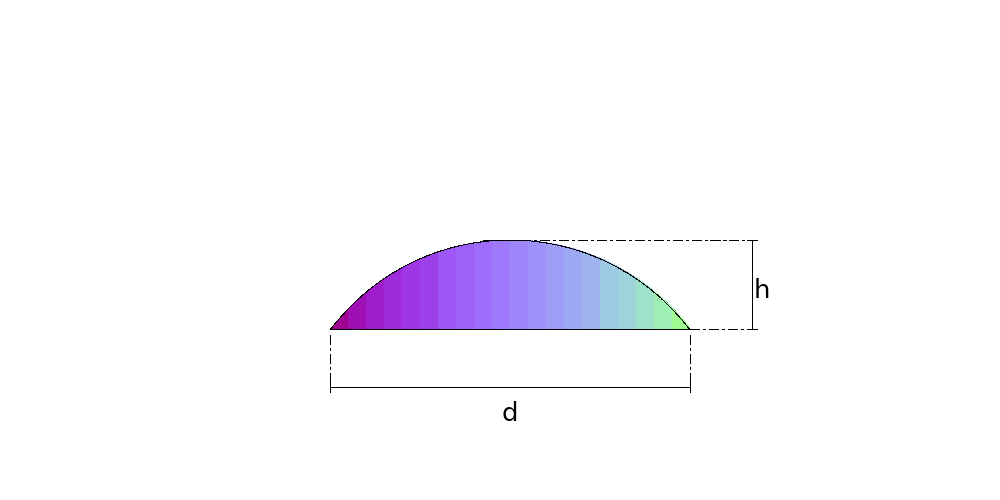
Type the diameter of the dome at its base and its height: half the diameter for a hemisphere, less for a shallower dome. Pick the number of gores and, for foam or sheet, the thickness. Print gives one gore at 1:1; cut as many as there are gores.
| Sphere radius | – |
|---|---|
| Gore length, tip to base | – |
| Widest point of the gore | – |
| Gore width at the base | – |
| Edge length | – |
| Station | From the tip, along the centre line | Out from the centre line |
|---|
One gore: cut it as many times as the number of gores. The dashed line is the centre line and the grey arcs are the stations; the table gives each station as a point of the edge, measured from the tip down the centre line and then square out from it. The edge comes out a little longer than the centre line, as the note says: the gores close by easing the edges as they are glued or welded. With a thickness, the gore is worked on the middle of the material and the diameter and height are the outside ones. Nothing is sent anywhere: the template is drawn and printed by your browser.
How to use the template
- Print at actual size, 100 %, with no fit-to-page, and measure the check bar on the sheet: it must read 100 mm or 4 in. Glue the sheets on the repeated strip when the gore took more than one.
- Cut out the gore and trace it as many times as there are gores. Mark the centre line on each: it is the true length from the top to the base.
- Join the gores edge to edge, from the base up: glue for paper and foam, tape or tabs for card, tack welds for sheet. The tips meet at the top.
- The edges come out slightly longer than the centre line (3.84 % with 8 gores on a hemisphere, 1.71 % with 12): ease them as you go, and the dome closes. More gores give a rounder dome and less to ease.
- For a whole ball, make two hemispheres and join them at the equator.
The formula
Take D as the diameter of the dome at the base and h as its height. The sphere radius, and the angle from the top to the base, are
- Sphere radius and angle
R = (D²/4 + h²) / (2h) ; θ0 = arccos((R − h) / R)For a hemisphere h = D/2, R = D/2 and θ0 = 90°. With a thickness t, the gore is worked on the middle of the material: R − t/2.
- The gore at each station
length along the centre line = R × θ ; half width = π × R × sin θ / nθ runs from 0 at the top to θ0 at the base, and n is the number of gores. The half width is measured along the station, which is an arc of radius R × tan θ centred on the centre line, on the side of the tip: the parallel of the sphere unrolled on the cone that touches it there.
That is the layout the boilermaking books give for a spherical head, and it puts the base of each gore on the base circle of the dome. The area comes out a little over the sphere's and the edges a little longer than the centre line; the material takes it up as it is joined.
Worked example
A 600 mm hemisphere (D = 600, h = 300) in paper, in 8 gores:
- R = (600²/4 + 300²) / 600 = 300 mm, and θ0 = 90°.
- The gore is π × 300 / 2 = 471.2 mm long, from the tip to the base.
- At the base it is 2 × π × 300 / 8 = 235.6 mm wide, and the edge is 489.3 mm long, 3.84 % over the centre line.
| Station | From the tip, along the centre line | Out from the centre line |
|---|---|---|
| 0 | 0 mm | 0 mm |
| 2 | 109.7 mm | 44.1 mm |
| 4 | 224.1 mm | 82.2 mm |
| 6 | 345.3 mm | 108.4 mm |
| 8 | 471.2 mm | 117.8 mm |
How many gores
More gores make a rounder dome, narrower panels and less to ease at the edges. For a 600 mm hemisphere:
| Gores | Gore length | Width at the base | Edge over the centre line |
|---|---|---|---|
| 8 | 471.2 mm | 235.6 mm | 3.84 % |
| 12 | 471.2 mm | 157.1 mm | 1.71 % |
A shallow dome eases less: a 1000 mm dome 250 mm high in 1 mm sheet, in 12 gores, has gores 579.1 mm long and 260.5 mm wide at the base, with the edge 0.82 % over the centre line.
For EVA foam, measure the dome on the outside and type the foam thickness: a 400 mm hemisphere in 10 mm foam, in 6 gores, works on a 195 mm radius, with gores 306.3 mm long and 204.2 mm wide.
Frequently asked questions
- How do you make a dome template?
- Work out one gore: its length along the centre line is the sphere's arc from the top to the base, and its width at each height is the circle at that height divided by the number of gores. The generator above does it from the diameter and the height, and prints the gore at full size.
- How many gores does a hemisphere need?
- Six is the fewest that look round; 8 to 12 is usual. On a 600 mm hemisphere, 8 gores are 235.6 mm wide at the base and 12 gores 157.1 mm, with the edges 3.84 % and 1.71 % longer than the centre line.
- How do I make a dome out of EVA foam?
- Type the outside diameter and height of the dome and the foam thickness, print the gore, cut it as many times as there are gores and glue the edges with contact cement, from the base up. Heat the foam lightly so the gores take the curve.
- Can I make a full ball?
- Make two hemispheres with the same diameter and gores and join them at the equator: each gore of one meets a gore of the other.
- Does the template work for sheet metal?
- Yes: type the plate thickness and the gore is worked on the middle of the plate. For a head on a tank, with a crown plate and the DXF, use the spherical head in gores.
Parts in this guide
Other guides
- How to develop a cone (frustum) in sheet metal: formula, sector radii and angle, step by step
- Lobster back bend calculator (segmented 90° elbow): gore angles, cut heights and how many plates
- Pipe saddle calculator and development: how to lay out a pipe-to-pipe branch (tee) at 90 and 45 degrees
- Square to round transition: development by triangulation, step by step
- Bend allowance and K-factor calculator, and the neutral axis: why every development uses D − t
- Sheet metal glossary: the terms of marking out and pattern development in plate fabrication
- How we check the Planichapa calculations, and who is behind them
- Plate 'n' Sheet alternative: Planichapa develops sheet metal parts in the browser, with the price on the page
- How to lay out a mitre-cut pipe: paper template, sine wave and ordinate table
- LITIO alternative: Planichapa develops sheet metal parts in the browser, nothing to install, now that LITIO2 is no longer sold
- Pipe ovality: a calculator, the formula, a worked example, the limits the codes use and how to measure it in the shop
- Steel plate weight calculator, weight per m², gauges and stock plate sizes: table and formula
- Sheet metal pattern development software: how to choose, and what changes between a desktop program, a phone app and an online calculator
- Eccentric and concentric reducers: which one to use and how each one develops on plate
- Roller chain size chart: ANSI, ISO 606, motorcycle and bicycle chain pitch and roller diameter
- Sprocket dimensions: pitch diameter, outside and root diameter, tooth form and a pitch diameter chart
- Bolt circle layout: the position of each hole, the chord between holes and a chord chart
- Chain length and sprocket ratio: the formulas, a worked example and how many links to cut
- Screw flight calculator: the flat blank of a screw conveyor flight (auger), with the formula and a worked example
- Plate rolling calculator: the blank length of a rolled shell, with the formula, a chart and a worked example
- Tube notching template generator: a printable coping template for any tube, angle and offset
- Dished head calculator: depth, volume, blank diameter and weight of torispherical, 2:1 elliptical and hemispherical heads
- Cone template generator: a printable full-size cone template for hoppers, funnels and reducers
- Pie cut calculator for exhaust and tube bends: saw angle, pie lengths and a wrap-around template
- Duct transition layout: square to round duct, centred, offset or flat on one side
- Pipe template, printable at full size: tee saddle, 45° lateral and mitre cut for every pipe size from NPS 1/2 to 12
- Register boot layout: from a floor, wall or ceiling register to a round duct, in inches
- Plenum box and plenum transition layout: the sides, the end cap, the collar and the transitions
- Smoker stack and firebox templates: the cuts where pipe meets the cook chamber, in inches
- Laser and plasma cutting cost calculator: the formula, a worked example and how to measure the cut length
- Tank volume calculator and strapping chart: horizontal and vertical tanks with 2:1, torispherical, hemispherical or flat heads
- Merge collector template generator: a printable cutting template for 2, 3, 4, 6 or 8 into 1
- DIY cyclone dust collector plans: every sheet of the cyclone from the Stairmand proportions, for any duct size