Dished Head in Petals (Torispherical and 2:1) flat pattern
What it is
A dished head in petals is a vessel or tank head too big for the press, built from plate: a crown plate and petals running down from it through the crown, the knuckle and the straight flange, each one formed and welded to the next. The page gives the four standard profiles -- the DIN 28011 Klöpper, the DIN 28013 Korbbogen, the ASME F&D and the 2:1 semi-ellipsoidal -- from the shell outside diameter, and draws the petal with the textbook layout for a surface of revolution, along with the crown plate.
Where it is used
Storage tank, silo and digester heads, pressure vessel heads larger than a press can dish, reactor and process tank bottoms, and custom replacement heads.
Measurements the calculation needs
- TT Head type
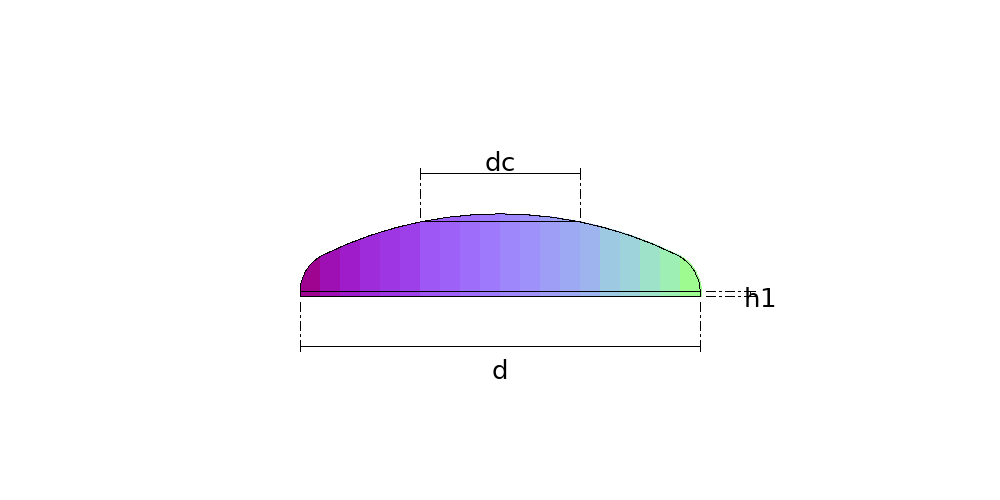
- D Shell outside diameter (Da)
- H1 Straight flange
- S Number of petals
- DC Crown plate diameter (0 = none)
- DV Divisions
- THK Thickness
Calculate with your own measurements
No account needed: enter the measurements in millimetres or inches and get the figures and the drawing. The scaled PDF template, the DXF for the cutting table and the 3D model take a free account.
Diameters and sides are outside measurements. The flat pattern already allows for the plate thickness, working on the mean line.
Inches or millimetres? mm inches
How it develops: the formulas
- The inside radii, by the standard
Klöpper: R = Da, r = 0.1 Da ; Korbbogen: R = 0.8 Da, r = 0.154 Da ; F&D: R = Da, r = 0.06 Da ≥ 3tIn the example, the Da 4000 Klöpper: a 4000 crown and a 400 mm knuckle. The 2:1 is the ellipse with semi-axes a and a/2, a being the inside radius of the shell.- Where the crown meets the knuckle
sin θ1 = (a − r) / (R − r)a is the shell inside radius, Da/2 − t. In the example, (1988 − 400) / (4000 − 400) gives θ1 = 26.17°.- The petal station
arc radius = ρ / cos θ ; half-width = π ρ / s, along the arcρ is the radius of the mid-surface parallel and s the number of petals. At the tangency in the example, ρ = 1767.1 mm and the arc radius is 1969.0 mm; on the straight flange θ = 90° and the station is straight.- The petal meridian and the crown plate
S = ∫ ds, from the crown plate edge to the foot of the knuckle, plus the straight flangeIn the example, 2282.4 − 804.2 + 42 = 1520.2 mm; the crown plate disc is Ø 2 × 804.2 = 1608.4 mm.
Worked example
The values the form comes pre-filled with, run through the tool itself:
| Head type | Klöpper (DIN 28011) |
|---|---|
| Shell outside diameter (Da) | 4000 mm |
| Straight flange | 42 mm |
| Number of petals | 16 |
| Crown plate diameter (0 = none) | 1600 mm |
| Divisions | 24 |
| Thickness | 12 mm |
| The flat pattern fits a plate of | 1608 × 1608 mm |
| Flat patterns produced | 2 |
Result of the example
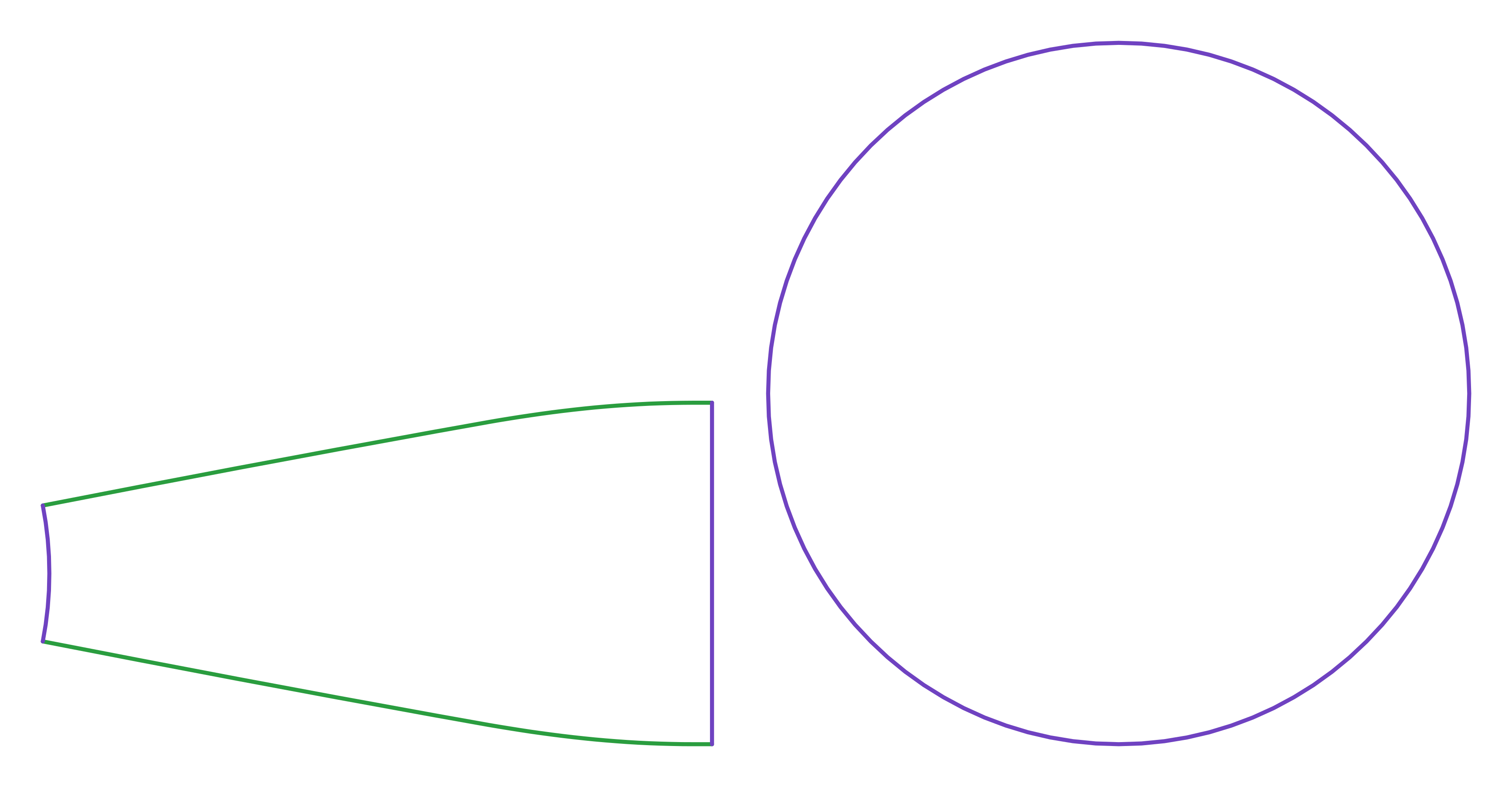
| Plate 1 | 1535 × 783 mm, cut 16 times |
|---|---|
| Area and weight | 0.90 m² · ≈ 84.9 kg in 12 mm steel |
| Arc radii | 815.2 mm |
| Sector angle | 22° |
| Plate 2 | 1608 × 1608 mm |
| Area and weight | 2.03 m² · ≈ 191.4 kg in 12 mm steel |
| Arc radii | 804.2 mm |
| Sector angle | 360° |
Assembly notes
The profile is the standard's, by the inside radii: a 4,000 mm crown and a 400 mm knuckle, and an inside depth of 769.2 mm to the foot of the knuckle, where the straight flange starts.
The head is NOT developable: no flat plate turns into a crown and a knuckle without stretching. This template is the textbook layout for a surface of revolution — true length along the meridian, each station on the developed parallel of the tangent cone, with the half-width measured along the arc — and each petal has to be formed, on a press or a flanging machine. The seam comes out 2.4% longer than the meridian, and the AREA is 1% over, which forming takes up. More petals, less excess.
The CROWN PLATE is sheet 2: a disc Ø1,608.4 mm, the true length of its meridian from edge to edge, formed afterwards to the crown curvature, like the petals. The AREA is 0.3% over and forming takes it up. The petals butt against its edge.
How to mark it out on the plate
- Pick the head type and enter the shell outside diameter, the straight flange, the number of petals, the crown plate diameter and the plate thickness.
- Cut the crown plate and the s petals; the note gives the seam and area excess.
- Form the crown plate to the crown curvature, and each petal through the crown and the knuckle, station by station.
- Fit the petals round the crown plate, seam to seam, and weld; the straight flange meets the shell.
Common mistakes and tolerances
- Too few petals
- The knuckle is the most curved part of the head, and a wide petal stretches too much there: on the 4 m Klöpper, eight petals give a seam 9.6% longer than the meridian, sixteen 2.4%.
- Entering the inside diameter
- The standards give the radii from the shell outside diameter. With the inside one, the crown and the knuckle come out smaller and the head does not fit the shell.
- Leaving out the straight flange
- The straight flange moves the weld to the shell away from the knuckle, where the stress is highest: 3.5 thicknesses on a Klöpper, 3 on a Korbbogen.
Guides about this part
Frequently asked questions
- How do you lay out a torispherical head petal?
- Along the meridian: the centre line of the petal has its true length, from the crown plate to the straight flange, and each station is the developed parallel of the tangent cone, radius ρ / cos θ, with the half-width π ρ / s measured along the arc. On the crown the arc is the sphere's; on the knuckle it opens up; on the straight flange it becomes straight. On the 4 m Klöpper of the example, the petal has a 1520.2 mm meridian and is 783 mm wide at the flange.
- How many petals should I use?
- As many as the knuckle needs. It is the most curved part of the head, and a wide petal stretches too much there: on the 4 m Klöpper, with 8 petals the seam would come out 9.6% longer than the meridian; with 16, 2.4%; with 24, 1.1%. The note gives the excess for each size, and the stock plate size usually settles the rest.
- What is the crown plate for?
- So the petals do not end in points at the pole. The disc is the true length of the crown cap's meridian, edge to edge, formed to the crown curvature: in the example, a Ø1608.4 mm disc with 0.34% excess area. Without it, the petals meet at a single point.
- Which diameter do I enter?
- The shell outside diameter, Da, which is what the standards use: the inside crown and knuckle radii come from it. On a Klöpper, crown Da and knuckle 0.1 Da; in the 4000 mm example, 4000 and 400 mm.
- How deep is the head?
- The inside depth, to the foot of the knuckle, is R − √((R − r)² − (a − r)²), with a the inside radius of the shell: 769.2 mm on the 4000 Klöpper in 12 mm plate, close to the 768.5 of the DIN 28011 approximation, 0.1935 Da − 0.455 t. The straight flange adds to that.
You can work out the figures right here, with no account. PDF, DXF, 3D and history take an account — free, with unlimited calculations.