Sphere Gore (Dished Head Petal) flat pattern
What it is
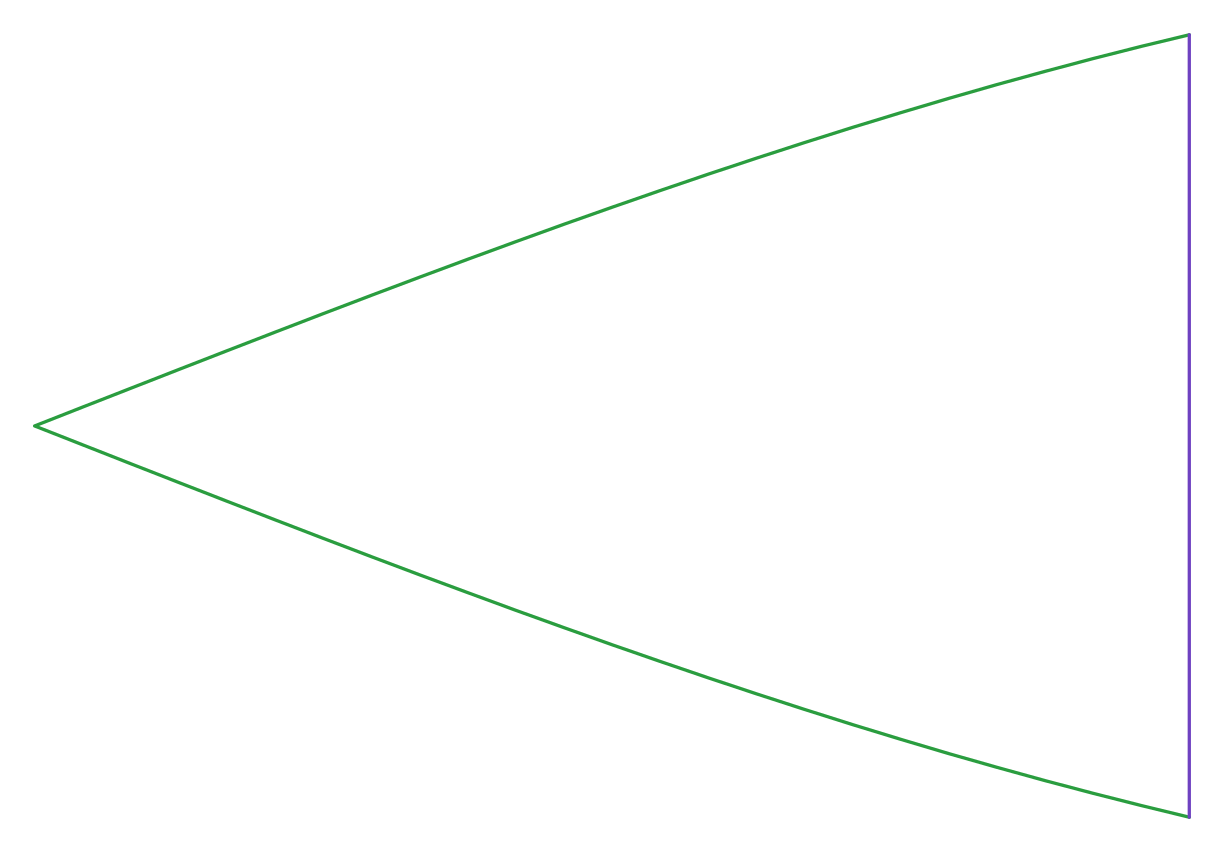
One gore of a spherical head, and as many as the head takes. It is NOT an exact development, and the calculation says so: a sphere is not developable, no flat sheet becomes a cap without stretching. What comes out here is the layout from the plate-work books — true length along the meridian, and each station on the arc of its developed parallel, with the half-width measured along the arc — and the gore is formed afterwards, in a press or hot.
Where it is used
Tank and silo heads, vessel caps, reservoir domes, spherical equipment bottoms.
Measurements the calculation needs
- D Diameter of the opening
- H Rise (height of the head)
- S Number of gores
- DV Divisions
- THK Plate thickness
Calculate with your own measurements
No account needed: enter the measurements in millimetres or inches and get the figures and the drawing. The scaled PDF template, the DXF for the cutting table and the 3D model take a free account.
Diameters and sides are outside measurements. The flat pattern already allows for the plate thickness, working on the mean line.
Units: mm inches
How it develops: the formulas
- Sphere radius
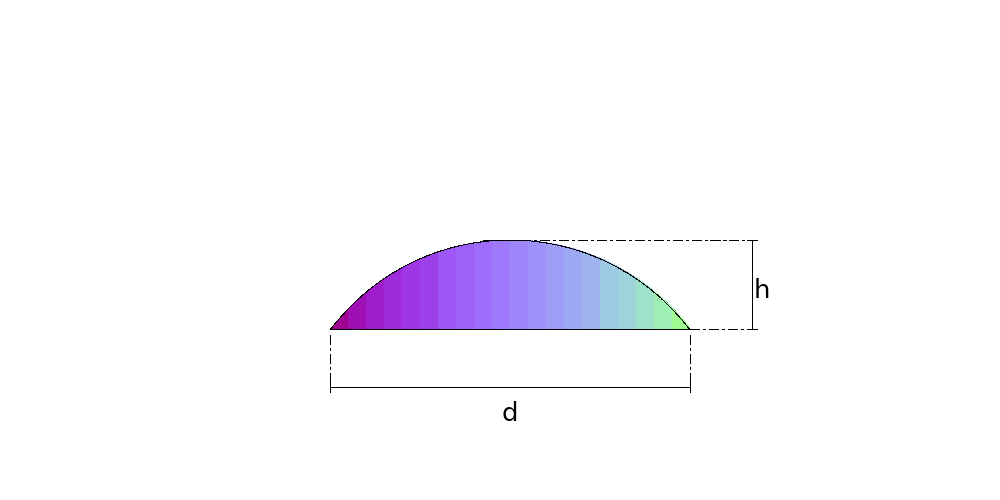
R = (D²/4 + h²) / (2 × h)D is the mouth diameter and h the rise. For D = 2000 and h = 500: R = 1250 mm.- Meridian angle and length
φ0 = arcsin( D / (2R) ) ; meridian = R × φ0φ0 = 53.13° = 0.927 rad. On the outside face the meridian measures 1250 × 0.927 = 1159 mm; the template measures it on the mean surface, 1245 × 0.927 = 1154.5 mm, and that is the length of the gore in the example.- Half width of the gore at each station, measured along the arc
w(φ) = π × R × sin φ / ss is the number of gores, φ the angle from the pole and R the radius on the mean surface, R − t/2. At the mouth, for 8 gores in 10 mm plate: w = π × 1245 × 0.8 / 8 = 391.1 mm of half width, measured along the mouth arc.- Arc of each station
ρ(φ) = R × tan φ ; sweep = π × cos φ / sEach station is struck with radius ρ from a centre on the middle line of the gore, on the pole side: the apex of the cone tangent to the sphere at that station. The half width w takes up the sweep on that arc. At the mouth in the example: ρ = 1245 × tan 53.13° = 1660 mm and a sweep of 13.5° each side, 27° over the whole arc, giving a 775.0 mm chord and a 45.9 mm rise.
Worked example
The values the form comes pre-filled with, run through the tool itself:
| Diameter of the opening | 2000 mm |
|---|---|
| Rise (height of the head) | 500 mm |
| Number of gores | 8 |
| Divisions | 24 |
| Plate thickness | 10 mm |
| The flat pattern fits a plate of | 1154 × 775 mm |
Result of the example
| Plate | 1154 × 775 mm, cut 8 times |
|---|---|
| Area and weight | 0.49 m² · ≈ 38.6 kg in 10 mm steel |
| Arc radii | 1,660 mm |
| Sector angle | 27° |
Assembly notes
A sphere is NOT developable: no flat sheet becomes a cap without stretching. This pattern is the boilermaker's layout from the plate-work books — true length along the meridian, and each station on the arc of its developed parallel, with the half-width measured along the arc — and the gore has to be formed, in a press or hot. The seam comes out close to the meridian's length and the mouth corner square; the AREA is 0.9% over at these dimensions, and that surplus is what forming absorbs. More gores, less surplus.
Weld the sheets with the longitudinal seams 180° apart, not lined up. Lined up, the piece assembles into a different shape — and the longitudinal seam crosses the circumferential one.
Guides about this part
- Steel plate weight calculator, weight per m², gauges and stock plate sizes: table and formula
- Dished head calculator: depth, volume, blank diameter and weight of torispherical, 2:1 elliptical and hemispherical heads
Frequently asked questions
- If a sphere is not developable, what does this pattern guarantee?
- The true length of the meridian, down the middle of the gore, and the mouth: each station is the arc of its parallel developed on the cone tangent to the sphere at that height, with the half-width measured along the arc, so the mouths of the gores add up to the full round and the mouth corner comes out square. The seams stay close to the meridian — 1.85% longer in the example, against 5.7% with straight stations. The AREA does not close exactly: it is 0.9% over in the example, and the assembly note gives the figure for each size. That is what forming absorbs.
- How many gores?
- The more the better — in the example, with 6 gores the seam runs 3.3% past the meridian and the area is 1.6% over; with 8, 1.85% and 0.9%; with 12, 0.8% and 0.4%. Eight to twelve is usual. Below three the flat sheet would have to stretch a large fraction of its own length, and the calculation refuses.
- Can the rise exceed half the diameter?
- No. At half the diameter the head is a hemisphere, and past that the mouth stops being the widest parallel: the gore starts to belly, and a layout by meridian and parallel no longer describes the part.
- And the sphere's radius, where does that come from?
- From the mouth and the rise, which is what you have in hand. It is (d²/4 + h²) over 2h. The calculation does the arithmetic; you give the two dimensions of the head.
You can work out the figures right here, with no account. PDF, DXF, 3D and history take an account — free, with unlimited calculations.