Angle ring calculator: cut length for leg-out and leg-in rings
1:1 template and DXF
What it is
An angle ring is a full circle of angle iron rolled in a section bender: the duct and stack flange, the stiffening ring of a pipe, silo or tank, the hoop of a table or a light fitting. The cut length runs along the centreline, which in an angle passes through the centroid, closer to the heel than to the middle of the leg, and it changes with the leg out or in. The page gives the bar length from the inside, outside or centreline diameter, the three diameters, the circumference to check with a tape and how many rings a bar makes, and draws the ring full size. It also does rings of square tube and flat bar.
Where it is used
Angle flanges for ducts, fans and stacks, stiffening rings for pipes, silos and tanks, hoops for tables, light fittings and gates, round machine and water-tank bases, and drum and kiln bands.
Measurements the calculation needs
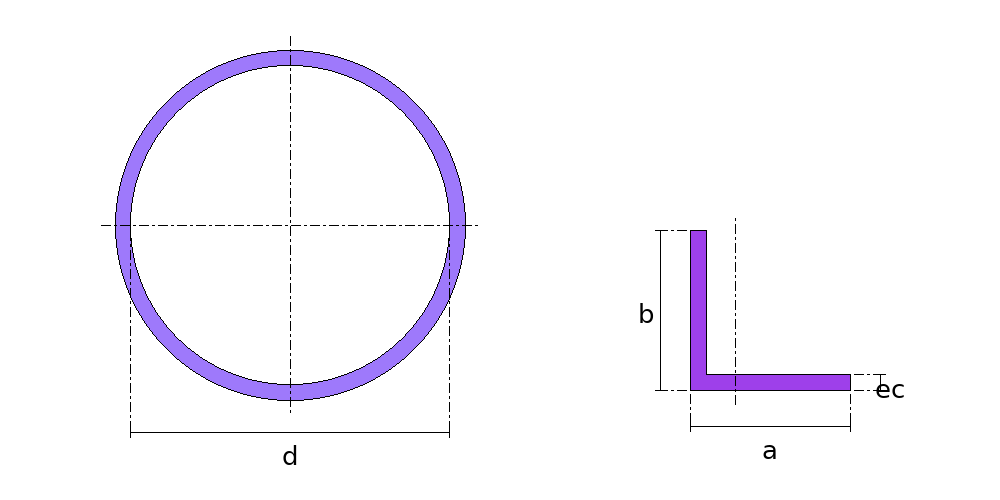
- PA Section
- A Flat leg, in the plane of the ring (tube: the depth in the plane)
- B Upright leg (tube: the other side)
- EC Angle thickness
- D Ring diameter
- RD Diameter measured
- PT Straight end on each side (0 = none)
- LB Bar length (0 = no count)
Calculate with your own measurements
No account needed: enter the measurements in millimetres or inches and get the figures and the drawing. The scaled PDF template, the DXF for the cutting table and the 3D model take a free account.
Diameters and sides are outside measurements. The flat pattern already allows for the plate thickness, working on the mean line.
Inches or millimetres? mm inches
Made this part? Send a photo: once approved, it appears here with your shop's name, and your account gets 30 days of full access. Send the photo
How it develops: the formulas
- The angle's centroid
x̄ = (b e + a² − e²) / (2 (a + b − e))From the heel, along the flat leg a, with b the upright leg and e the thickness. In the example, 14.3 mm.- The centreline diameter
Dn = D + 2 x̄ (leg out, inside); Dn = D − 2 x̄ (leg in, outside)In tube and bar, x̄ is half the depth in the plane of the ring. In the example, 1000 + 2 × 14.3 = 1028.7 mm.- Bar length
L = π × Dn + 2 × straight endIn the example, π × 1028.7 = 3231.7 mm.
Worked example
The values the form comes pre-filled with, run through the tool itself:
| Section | Angle, leg out |
|---|---|
| Flat leg, in the plane of the ring (tube: the depth in the plane) | 50 mm |
| Upright leg (tube: the other side) | 50 mm |
| Angle thickness | 5 mm |
| Ring diameter | 1000 mm |
| Diameter measured | Inside (ID) |
| Straight end on each side (0 = none) | 0 mm |
| Bar length (0 = no count) | 6000 mm |
| The flat pattern fits a plate of | 1100 × 1100 mm |
Result of the example
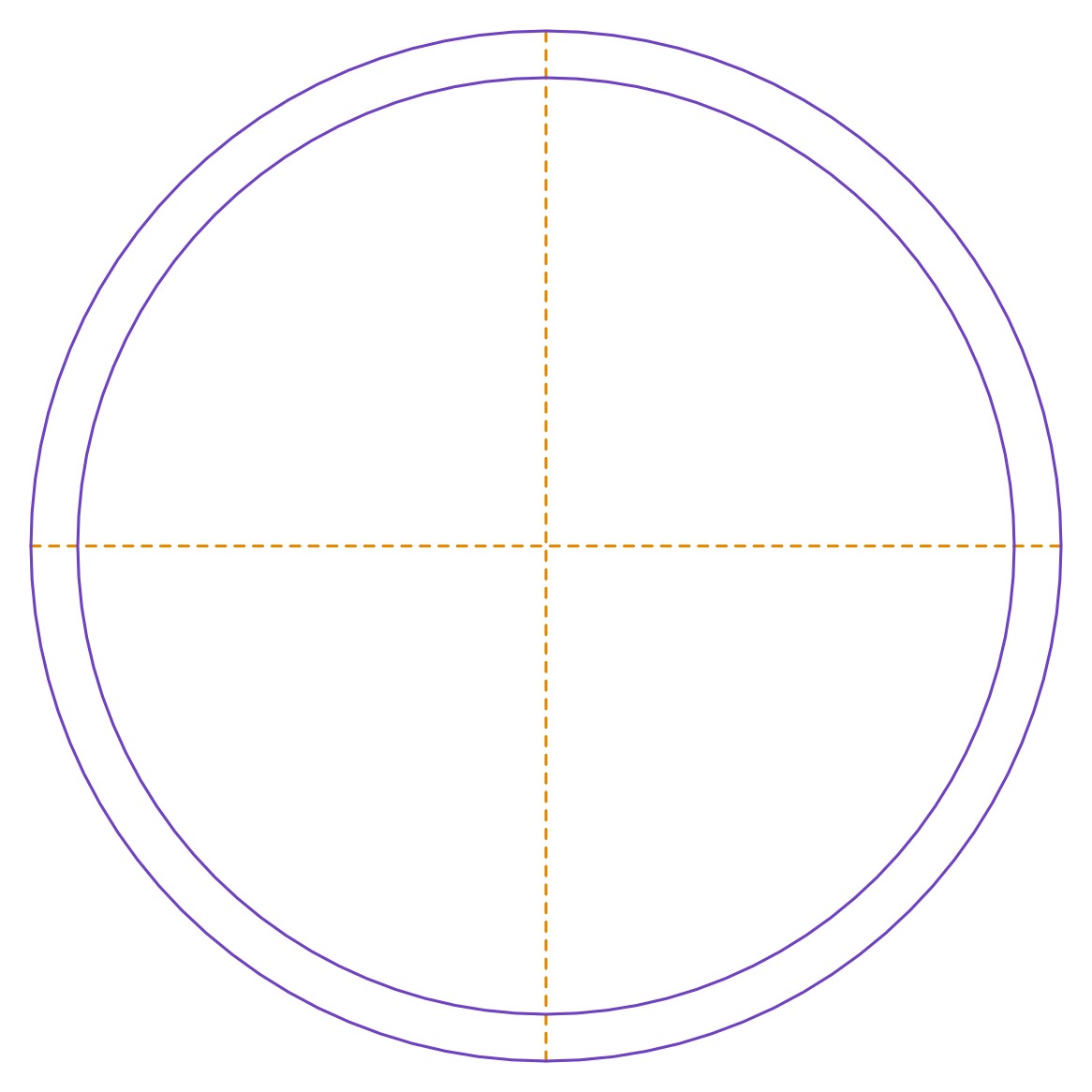
| Plate | 1100 × 1100 mm |
|---|---|
| Arc radii | 500 mm · 550 mm |
| Sector angle | 360° |
Assembly notes
Ring diameter: 1,100 mm outside, 1,028.7 mm on the centreline and 1,000 mm inside.
50 × 50 × 5 mm angle, leg out: the heel is on the inside, and the centroid sits 14.3 mm from it, along the flat leg. The centreline runs through it: it neither stretches nor shrinks in the rolls, and the bar is cut to its length.
Cut the bar to 3,231.7 mm: the circumference on the centreline, π × 1,028.7 mm.
To check the finished ring, wrap a tape around it: the outside circumference is 3,455.8 mm. Then measure the outside diameter across, 1,100 mm both ways: the difference between the two readings is the out-of-round.
A 6,000 mm bar makes one ring, with 2,768.3 mm left over.
A three-roll bender cannot bend the ends: a straight length is left at each end, about half the distance between the bottom rolls, and the ring closes with a peak. Enter that allowance as Straight end to cut it off after rolling, or pre-bend the ends in a press first.
How to mark it out on the plate
- Choose the section: angle with the leg out or in, or tube and bar.
- Enter the legs, the flat one in the plane of the ring and the upright one, and the thickness.
- Enter the diameter and the face it refers to: inside, outside or centreline.
- Cut the bar to the length worked out, roll it and cut off any straight ends the rolls left.
- Check the outside circumference with a tape and the diameter both ways, then weld the joint.
Common mistakes and tolerances
- Cutting to the middle of the leg
- In an angle the centreline runs through the centroid, close to the heel. Cut to the middle of the leg, the example's bar would be 67 mm too long.
- Mixing up leg out and leg in
- Leg out puts the heel on the inside of the ring; leg in, on the outside. The same angle at the same diameter takes a different bar.
- Measuring the wrong face
- A duct flange is ordered by its inside diameter, the duct's. Ordered by the outside, it comes out two legs smaller and does not fit.
- Forgetting the straight ends
- The rolls cannot bend the ends, and the ring closes with a peak. Enter the allowance as Straight end, or pre-bend the ends.
Frequently asked questions
- How do you calculate the length of angle iron for a ring?
- From the circumference of the centreline, which in an angle runs through the centroid: L = π × Dn. Leg out, with the inside diameter D, Dn = D + 2x̄; leg in, with the outside diameter, Dn = D − 2x̄, where x̄ is the distance from the heel to the centroid. An L2×2×1/4 leg out with a 40" ID has x̄ = 0.592" and takes π × 41.184 = 129.38" of bar; in the page example, a 50 × 5 angle for a 1000 mm duct takes 3231.7 mm.
- Where is the centroid of an angle?
- At x̄ = (b e + a² − e²) / (2 (a + b − e)) from the heel, along the flat leg a, with b the upright leg and e the thickness. It is the x̄ of the steel tables: 0.592" for an L2×2×1/4, and 0.736" or 1.24" for an L4×3×1/4, depending on which leg lies flat.
- Leg out or leg in?
- Leg out is the duct and stack flange: the upright leg wraps the pipe and the flat leg points out, where the bolts go. Leg in is the ring that fits inside a pipe or tank. The sums differ: leg out, the heel is on the inside and the centreline x̄ outward of it; leg in, x̄ inward. The 50 × 5 angle at 1000 mm outside, leg in, takes 3051.5 mm. Leg in is the harder roll: the thin toe of the flat leg is on the side that shrinks, and it buckles easily.
- Why not cut to the middle of the leg?
- Because an angle is not symmetric: the upright leg puts metal at the heel, and the centroid sits close to it. Cut to the middle of the leg, the example's centreline would be 25 mm from the heel instead of 14.3, and the bar 67 mm too long.
- Which diameter should I enter?
- The one the job calls for, on the face it refers to: a duct flange is ordered by its inside diameter, the duct it fits over; a ring that goes inside a pipe, by its outside diameter, the pipe's bore. The page gives all three diameters and the outside circumference to check with a tape.
- And a ring of square tube or flat bar?
- Choose tube or bar: the centreline is then in the middle of the depth in the plane of the ring. A 50 × 30 tube rolled the hard way to 1000 mm outside takes π × 950 = 2984.5 mm of bar.
- What if I don't have a section bender?
- An angle ring can also be made by notching one leg in V cuts and bending it by hand: see the Angle Iron V-Notch Bend, which gives the size and pitch of the cuts.
You can work out the figures right here, with no account. PDF, DXF, 3D and history take an account — free, with unlimited calculations.