How to bend angle iron with a V notch
What it is
A V-notch bend makes a corner in angle iron, channel and cable tray without cutting the bar through: a V taken out of the legs on the inside of the bend leaves the one on the outside whole, and it folds like a hinge until the V closes. With several small notches the section makes a curve, all the way to a ring. The page gives the depth and the opening of each V, the pitch of the curve and what is left between notches, and a 1:1 template to wrap round the section and mark the cut.
Where it is used
Angle iron frames, water tank lids and rims, angle rings for duct and chimney flanges, machine bases, shelf brackets, and vertical and horizontal bends in cable tray and strut channel.
Measurements the calculation needs
- PV Section and where the V goes
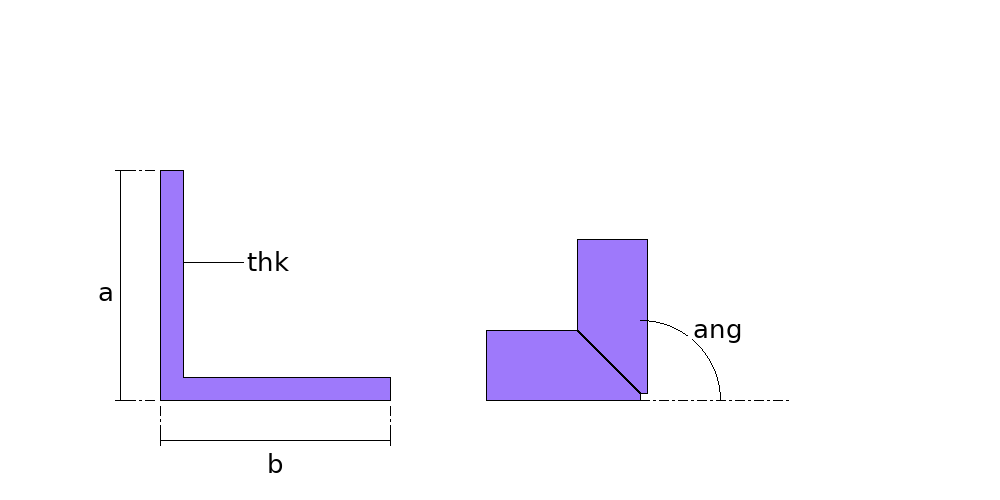
- A Leg height, outside (on an angle, the leg that takes the V)
- B Width of the leg that bends (angle) or of the web (channel), outside
- THK Section thickness
- R Corner radius of the section, outside (0 = sharp)
- ANG Bend angle (90 = square corner)
- NC Number of cuts (1 = one corner)
- RC Curve radius on the outside face of the leg that bends (with more than one cut)
Calculate with your own measurements
No account needed: enter the measurements in millimetres or inches and get the figures and the drawing. The scaled PDF template, the DXF for the cutting table and the 3D model take a free account.
Diameters and sides are outside measurements. The flat pattern already allows for the plate thickness, working on the mean line.
Inches or millimetres? mm inches
How it develops: the formulas
- The depth and the opening of the V
depth = a − t ; opening = 2 × (a − t) × tan(α / 2)a is the height of the cut leg, outside, and the other leg, which stays, is the hinge. In the example, 40 − 4 = 36 mm deep and, at 90°, 2 × 36 × tan 45° = 72 mm at the edge. On a channel on its side, the depth of the V is the web width less the thickness.- The template
L = a + b (angle) ; L = 2 × a + b (channel), less (2 − π/2) × r per rounded cornerThe outside face unrolled, from one free edge to the other. On the sharp-cornered angle of the example, 40 + 40 = 80 mm; on a 100 × 50 tray with a 3 mm corner, 197.4 mm.- The outline of the V on the section
y = ± (z − t) × tan(α / 2)z is the depth of the point from the outside face of the leg that bends: zero on the hinge, and the V starts one thickness in. At the edge of the leg in the example, z = 40 and y = ±36 mm.- The kerf curve
α = angle / n ; pitch = 2 × (R − t) × sin(α / 2) ; left between cuts = pitch − 2 × (a − t) × tan(α / 2)R is the radius of the curve on the outside face of the leg that bends. On a ring of 40 × 4 angle with R = 500 in 36 cuts: α = 10°, a pitch of 86.5 mm and 80.2 mm left between cuts.
Worked example
The values the form comes pre-filled with, run through the tool itself:
| Section and where the V goes | Angle (V in one leg) |
|---|---|
| Leg height, outside (on an angle, the leg that takes the V) | 40 mm |
| Width of the leg that bends (angle) or of the web (channel), outside | 40 mm |
| Section thickness | 4 mm |
| Corner radius of the section, outside (0 = sharp) | 0 mm |
| Bend angle (90 = square corner) | 90° |
| Number of cuts (1 = one corner) | 1 |
| Curve radius on the outside face of the leg that bends (with more than one cut) | 0 mm |
| The flat pattern fits a plate of | 132 × 80 mm |
Result of the example
| Plate | 132 × 80 mm |
|---|---|
| Area and weight | 0.009 m² · ≈ 0.29 kg in 4 mm steel |
Assembly notes
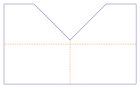
Wrap the template round the outside of the angle with the straight edges square and the long dashed line on the corner; the short dashed one, on the leg that stays whole, is the bend line. Mark the V on the other leg and cut down to the hinge line, 4 mm from the outside face of the whole leg, without cutting it. The V opens 72 mm at the edge; bend 90°, with the cut leg on the inside, until the faces of the V meet, and weld the V if you want the corner closed.
How to mark it out on the plate
- Choose the section (angle, upright channel or channel on its side) and enter the legs outside, the thickness, the corner radius, the bend angle and, for a curve, the number of cuts and the radius.
- Print the template 1:1, cut it out and wrap it round the outside of the section, with the straight edges square and the long dashed lines on the corners.
- Mark the outline of each V and the bend line, one thickness from the outside face of the leg that bends.
- Cut the marked legs with the disc or the saw down to the hinge line, without cutting the leg that bends.
- Bend slowly until the faces of the V meet, and weld the V if you want the corner closed.
Common mistakes and tolerances
- Cutting the leg that bends
- The leg on the outside of the bend is the hinge: cut through, the section falls in two. The V stops one thickness from its outside face, 4 mm on a 40 × 4 angle.
- Putting the V in the outer leg
- The leg that takes the V is the one on the inside of the bend, which shrinks. With the V in the outer leg the bend opens the cut instead of closing it, and the corner does not close.
- Cuts too close on a curve
- If the Vs touch at the edge, nothing is left between them and the curve does not hold. The calculation refuses less than one thickness between cuts: increase the radius or reduce the number of cuts.
Frequently asked questions
- How do you bend angle iron to 90°?
- With a V notch in one leg: cut the leg on the inside of the bend into a V down to the hinge line, one thickness from the outside face of the other leg, and leave the other leg whole, as the hinge. Bent, the V closes and the whole leg makes the corner with no joint. On the 40 × 40 × 4 angle of the example, the V is 36 mm deep and opens 72 mm at the edge.
- How big is the V?
- The depth is the leg height less the thickness, a − t, and the opening at the edge is 2 × (a − t) × tan(angle/2): 72 mm at 90° on a 40 × 4 angle, 29.8 mm at 45°. On a channel on its side, the V crosses the web, and the slot in the inner flange is as wide as the mouth of the V.
- How do you bend angle iron into a circle?
- With a kerf curve: choose the radius on the outside face of the leg that bends and the number of cuts, and each one bends 360° divided by the number. On a ring of 500 mm radius with 36 cuts, each V is 10°, opens 6.3 mm and sits 86.5 mm from the next, leaving 80.2 mm between two. The cut leg goes on the inside of the ring.
- How do you bend cable tray?
- For a vertical bend, rising towards the flanges, both flanges take the V and the web bends: choose the upright channel. For a horizontal bend, the V crosses the web and becomes a slot in the flange on the inside of the curve, and the outer flange bends: choose the channel on its side. On a 100 × 50 tray in 1.5 mm sheet, the V of a 90° vertical bend opens 97 mm in each flange.
- Why wrap the template round the section?
- Because that way the Vs in every leg and the bend line are marked at once, in the right place, and over the rounded corners of a formed section the V line curves. On a kerf curve, the template carries every cut at the right pitch, which is what the curve needs to close round.
You can work out the figures right here, with no account. PDF, DXF, 3D and history take an account — free, with unlimited calculations.