3D barn star: the template for the five points
What it is
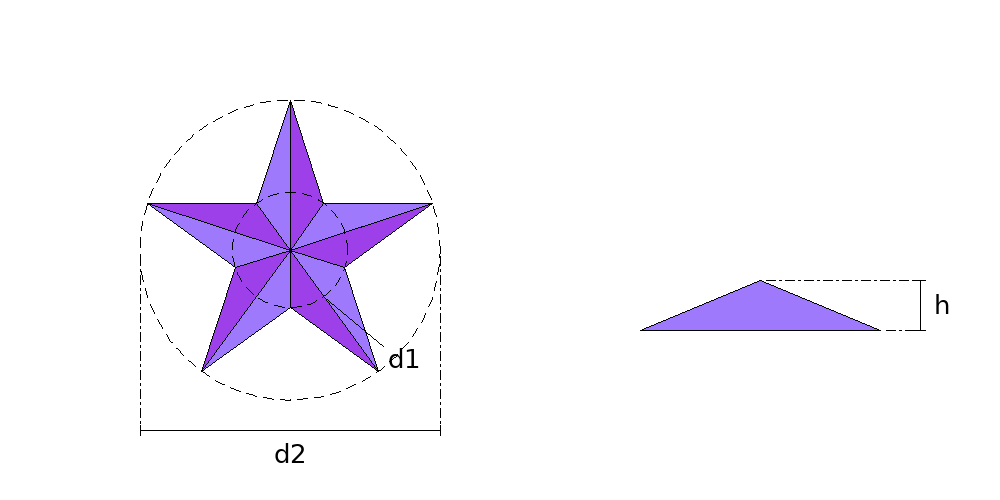
A 3D sheet metal barn star is the raised five-point star of barns, porches and gates, made of ten triangles folded round a raised centre: a ridge from the centre to each point, a valley from the centre to each notch. The page gives the template for each point, folded along its ridge and joined to its neighbours at the valleys, and, on a tall star, the whole star in one plate with one seam.
Where it is used
Barn and porch stars, gate, fence and wall decoration, art and shop-window pieces, trophies and lamps.
Measurements the calculation needs
- D2 Diameter through the points
- D1 Diameter through the valleys
- H Centre height (relief)
- THK Thickness
- EP How to cut
Calculate with your own measurements
No account needed: enter the measurements in millimetres or inches and get the figures and the drawing. The scaled PDF template, the DXF for the cutting table and the 3D model take a free account.
Diameters and sides are outside measurements. The flat pattern already allows for the plate thickness, working on the mean line.
Inches or millimetres? mm inches
How it develops: the formulas
- The ridge and the valley
ridge = √((D/2)² + h²) ; valley = √((d/2)² + h²)From the raised centre to the point and to the valley. In the example, 305.94 and 129.71 mm.- The side of each point
side = √((D/2)² + (d/2)² − 2 × (D/2) × (d/2) × cos 36°)217.72 mm in the example, the same as the flat star.- The angle of each triangle at the centre
cos θ = (ridge² + valley² − side²) / (2 × ridge × valley)37.43° in the example: the ten add up to 374.3°, more than a full turn.
Worked example
The values the form comes pre-filled with, run through the tool itself:
| Diameter through the points | 600 mm |
|---|---|
| Diameter through the valleys | 230 mm |
| Centre height (relief) | 60 mm |
| Thickness | 0.8 mm |
| How to cut | Five points (joined at the valleys) |
| The flat pattern fits a plate of | 306 × 158 mm |
Result of the example
| Plate | 306 × 158 mm, cut 5 times |
|---|---|
| Area and weight | 0.024 m² · ≈ 0.15 kg in 0.8 mm steel |
Assembly notes
The pattern develops the SHARP CORNER, on the mean line — the theoretical layout, which is what gets delivered. If you fold it on a press brake with an inside radius, the blank comes out LONG: each fold needs, against this pattern, the deduction 2*(r+t/2)*tan(a/2) − a*(r + k*t), with r the inside radius, a the bend angle in radians, and your tooling's k. On a 500x300 tube in 1.5 mm sheet with four 90° folds that is 3.6 mm at radius 0.75 and 9.3 mm at radius 4.5 — always to be taken off. A welded or V-notched corner closes on the sharp corner and needs no deduction.
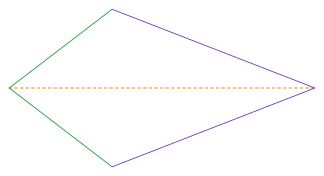
Cut the five identical points and fold each one along the ridge, 305.9 mm long, until its two valleys, 129.7 mm long, meet those of the neighbouring points; each point side is 217.7 mm, with 37.4° per triangle at the centre. Weld or rivet the five at the valleys, from behind.
Fold each ridge to 118° between its two faces, measured from the front, and each valley to 143°, measured from behind. The higher the centre, the more both close.
How to mark it out on the plate
- Enter the point and valley diameters, the centre height and the thickness, and choose five points or one plate.
- Cut the five points, or send the DXF to the cutter.
- Fold each point along the ridge, outwards, until its two valleys sit at the star's angle.
- Bring the five together at the valleys, centre raised, and weld or rivet from behind.
Common mistakes and tolerances
- Making a low star from one plate
- With a low centre the ten triangles go past a full turn round the centre and the plate would overlap. Make it in five points.
- Folding the valley outwards
- The ridge, from the centre to the point, folds out; the valley, from the centre to the notch, folds in. Swapped, the star sinks in the middle.
- Measuring the valley from the point
- Both diameters are circles with the same centre: the one through the points and the one through the valleys, each across the whole star.
Frequently asked questions
- How do you make a 3D metal barn star?
- In five points: each is a diamond of two triangles, folded along the ridge from the centre to the tip; the five meet at the valleys and are welded or riveted from behind. In the example, the 600 mm star with the centre raised 60, each point has a 305.94 mm ridge, a 129.71 mm valley and 217.72 mm sides, and comes out of a 305.9 × 157.7 mm rectangle.
- Why not one plate?
- Because raising the centre of a star with deep valleys makes each triangle wider at the centre: in the example, 37.43° instead of the 36° of the flat star, and the ten add up to 374°, more than a full turn, which no flat plate gives without overlapping. On a tall star the sum drops below 360°, and then the page draws the whole star in one plate, with a seam at one valley.
- What ratio between the points and the valleys?
- The regular star's, the valley at 0.382 of the point: 230 mm for 600. A bigger valley gives a fatter star; past 0.809 of the point it turns into a pentagon, and the page refuses it.
- How high should the centre be?
- A tenth of the diameter gives the relief of a barn star: 60 mm on 600. Higher, the points get steeper and the shadow stronger.
- What plate should I use?
- Thin plate, 0.5 to 1.2 mm: galvanised, stainless, copper or weathering steel. The dimensions are on the mean line, and on thin plate the thickness does not change the template.
You can work out the figures right here, with no account. PDF, DXF, 3D and history take an account — free, with unlimited calculations.