Sheet metal box and tray calculator
What it is
A sheet metal box is the tray, the open box and the slip-on lid that a box and pan brake folds from a cross-shaped blank: the base with a wall on each side and a notch at each corner. The page works out the blank from the outside dimensions and the K-factor, takes out the corner relief where the bends meet and, if you ask for them, draws the corner tabs that close the box from the outside, with the bend lines in the DXF.
Where it is used
Trays and electrical enclosure boxes, drawers and tool boxes, drip and oil trays, guards and covers, catering pans and sinks, battery boxes and slip-on lids.
Measurements the calculation needs
- X Outside length
- Y Outside width
- H Outside height
- AB Corner tab (0 = open corners)
- THK Thickness
- R Inside bend radius (0 = sharp corner)
- KF K-factor (0 = from the table)
Calculate with your own measurements
No account needed: enter the measurements in millimetres or inches and get the figures and the drawing. The scaled PDF template, the DXF for the cutting table and the 3D model take a free account.
Diameters and sides are outside measurements. The flat pattern already allows for the plate thickness, working on the mean line.
Inches or millimetres? mm inches
How it develops: the formulas
- The bend deduction
BD = 2 × (r + t) − (π/2) × (r + K × t)A 90° bend. In the example, r = t = 1.5 and K = 0.421 from Mario Rossi's table: BD = 6 − 3.35 = 2.65 mm.- The blank
L = X + 2 × H − 2 × BD ; W = Y + 2 × H − 2 × BDIn the example, 400 + 100 − 5.30 = 494.70 mm by 300 + 100 − 5.30 = 394.70 mm.- The bend lines
from the edge = H − (r + t) + BA/2The flat of the wall plus half the neutral-axis arc: 47 + 1.67 = 48.67 mm from the edge of each wall.- The corner notch
side = H − (r + t) + BAThe square taken out of each corner of the cross: 50 − 3 + 3.35 = 50.35 mm. With a sharp corner, r = 0, the side is the height itself.
Worked example
The values the form comes pre-filled with, run through the tool itself:
| Outside length | 400 mm |
|---|---|
| Outside width | 300 mm |
| Outside height | 50 mm |
| Corner tab (0 = open corners) | 0 mm |
| Thickness | 1.5 mm |
| Inside bend radius (0 = sharp corner) | 1.5 mm |
| K-factor (0 = from the table) | 0 |
| The flat pattern fits a plate of | 495 × 395 mm |
Result of the example
| Plate | 495 × 395 mm |
|---|---|
| Area and weight | 0.19 m² · ≈ 2.2 kg in 1.5 mm steel |
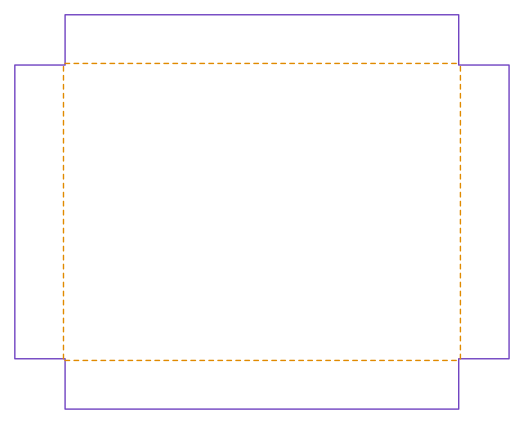
Ordinate table
| # | Position on the plate | Element height |
|---|---|---|
| 1 | 0 mm | 294 mm |
| 2 | 48.7 mm | 294 mm |
| 3 | 50.3 mm | 50.3 mm |
| 4 | 50.3 mm | 50.3 mm |
| 5 | 444.3 mm | 50.3 mm |
| 6 | 444.3 mm | 50.3 mm |
| 7 | 446 mm | 294 mm |
| 8 | 494.7 mm | 294 mm |
Assembly notes
The blank is 494.7 × 394.7 mm, a cross with a notch at each corner. The bend lines are 48.7 mm from the edge of each wall, and between them the base is 397.3 × 297.3 mm.
Press-brake bend with a K-factor of 42.1% of the thickness: each bend uses 3.3 mm of sheet along the neutral-axis arc and takes 2.7 mm off the sum of the outside dimensions, with a setback of 3 mm on each side of the virtual sharp. The K-factor changes with tooling and material: check it with a test bend on your machine.
The corners are open: the notch starts where the bend zones meet, so the bends do not run into each other, and each wall stops 3 mm short of the outside corner of the box. Fold the four walls to 90° and close the corners with a weld, rivets through an inside angle, or sealant.
Fold to an angle of 90° BETWEEN THE TWO FACES — what a protractor reads on the finished part, not the press stroke angle. Every crease on this part has the same angle.
How to mark it out on the plate
- Enter the outside length, width and height, the thickness, the inside bend radius and, if you want them, the corner tab and your brake's K-factor.
- Cut the blank with the corner notches, or send the DXF to the laser or plasma cutter.
- Mark the bend lines from the assembly note, measuring from the edge of each wall.
- With tabs, fold the tabs to 90° first, then the width walls and last the length walls; without tabs, the four walls in any order.
- Close the corners with welds, rivets or spot welds on the tabs, and check the outside dimensions with a tape.
Common mistakes and tolerances
- Adding up the dimensions and cutting
- The blank comes out long: each wall has a bend, and in 1.5 mm sheet with a 1.5 radius each one deducts 2.65 mm. The example tray would come out 5.3 mm too big each way.
- A notch that is too small
- If the notch does not reach where the bend zones meet, the bends run into each other at the corner and the sheet tears or buckles there.
- Folding the length before the width, with tabs
- The tabs get in the way: the width wall cannot come up once they are closed. The order is tabs, width, length.
Frequently asked questions
- How do you work out the blank size of a sheet metal box?
- Add two heights to the outside length and take off two bend deductions; the same across the width. For a 400 × 300 × 50 tray in 1.5 mm sheet with a 1.5 radius, each bend deducts 2.65 mm, and the blank is 400 + 2 × 50 − 2 × 2.65 = 494.70 by 394.70 mm.
- How big is the corner notch?
- The notch starts where the two bend zones meet, at the corner of the flat base, and runs out to the edge: in the example, a 50.35 mm square. That keeps the bends from running into each other, and each wall stops r + t = 3 mm short of the outside corner.
- What are corner tabs for?
- To close the corner without a butt weld: the length wall carries on and folds 90° round the outside of the width wall, where it is spot welded or riveted. The tab folds on the same radius, and its inside arc just clears the corner of the width wall.
- What order do I fold it in?
- Without tabs, any order; on a box and pan brake the last two walls need the fingers set to the inside width. With tabs, first the four tabs, then the width walls, and last the length walls, which bring the tabs round the outside.
- Are the dimensions outside?
- Yes: length, width and height are what the tape reads on the finished box, outside. For the inside, take two thicknesses off the length and width and one off the height: 397 × 297 × 48.5 mm in the example.
You can work out the figures right here, with no account. PDF, DXF, 3D and history take an account — free, with unlimited calculations.