180° Segmented Bend flat pattern
What it is
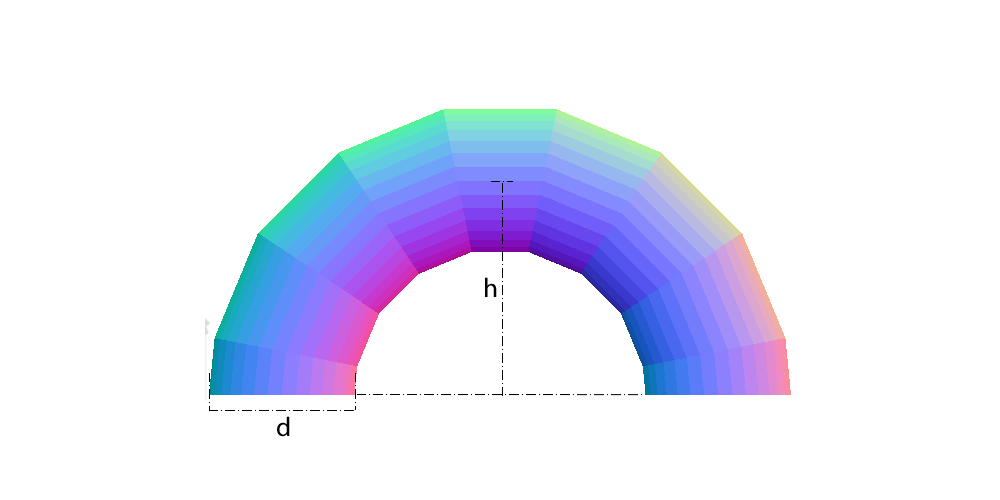
The 180 degree segmented bend — the full return. Same construction as the segmented bend with the angle locked: the tube leaves in the direction opposite to the one it entered, around the radius you give.
Where it is used
Returns in coils, plate-built heat exchangers, ducting that must double back within a short run.
Measurements the calculation needs
- H Bend radius (to the tube axis)
- D Outside diameter of the tube
- ANG Angle of the bend
- S Number of gores
- DV Divisions
- THK Plate thickness
Calculate with your own measurements
No account needed: enter the measurements in millimetres or inches and get the figures and the drawing. The scaled PDF template, the DXF for the cutting table and the 3D model take a free account.
Diameters and sides are outside measurements. The flat pattern already allows for the plate thickness, working on the mean line.
Units: mm inches
How it develops: the formulas
- Half-mitre
β = 90° / gores5 gores: 18°; 6 gores: 15°; 8 gores: 11.25°. The return needs twice the gores of a 90° bend for the same finish.- Cut height at each element
y(φ) = (R + r × cos φ) × tan βFor D = 800, 10 mm plate, R = 1200 and 5 gores: throat 261.6 mm and heel 518.2 mm on the end gore; the middle gore is double.- Plate length
L = π × (D − t)2481.9 mm in the example.
Worked example
The values the form comes pre-filled with, run through the tool itself:
| Bend radius (to the tube axis) | 47-1/4" (47.2441) |
|---|---|
| Outside diameter of the tube | 31-1/2" (31.4961) |
| Angle of the bend | 180° |
| Number of gores | 5 |
| Divisions | 16 |
| Plate thickness | 3/8" (0.3937) |
| The flat pattern fits a plate of | 97-11/16" × 40-13/16" |
| Flat patterns produced | 2 |
Result of the example
| Plate 1 | 97-11/16" × 20-3/8", cut 2 times |
|---|---|
| Area and weight | 10.4 ft² · ≈ 167.5 lb in 3/8" steel |
| Plate 2 | 97-11/16" × 40-13/16", cut 4 times |
| Area and weight | 20.8 ft² · ≈ 334.9 lb in 3/8" steel |
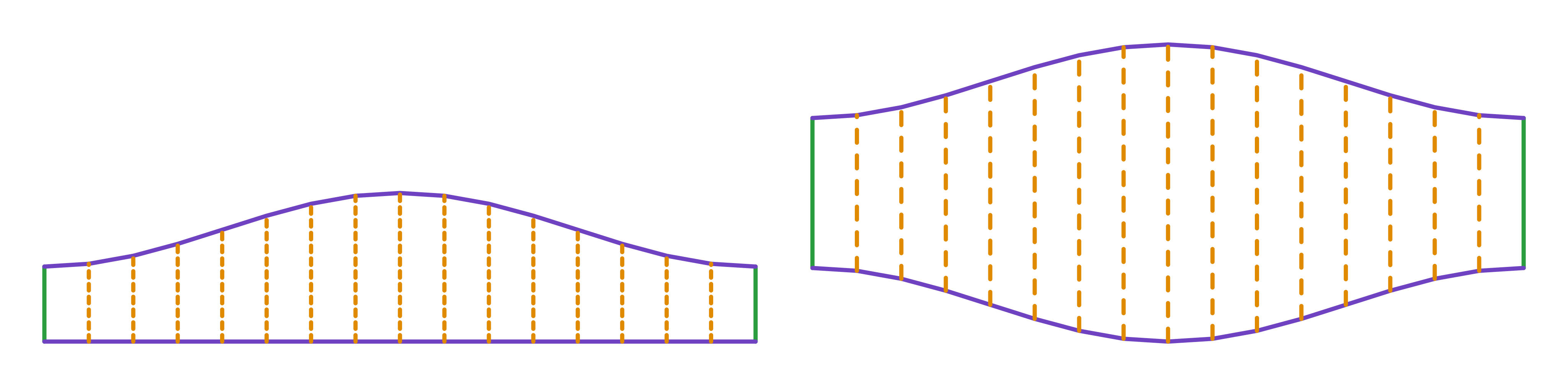
Ordinate table
| # | Position on the plate | Element height |
|---|---|---|
| 1 | 0" | 10-5/16" |
| 2 | 6-1/8" | 10-11/16" |
| 3 | 12-3/16" | 11-3/4" |
| 4 | 18-5/16" | 13-7/16" |
| 5 | 24-7/16" | 15-3/8" |
| 6 | 30-9/16" | 17-5/16" |
| 7 | 36-5/8" | 18-15/16" |
| 8 | 42-3/4" | 20" |
| 9 | 48-7/8" | 20-3/8" |
| 10 | 54-15/16" | 20" |
| 11 | 61-1/16" | 18-15/16" |
| 12 | 67-3/16" | 17-5/16" |
| 13 | 73-5/16" | 15-3/8" |
| 14 | 79-3/8" | 13-7/16" |
| 15 | 85-1/2" | 11-3/4" |
| 16 | 91-5/8" | 10-11/16" |
| 17 | 97-11/16" | 10-5/16" |
Assembly notes
Every gore comes with its longitudinal seam on the throat, the shortest weld, and the gores go together all the same way round, heel to heel. Do not turn a cut gore half a turn to stagger the seams: its long side goes to the throat and the bend loses angle. To stagger them, mark every second gore from the heel instead — cut the paper template on its middle line and swap the two halves.
Common mistakes and tolerances
- Too few gores
- With 3 gores the return has 30° half-mitres and each middle gore turns 60°: the bend comes out faceted and pressure loss rises. Five to seven is the usual range.
- Radius under half the diameter
- R < D/2 makes the gores cross at the throat; the calculation refuses it.
Guides about this part
- Lobster back bend calculator (segmented 90° elbow): gore angles, cut heights and how many plates
- Pie cut calculator for exhaust and tube bends: saw angle, pie lengths and a wrap-around template
Frequently asked questions
- How many gores does a 180 degree return need?
- Since the angle is twice that of a 90 degree bend, the gore count usually doubles to keep the same finish. Five to seven is the usual range.
- Where is the radius measured from?
- From the centre of the bend to the tube axis, as in the other segmented bends.
You can work out the figures right here, with no account. PDF, DXF, 3D and history take an account — free, with unlimited calculations.