Polygon to round development
What it is
A polygon to round is the transition from the opening of a regular polygon -- a hexagon, an octagon, a pentagon -- to a round opening: the stack on a hexagonal firebox, the hopper of an octagonal silo, the hood over a polygonal base. It is developed like the square to round: a cone fan at each corner and a flat triangle on each side, by their true lengths, in one plate, with the seam in the middle of a side.
Where it is used
Stacks and ducts on hexagonal or octagonal fireboxes and boilers, hoppers and bottoms of polygonal silos, hoods over polygonal bases, and duct transitions in art and architecture.
Measurements the calculation needs
- NC Number of polygon sides
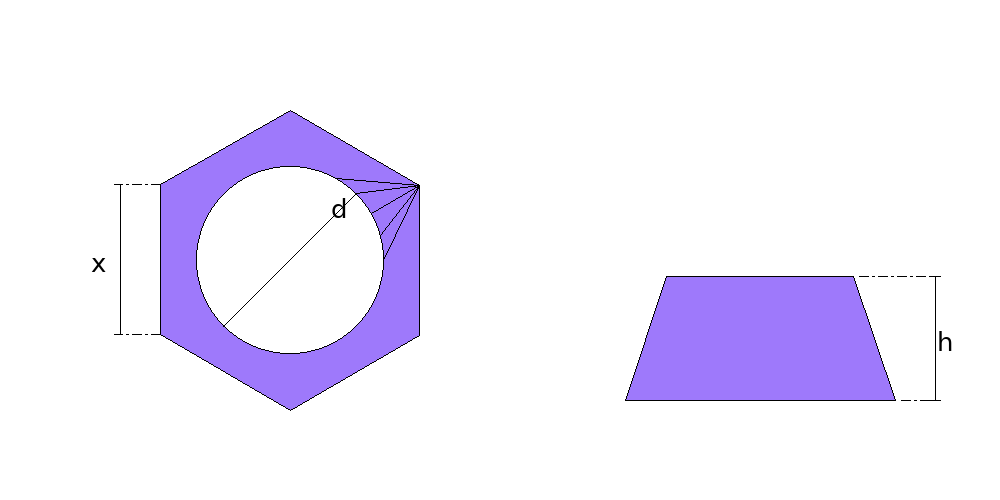
- X Polygon side, outside
- D Round opening diameter
- H Height between the openings
- DV Divisions of the round opening (multiple of the sides)
- THK Thickness
Calculate with your own measurements
No account needed: enter the measurements in millimetres or inches and get the figures and the drawing. The scaled PDF template, the DXF for the cutting table and the 3D model take a free account.
Diameters and sides are outside measurements. The flat pattern already allows for the plate thickness, working on the mean line.
Inches or millimetres? mm inches
How it develops: the formulas
- The polygon on the mean line
apothem = x / (2 tan(180°/n)) − t/2 ; half side = apothem × tan(180°/n)In the example, 346.41 − 1.5 = 344.91 mm of apothem and 199.13 of half side.- The true length of each fan line
L = √(h² + (xc − xb)² + (yc − yb)²)From the corner to the station of the round opening, in plan and in height. In the example, 618.40 to 639.49 mm.- The seam
from the middle of the first side to the point of the opening at 0°607.69 mm in the example.- The plate
n fans and n flat triangles, in one strip1722.9 × 1509.3 mm in the example, 1.21 m².
Worked example
The values the form comes pre-filled with, run through the tool itself:
| Number of polygon sides | 6 |
|---|---|
| Polygon side, outside | 400 mm |
| Round opening diameter | 500 mm |
| Height between the openings | 600 mm |
| Divisions of the round opening (multiple of the sides) | 24 |
| Thickness | 3 mm |
| The flat pattern fits a plate of | 1723 × 1509 mm |
Result of the example
| Plate | 1723 × 1509 mm |
|---|---|
| Area and weight | 1.21 m² · ≈ 28.4 kg in 3 mm steel |
| Arc radii | 1,052.1 mm · 1,296.7 mm |
| Sector angle | 3.5 · 2.9° |
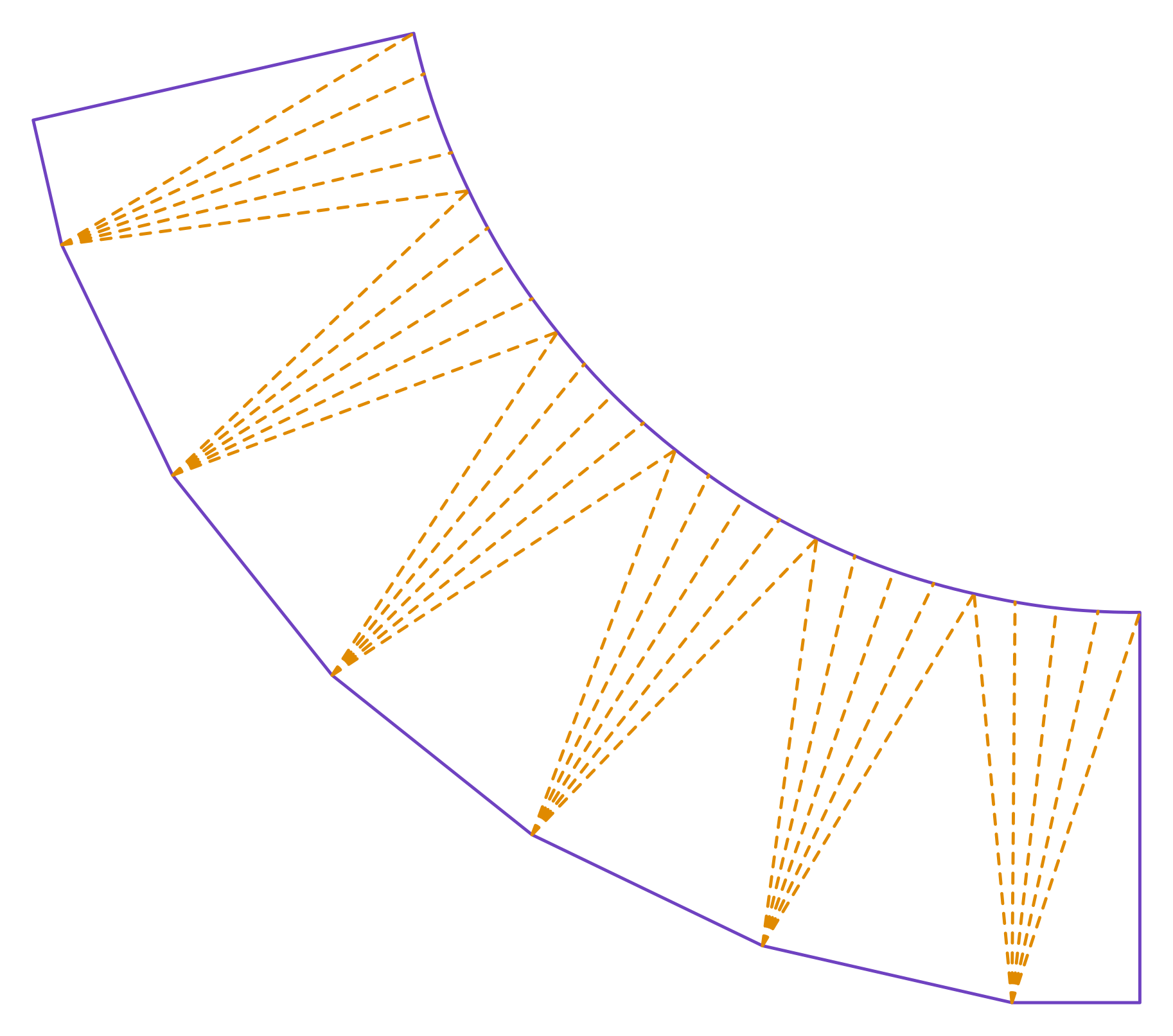
How to mark it out on the plate
- Enter the number of sides, the polygon side outside, the round opening diameter, the height, the divisions and the thickness.
- Cut the plate, or send the DXF to the cutter.
- Crease the fan lines lightly and fold the corners, leaving the side triangles flat.
- Close the seam in the middle of the side and weld the openings.
Common mistakes and tolerances
- Entering the distance across flats as the side
- The field asks for the side. With the distance across flats in its place, the hexagon comes out 1.73 times too big.
- Divisions that do not split by the sides
- Every corner needs the same number of divisions: the page refuses divisions that are not a multiple of the number of sides.
- Curving the side triangles
- The side triangles are flat; only the corner fans curve. Curving a side leaves the polygon opening crooked.
Frequently asked questions
- How do you develop a hexagon to round?
- By triangulation, like the square to round: at each corner of the polygon, a fan of lines to the arc of the round opening that faces it; on each side, a flat triangle to the point of the opening in the middle of the side. Every line goes onto the plate at its true length. In the example, the hexagon of side 400 to Ø500 at 600 high, the fan lines run from 618.40 to 639.49 mm, and the plate is 1722.9 × 1509.3 mm.
- Which polygon dimension do I enter?
- The side, outside, and the number of sides. On the hexagon of side 400, the distance across flats is 692.8 mm and across corners, 800. If you have the distance across flats S, the side is S × tan(180°/n): on a hexagon, S / 1.732.
- How many divisions?
- A multiple of the number of sides, so every corner gets the same fan: on a hexagon, 24 gives four triangles per corner. More divisions do not change the plate; they only add fold lines in the fan.
- Is it the square to round with four sides?
- It is: the polygon with four equal sides gives the same plate as the square to round, point for point. For unequal sides, use the rectangle to round.
- Where is the seam?
- In the middle of a side, where the plate is flat and the weld is straight, away from the corner. The plate comes out whole, the fans and the side triangles alternating.
You can work out the figures right here, with no account. PDF, DXF, 3D and history take an account — free, with unlimited calculations.