Oblique Cone flat pattern
What it is
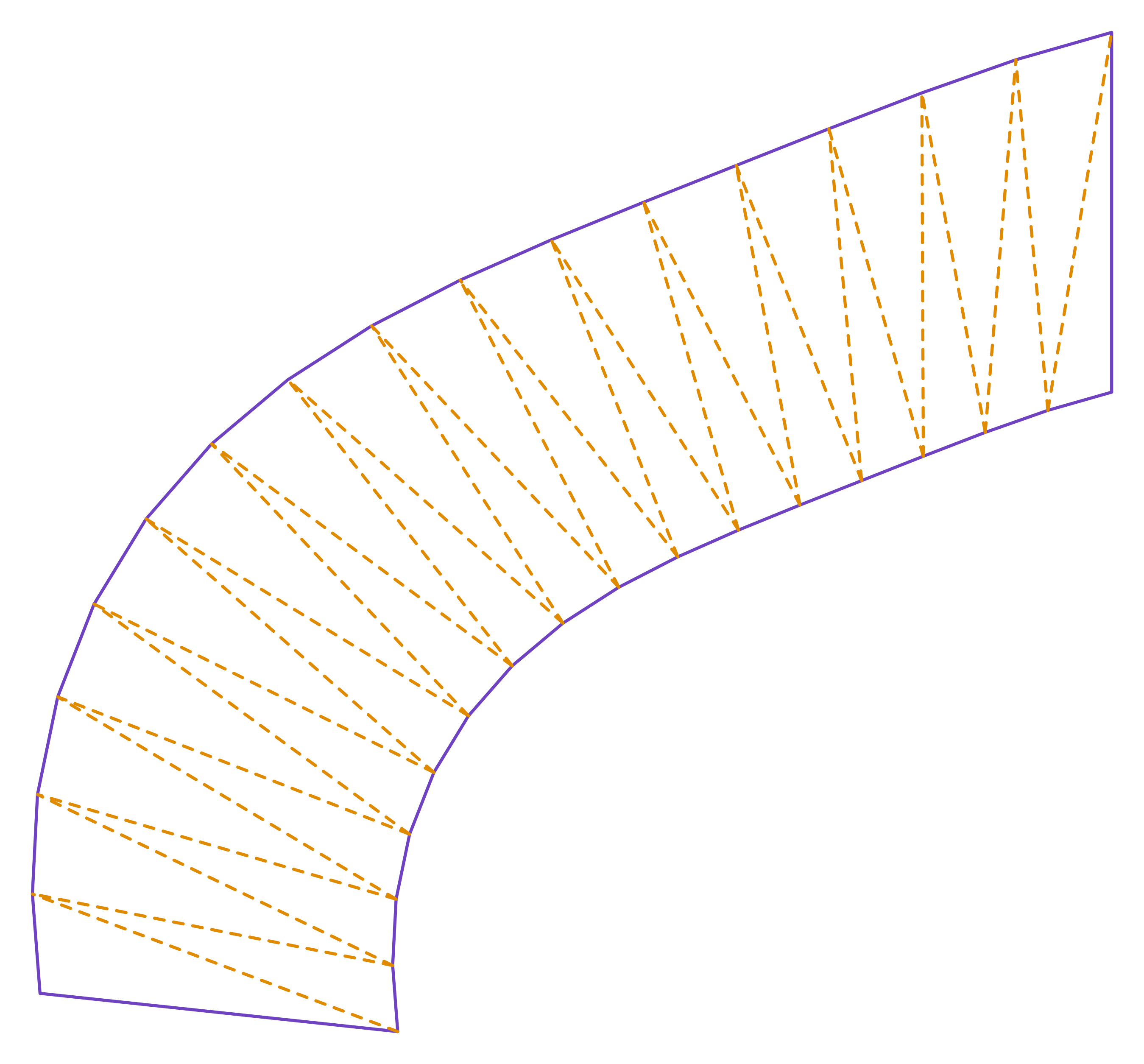
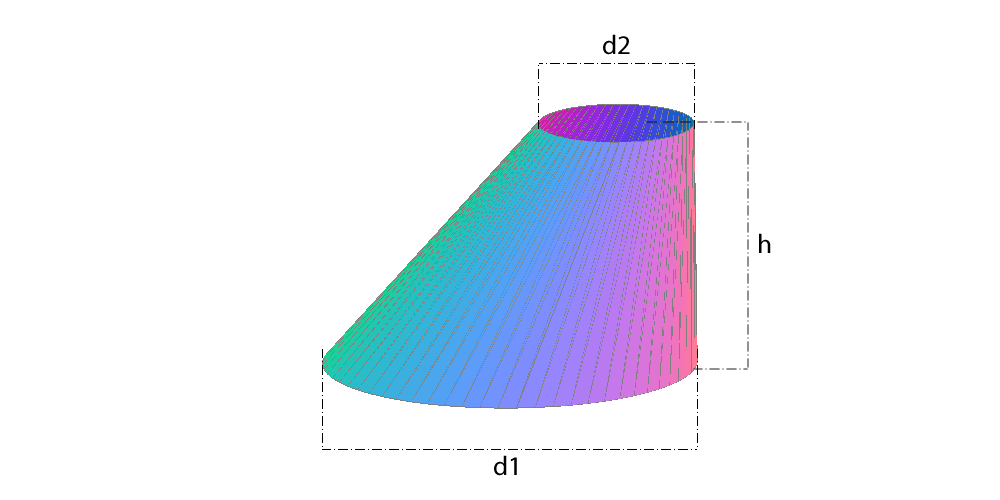
In an oblique cone the two diameters do not share an axis: one opening is offset from the other. That breaks the symmetry, so the development is no longer an annular sector — it has to be solved by triangulation, dividing the surface into narrow strips and developing them one at a time.
Where it is used
Offset pipe transitions, exhaust manifolds, side nozzles on tanks, connections that must clear an obstruction.
Measurements the calculation needs
- D1 Diameter of the bottom mouth
- D2 Diameter of the top mouth
- H Vertical height between the mouths
- DV Divisions
- THK Plate thickness
Calculate with your own measurements
No account needed: enter the measurements in millimetres or inches and get the figures and the drawing. The scaled PDF template, the DXF for the cutting table and the 3D model take a free account.
Diameters and sides are outside measurements. The flat pattern already allows for the plate thickness, working on the mean line.
Units: mm inches
Worked example
The values the form comes pre-filled with, run through the tool itself:
| Diameter of the bottom mouth | 800 mm |
|---|---|
| Diameter of the top mouth | 1200 mm |
| Vertical height between the mouths | 800 mm |
| Divisions | 16 |
| Plate thickness | 3 mm |
| The flat pattern fits a plate of | 2546 × 2357 mm |
Result of the example
| Plate | 2546 × 2357 mm |
|---|---|
| Area and weight | 2.62 m² · ≈ 61.6 kg in 3 mm steel |
Guides about this part
- How to develop a cone (frustum) in sheet metal: formula, sector radii and angle, step by step
- Eccentric and concentric reducers: which one to use and how each one develops on plate
Frequently asked questions
- Why does the number of divisions change the result?
- Because triangulation approximates the curve with straight segments. More divisions follow the outline more closely; fewer make the pattern easier to mark. For thin plate and large diameters, increase the divisions.
- Can this part be rolled?
- It is not a surface of revolution, so it does not come off in one pass. In practice it is formed in sections and checked against a template — which is exactly why the flat pattern has to be right before cutting.
You can work out the figures right here, with no account. PDF, DXF, 3D and history take an account — free, with unlimited calculations.