Rectangular Duct Wye flat pattern
What it is
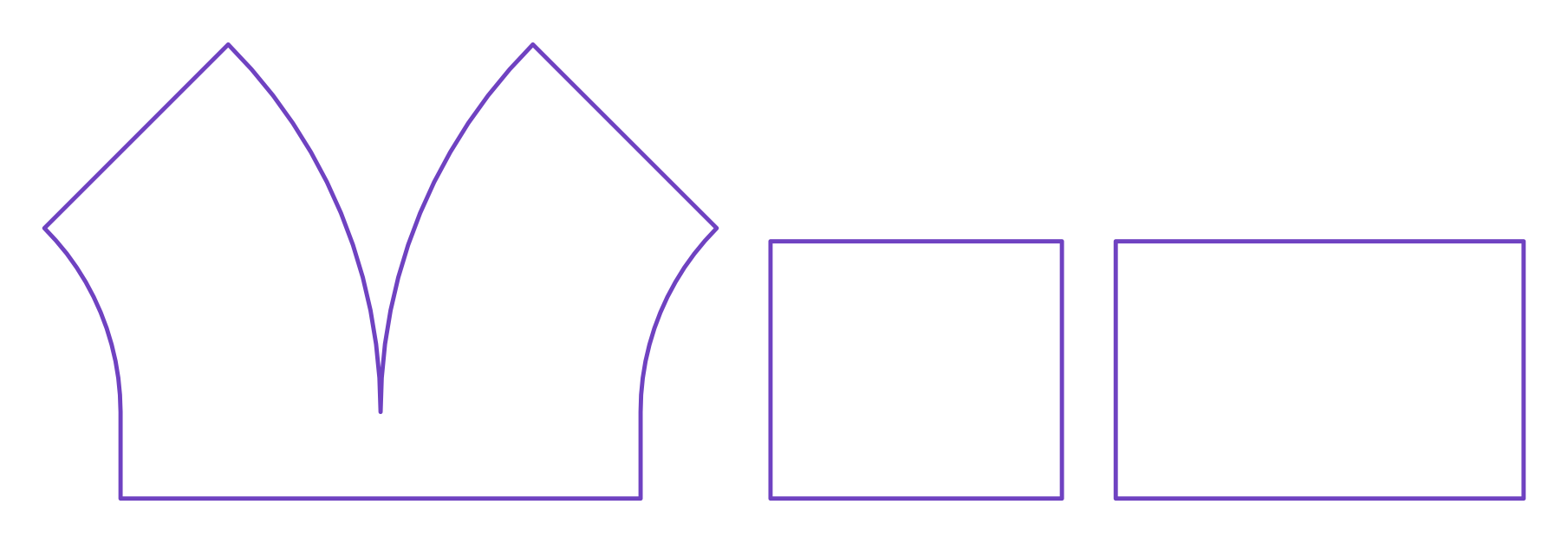
The rectangular wye is the Y-branch of a duct run: the trunk splits into two equal legs, each turning its own way. Like the S-offset, it comes out the way a duct shop makes it — two flat cheeks with the Y outline and the wrappers rolled between them: the outer one on each side, which is the side of the trunk and the throat of the leg, and the inner one, the heel, which meets the other leg's heel at the crotch. Catalogues also call it breeches, or a dovetail when the legs turn 90°. The calculation returns the cheeks drawn in arcs, the wrappers at their mid-line length, the 1:1 template and the DXF.
Where it is used
Splitting an air-conditioning or ventilation run into two branches, extraction and dust collection manifolds, air distribution off a plenum, and twin outlets from a fan or a unit.
Measurements the calculation needs
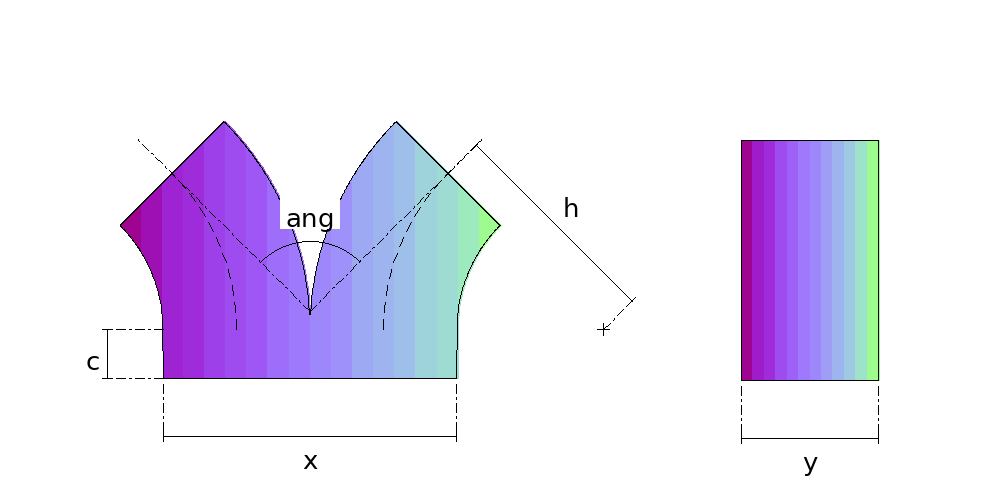
- X Width of the trunk, in the plane of the wye
- Y Duct side across the wye
- ANG Angle between the two legs
- H Radius to the centreline of each leg
- C Straight length of the trunk
- THK Plate thickness
Calculate with your own measurements
No account needed: enter the measurements in millimetres or inches and get the figures and the drawing. The scaled PDF template, the DXF for the cutting table and the 3D model take a free account.
Diameters and sides are outside measurements. The flat pattern already allows for the plate thickness, working on the mean line.
Units: mm inches
How it develops: the formulas
- The radii of each leg
Rt = h − x/4 ; Rh = h + x/4 ; θ = angle / 2h is the radius to the centreline of the leg, which is x/2 wide. Rt is the throat, on the outside of the wye, and Rh the heel, in the middle. In the example, a 600 trunk and h = 450: 300 and 600 mm, and each leg turns 45°.- The outer wrapper
Lo = c + θ × (Rt + t/2)The straight side of the trunk plus the throat of the leg, on the mid-line. In the example: 100 + 236.2 = 336.2 mm.- The inner wrapper
Li = θ × (Rh − t/2)The heel, from the crotch to the mouth of the leg, on the mid-line. In the example: 470.6 mm.
Worked example
The values the form comes pre-filled with, run through the tool itself:
| Width of the trunk, in the plane of the wye | 23-5/8" (23.622) |
|---|---|
| Duct side across the wye | 11-13/16" (11.811) |
| Angle between the two legs | 90° |
| Radius to the centreline of each leg | 17-11/16" (17.7165) |
| Straight length of the trunk | 3-15/16" (3.937) |
| Plate thickness | 1/16" (0.0591) |
| The flat pattern fits a plate of | 30-9/16" × 20-5/8" |
| Flat patterns produced | 3 |
Result of the example
| Plate 1 | 30-9/16" × 20-5/8", cut 2 times |
|---|---|
| Area and weight | 2.9 ft² · ≈ 7.1 lb in 1/16" steel |
| Arc radii | 11-13/16" · 23-5/8" |
| Sector angle | 45° |
| Plate 2 | 13-1/4" × 11-11/16", cut 2 times |
| Area and weight | 1.1 ft² · ≈ 2.6 lb in 1/16" steel |
| Plate 3 | 18-1/2" × 11-11/16", cut 2 times |
| Area and weight | 1.5 ft² · ≈ 3.6 lb in 1/16" steel |
Assembly notes
Sheet 1 is the two CHEEKS, flat and identical, cut to the outside outline of the wye. Sheet 2 is the two OUTER wrappers, which make the side of the trunk and the throat of each leg; sheet 3 is the two INNER ones, the heels, which meet at the crotch. All of them go at the inside width, 297 mm, and fit between the cheeks.
On the outer wrapper the first 100 mm stay straight -- that is the side of the trunk -- and the rest is rolled until it seats on the cheek's 300 mm radius edge. The inner one is rolled along its whole length, to seat on the 600 mm radius edge. The two inner wrappers meet back to back at the crotch, where they are welded to each other before the cheeks go on.
How to mark it out on the plate
- Enter the trunk (x in the plane of the wye, y across it), the angle between the legs, the radius to the centreline of each leg, the straight of the trunk and the thickness.
- Cut two cheeks from the template. The centres of the legs lie on the line where the trunk ends, h + x/4 from the middle, one each side.
- Cut two outer and two inner wrappers at the inside width, y − 2t. Mark on the outer ones where the straight ends.
- Roll the wrappers: the outer one from the end of the straight, to the throat radius; the inner one along its whole length, to the heel radius.
- Weld the two inner wrappers back to back at the crotch, fit the wrappers between the cheeks and weld the edges.
Common mistakes and tolerances
- Putting the throat in the middle of the wye
- Each leg turns outwards, and its throat is the outside of the wye. The smaller radius goes on the outer wrappers.
- Forgetting the straight on the outer wrapper
- The outer wrapper starts on the trunk: the first c mm are straight, and only from there is it rolled.
- Wrappers at the outside width
- The cheeks cover the wrappers, so the wrappers go at the inside width, y − 2t. At the outside width the duct comes out deeper than entered.
Frequently asked questions
- How do you work out the wrappers of a rectangular wye?
- Each leg is a radius bend x/2 wide that turns half the angle between the legs. The outer wrapper measures the straight of the trunk plus the throat arc, c + θ × (h − x/4 + t/2); the inner one, the heel arc, θ × (h + x/4 − t/2). In the example, a 600 trunk split at 90°: 336.2 and 470.6 mm.
- Why is the throat on the outside of the wye?
- Because each leg turns its own way, and the centre of a bend lies on the side it turns towards. The side nearest the centre is the outside of the wye, which is the throat; the heels are in the middle, and they start together at the crotch.
- What is the straight of the trunk for?
- Without it the two legs would touch at a single point on the inlet, and the cheek would be two pieces. The straight joins them, and gives room to weld the crotch and to fit the flange or the joint.
- Can it make a dovetail tee?
- Yes: with 180° between the legs each one turns 90°, and the wye becomes the tee of two radius bends going out both ways.
You can work out the figures right here, with no account. PDF, DXF, 3D and history take an account — free, with unlimited calculations.