Rolled tube arch calculator: radius and cut length
1:1 template and DXF
What it is
A rolled tube arch is square or rectangular tubing rolled into a curve: the arched carport, gate and window, the pergola, the greenhouse and the hoop house. Whoever orders it knows the span and the rise; the tube roller asks for the radius, and whoever cuts the bar needs the length. The page works both out from the span and the rise, measured on the outside, the inside or the centreline of the tube, gives the rise at each station to check the arch with a string line and how many arches come out of a bar, and draws the arch full size to lay out on the floor.
Where it is used
Arched carports and roofs, arched gates, windows and transoms, pergolas, greenhouses and hoop houses, canopies, and curved frames for façades and signs.
Measurements the calculation needs
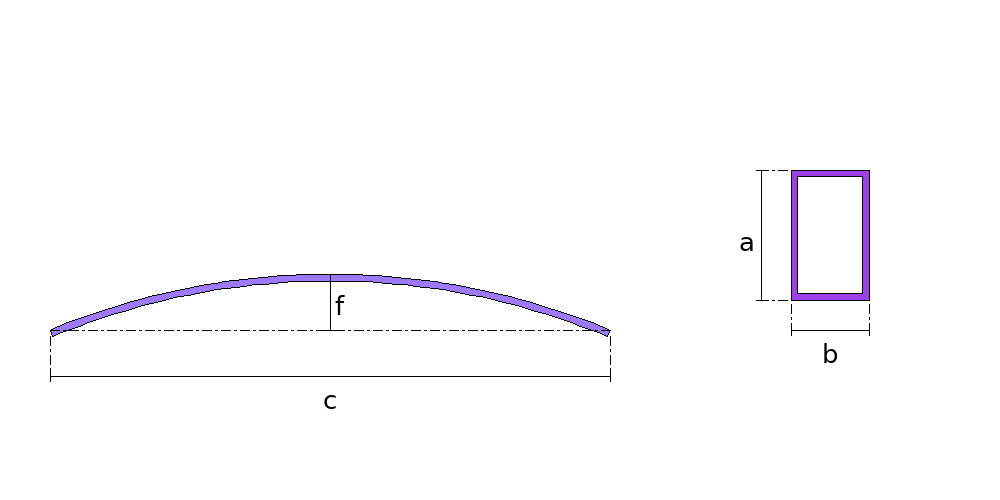
- A Tube depth in the plane of the arch
- B Tube width
- C Arch span
- F Arch rise
- RF Span and rise measured
- PT Straight end on each side (0 = none)
- LB Bar length (0 = no count)
Calculate with your own measurements
No account needed: enter the measurements in millimetres or inches and get the figures and the drawing. The scaled PDF template, the DXF for the cutting table and the 3D model take a free account.
Diameters and sides are outside measurements. The flat pattern already allows for the plate thickness, working on the mean line.
Inches or millimetres? mm inches
Made this part? Send a photo: once approved, it appears here with your shop's name, and your account gets 30 days of full access. Send the photo
How it develops: the formulas
- Radius from span and rise
R = (c²/4 + f²) / (2 f)On the face the span and rise were measured on. In the example, 5200 mm on the outside.- Arch angle
θ = 2 × atan( (c/2) / (R − f) )The same on all three faces: the bar is cut square, and the cut ends up on the radius. In the example, 45.24°.- Bar length
L = Rc × θ + 2 × straight endRc is the centreline radius, half the tube depth from the measured face, and θ is in radians. In the example, 5175 × 0.78958 = 4086.1 mm.- Rise at each station
y = √(R² − x²) − (R − f)The distance from the chord to the arch at x from the middle, on the face of the span. In the example, 375.9 mm at 500 mm from the middle.
Worked example
The values the form comes pre-filled with, run through the tool itself:
| Tube depth in the plane of the arch | 50 mm |
|---|---|
| Tube width | 30 mm |
| Arch span | 4000 mm |
| Arch rise | 400 mm |
| Span and rise measured | Outside of the arch (extrados) |
| Straight end on each side (0 = none) | 0 mm |
| Bar length (0 = no count) | 6000 mm |
| The flat pattern fits a plate of | 4000 × 446 mm |
Result of the example
| Plate | 4000 × 446 mm |
|---|---|
| Arc radii | 5,150 mm · 5,200 mm |
| Sector angle | 45.2° |

Ordinate table
| # | Position on the plate | Element height |
|---|---|---|
| 1 | 0 mm | 179 mm |
| 2 | 500 mm | 302.9 mm |
| 3 | 1,000 mm | 375.9 mm |
| 4 | 1,500 mm | 400 mm |
| 5 | 2,000 mm | 375.9 mm |
| 6 | 2,500 mm | 302.9 mm |
| 7 | 3,000 mm | 179 mm |
Assembly notes
Arch radius: 5,200 mm outside, 5,175 mm on the centreline and 5,150 mm inside; the arch spans 45.2°. Give the tube roller the radius of the face they will check the arch against.
Cut the bar to 4,086.1 mm: the arc length on the tube's centreline.
Measured with a tape on the rolled bar, the arc is 4,105.8 mm on the outside face and 4,066.3 mm on the inside.
Span and rise on each face: outside, 4,000 × 400 mm; centreline, 3,980.8 × 398.1 mm; inside, 3,961.5 × 396.2 mm.
To check the arch, stretch a string across the ends on the outside face and measure from the string to the arch: at 0, 500, 1,000, and 1,500 mm from the middle, the rise is 400, 375.9, 302.9, and 179 mm.
A 6,000 mm bar makes one arch, with 1,913.9 mm left over.
A three-roll bender cannot bend the ends: a straight length is left at each end, about half the distance between the bottom rolls. For the arch to curve right to the end, enter that allowance as Straight end and cut the ends off after rolling.
How to mark it out on the plate
- Measure the span and the rise and choose the face they refer to: outside, centreline or inside of the tube.
- Enter the tube depth in the plane of the arch, its width, the straight end the roller asks for and the bar length.
- Cut the bar to the length worked out and take it to the roller with the radius of the face they will check against.
- Check the arch with a string across the ends and the table of rises, or against the full-size template.
- Cut the straight ends off square, if the roller left them.
Common mistakes and tolerances
- Cutting the bar to the outside arc
- The bar is cut to the centreline: the outside arc is longer and the inside one shorter. Cut to the outside arc the bar is too long; to the inside, too short.
- Mixing up the faces
- The radius from an outside span, given to the roller as an inside radius, comes out a whole tube depth off. The page gives the three faces side by side.
- Forgetting the straight ends
- A three-roll bender cannot bend the ends. Without the allowance the arch comes out with two straight ends, wider and lower than ordered.
- Measuring the rise on a slant
- The rise is the height of the middle of the arch above the span line, square to it, not the distance from the middle of the arch to one end.
Frequently asked questions
- How do you find the radius of an arch from the span and the rise?
- R = (c²/4 + f²) / (2 f), with c the span and f the rise, on the same face of the tube. In the example, a 4000 mm span with a 400 mm rise gives a 5200 mm radius on the outside.
- How long a bar does the arch take?
- The arc length on the tube's centreline: its radius times the arch angle in radians. In the example, 50 × 30 tube rolled the hard way, with a 4000 span and a 400 rise on the outside, takes 4086.1 mm of bar, and a 6 m bar makes one arch with 1913.9 mm left over.
- Which radius do I give the tube roller?
- The one for the face they will check the arch against, inside or outside. The page gives all three -- outside, centreline and inside --, half the tube depth apart: 5200, 5175 and 5150 mm in the example.
- How do I check a rolled arch?
- Stretch a string across the ends on the face the span was measured on and measure from the string to the arch at the stations in the table. In the example, the rise is 375.9 mm at 500 mm from the middle, 302.9 mm at 1000 mm and 179 mm at 1500 mm.
- Why are the ends left straight?
- A three-roll bender cannot bend the part of the bar outside the rolls. For the arch to curve right to the end, enter the allowance the roller asks for as Straight end: it goes into the bar length, and the ends are cut off after rolling.
- Rolled the hard way or the easy way?
- Either, but the numbers change: what counts is the tube size in the plane of the arch. A 50 × 30 rolled the hard way has the inside and outside faces of the arch 50 mm apart; the easy way, 30.
You can work out the figures right here, with no account. PDF, DXF, 3D and history take an account — free, with unlimited calculations.