Triple wye development
What it is
A triple wye is the three-leg breeches: three openings leave the common one at 120° round the axis -- the dust and grain splitter, the triple silo outlet, the three-inlet exhaust collector. Each leg is an offset cone, from the common opening to its own, trimmed on the two vertical planes that separate it from its neighbours; the three are identical and come out of the same plate, cut three times, with the bottom edge ready for the joint.
Where it is used
Dust, grain and chip splitters, triple silo and hopper outlets, three-inlet exhaust and air collectors, and three-way pneumatic conveying diverters.
Measurements the calculation needs
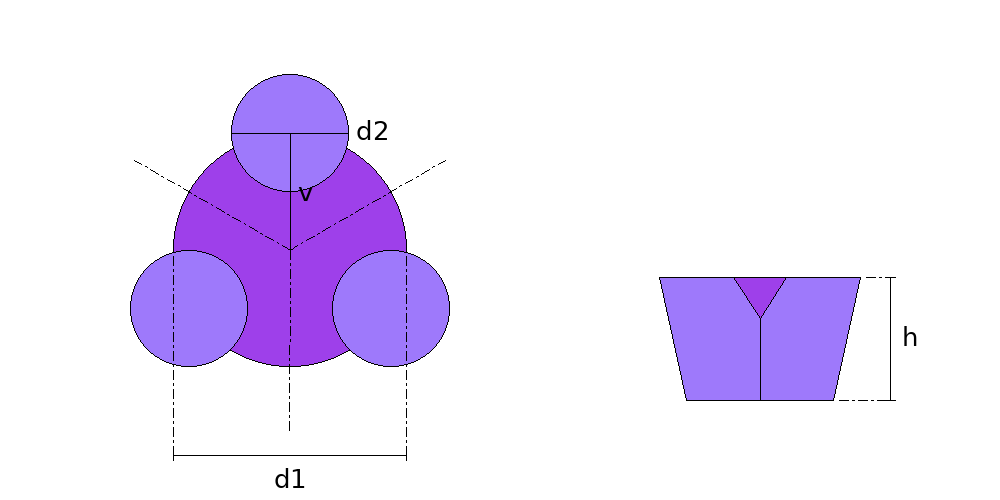
- D1 Common opening diameter, outside
- D2 Leg opening diameter, outside
- H Height between the openings
- V Offset of each opening centre from the axis
- DV Divisions per leg (multiple of 12)
- THK Thickness
Calculate with your own measurements
No account needed: enter the measurements in millimetres or inches and get the figures and the drawing. The scaled PDF template, the DXF for the cutting table and the 3D model take a free account.
Diameters and sides are outside measurements. The flat pattern already allows for the plate thickness, working on the mean line.
Units: mm inches
How it develops: the formulas
- The element line of each leg
from (r1 cos a, r1 sin a, 0) to (v + r2 cos a, r2 sin a, h)The offset cone, from the common opening to the opening of the 0° leg.- The trim on the planes
n · (P1 + t × (P2 − P1)) = 0, with n the normal of the plane at ±60°The element line starts where it enters the leg's third; the back one, at 180°, on the axis, at t = r1 / (r1 + v − r2) from the common opening: 333.3 mm up in the example.- The plate of each leg
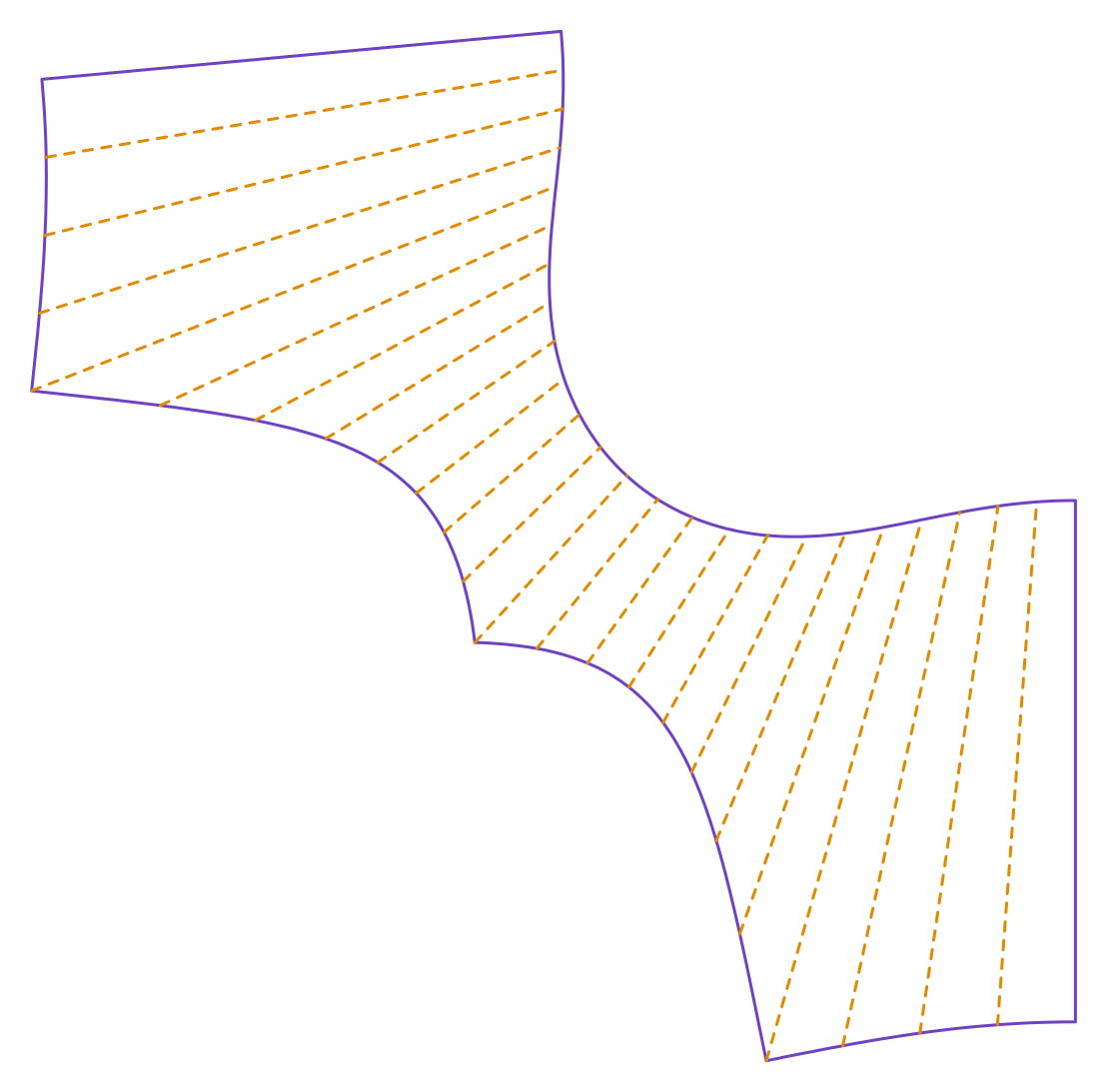
triangulated between the trimmed edge and the leg opening1045.1 × 1030.6 mm in the example, cut three times.
Worked example
The values the form comes pre-filled with, run through the tool itself:
| Common opening diameter, outside | 600 mm |
|---|---|
| Leg opening diameter, outside | 300 mm |
| Height between the openings | 500 mm |
| Offset of each opening centre from the axis | 300 mm |
| Divisions per leg (multiple of 12) | 24 |
| Thickness | 3 mm |
| The flat pattern fits a plate of | 1045 × 1031 mm |
Result of the example
| Plate | 1045 × 1031 mm, cut 3 times |
|---|---|
| Area and weight | 0.43 m² · ≈ 10.2 kg in 3 mm steel |
| Arc radii | 178 mm · 181.9 mm · 222.9 mm · 228.8 mm · 235.7 mm · 242.6 mm · 244.1 mm · 268.7 mm · 311.7 mm · 318.6 mm · 411 mm · 422.3 mm · 441.3 mm · 525.9 mm · 604.3 mm · 664.6 mm · 691.1 mm · 861.8 mm · 1,057.7 mm · 1,070.3 mm · 1,214.8 mm · 1,730.9 mm · 1,892.6 mm · 2,121.3 mm · 2,310.3 mm · 3,992.8 mm · 4,634.5 mm |
| Sector angle | 15.5 · 15.6 · 10 · 9.8 · 6.6 · 9.2 · 12.4 · 8.3 · 5.5 · 7 · 8.7 · 5.3 · 4.4 · 4.2 · 3.7 · 3.3 · 3.2 · 2.6 · 2.4 · 1.6 · 1.1 · 1 · 0.9° |
Assembly notes
The three legs come out of the same plate, cut three times: each takes a third of the Ø600 mm opening and meets its neighbours on the two planes at 60° to it, down to the axis. Assemble the three round the common opening, each with its seam on the outside element line, and weld the three plane joints; the Ø300 mm openings sit 300 mm from the axis, 500 mm up.
How to mark it out on the plate
- Enter the common opening, the leg opening, the height, the opening offset, the divisions and the thickness.
- Cut the same plate three times, or send the DXF to the cutter with the quantity.
- Roll each leg along the layout folds and close the seam on the outside element line.
- Bring the three together on the planes, points on the axis, and weld the common opening from below.
Common mistakes and tolerances
- Setting the openings too close
- With a leg opening past its side plane it would run into the neighbour: the page refuses, and asks for the centre more than the opening radius over sin 60° from the axis.
- Swapping the common opening for the legs'
- The common opening is the bottom one, whole and centred on the axis; each leg takes a third of it. The leg openings are offset, one per leg.
- Cutting the legs differently
- The three are the same plate. A template per leg, adjusted by eye, is how the plane joints fail to close.
Frequently asked questions
- How do you develop a triple wye?
- Each leg is an offset cone, from the common opening to its own, trimmed on the two vertical planes that separate it from its neighbours, at 60° either side. The plate is triangulated like the offset cone, with the bottom edge following the common opening across the leg's third and the planes elsewhere. In the example, 600 to three 300 openings, each leg comes from a 1045.1 × 1030.6 mm plate.
- Are the three legs the same?
- They are: the part has three-fold symmetry, and the same plate, cut three times, gives the three legs.
- Where do the legs meet?
- On three vertical planes through the axis, 120° apart, and all three on the axis, where the back element line of each leg crosses it: in the example, 333.3 mm up. Each joint is the same curve seen from both legs.
- How far apart can the openings be?
- Far enough for each leg's opening to fit in its third: the centre at v from the axis sits v × sin 60° from the side plane, and that distance has to exceed the opening radius. In the example, 259.8 mm against 150.
- Which dimensions do I enter?
- The outside diameters of the common opening and of the leg openings, the height between them, the offset of each opening centre from the axis, the divisions and the thickness.
You can work out the figures right here, with no account. PDF, DXF, 3D and history take an account — free, with unlimited calculations.