How to cut square tube at 45 degrees
What it is
A square tube miter is a frame corner made of two bars of square or rectangular tube cut in the same plane, which runs through the outside and the inside edge of the corner: 45° on each bar in a frame of equal tubes, and another angle when the corner is not square or the tubes are different sizes. The page gives the cut angle on each tube, the length of each bar along the outside and the inside face, and a 1:1 template to wrap round the tube and mark the cut for the angle grinder.
Where it is used
Gates, railings and frames in box section, picture frames, table and bench bases, roof structures, window frames, and frame corners at other angles, such as triangles, hexagons and mansards.
Measurements the calculation needs
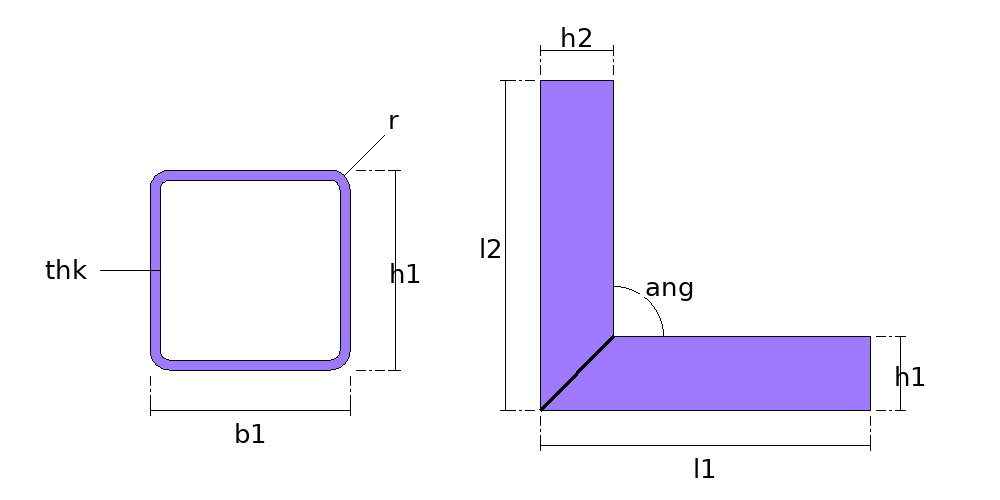
- ANG Angle between the tubes (90 = square corner)
- B1 Tube 1: width, outside (out of the plane of the frame)
- H1 Tube 1: side in the plane of the frame, outside (the one the cut crosses)
- L1 Tube 1: length up to the corner, along the outside face
- B2 Tube 2: width, outside (out of the plane of the frame)
- H2 Tube 2: side in the plane of the frame, outside (the one the cut crosses)
- L2 Tube 2: length up to the corner, along the outside face
- THK Tube wall
- R Tube corner radius, outside
Calculate with your own measurements
No account needed: enter the measurements in millimetres or inches and get the figures and the drawing. The scaled PDF template, the DXF for the cutting table and the 3D model take a free account.
Diameters and sides are outside measurements. The flat pattern already allows for the plate thickness, working on the mean line.
Units: mm inches
How it develops: the formulas
The worked figures on this page are for the metric example: ANG 90° · B1 40 mm · H1 40 mm · L1 500 mm · B2 40 mm · H2 40 mm · L2 500 mm · THK 2 mm · R 4 mm. In inches the example and the calculator start from those sizes rounded to the tape, so their numbers differ slightly.
- Where the inside edge lies
x_I = (h2 + h1 × cos θ) / sin θ ; z_I = (h1 + h2 × cos θ) / sin θθ is the angle between the tubes, 90° in a frame, and h1 and h2 their sides in the plane of the frame, outside. x_I and z_I are how far the inside edge of the corner sits back from the square of the outside one, along each tube. In the example, 40 × 40 at 90°: 40 mm on both.- The cut angle on each tube
tan φ1 = x_I / h1 ; tan φ2 = z_I / h2 ; φ1 + φ2 = 180° − θFrom square on the tube, in the same plane for both. In the example, 45° and 45°; in a 90° corner of a 60 mm tube with a 40 mm one, 33.7° and 56.3°.- The template's round
G = 2 × (b − 2r) + 2 × (h − 2r) + 2π × rThe outside face unrolled, with the corner of radius r outside: 2 × 32 + 2 × 32 + 25.1 = 153.1 mm on the 40 × 40 with a 4 mm corner.- The height of the cut on the template
y = 30 + (h − z) × tan φz is the depth of the point from the outside face, and the straight edge sits 30 mm past the deepest point of the cut. In the example, 70 mm at the middle of the outside face, 50 at the middle of the sides, 30 at the middle of the inside face, and 68.8 and 31.2 on the edges.- The ends of each bar
outside face = L ; inside face = L − h × tan φL is the length up to the edge of the corner, along the outside face. In the example, 500 and 460 mm.
Worked example
The values the form comes pre-filled with, run through the tool itself:
| Angle between the tubes (90 = square corner) | 90° |
|---|---|
| Tube 1: width, outside (out of the plane of the frame) | 1-1/2" |
| Tube 1: side in the plane of the frame, outside (the one the cut crosses) | 1-1/2" |
| Tube 1: length up to the corner, along the outside face | 20" |
| Tube 2: width, outside (out of the plane of the frame) | 1-1/2" |
| Tube 2: side in the plane of the frame, outside (the one the cut crosses) | 1-1/2" |
| Tube 2: length up to the corner, along the outside face | 20" |
| Tube wall | 1/16" |
| Tube corner radius, outside | 3/16" |
| The flat pattern fits a plate of | 5-11/16" × 2-11/16" |
| Flat patterns produced | 2 |
Result of the example
| Plate 1 | 5-11/16" × 2-11/16" |
|---|---|
| Area and weight | 0.08 ft² · ≈ 0.19 lb in 1/16" steel |
| Plate 2 | 5-11/16" × 2-11/16" |
| Area and weight | 0.08 ft² · ≈ 0.19 lb in 1/16" steel |
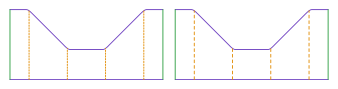
Ordinate table
| # | Position on the plate | Element height |
|---|---|---|
| 1 | 0" | 2-11/16" |
| 2 | 11/16" | 2-5/8" |
| 3 | 2-1/8" | 1-1/4" |
| 4 | 3-9/16" | 1-1/4" |
| 5 | 4-15/16" | 2-5/8" |
| 6 | 5-11/16" | 2-11/16" |
Assembly notes
Wrap each template round its tube with the straight edge square, the dashed lines on the tube's edges and the two ends of the paper meeting at the middle of the outside face, and mark along the top edge. The cut comes out at 45° from square on tube 1 and 45° on tube 2, in the same plane: bar 1 measures 20" along the outside face and 18-1/2" along the inside face, and bar 2, 20" and 18-1/2".
How to mark it out on the plate
- Enter the angle between the tubes, both sides of each tube outside, the length of each bar up to the corner, the wall and the corner radius.
- Print both templates 1:1 and cut each along its top edge, which is the cut.
- Wrap each template round its tube with the straight edge square, the dashed lines on the edges and the two ends of the paper at the middle of the outside face, and mark along the top edge.
- Cut on the line with the angle grinder or the saw, going through all four faces without leaving the line.
- Put the two bars together, check the angle of the corner and weld.
Common mistakes and tolerances
- Cutting 45° on different tubes
- With tubes of different sides in the plane of the frame, two 45° cuts do not match: the inside face of one runs past the other's. Each tube has its own angle, and the two add up to 180° minus the angle of the corner.
- Measuring the bar along the inside face
- The length up to the corner is the outside face's, the long point. Along the inside face the bar is shorter by the set-back of the cut: 40 mm on the 40 × 40 at 45°.
- Marking with the square face by face
- The error on each face carries over to the next, and the line does not close where it started. The wrapped template marks the whole round at once.
Frequently asked questions
- How do you cut square tube at 45° without a miter saw?
- Wrap the template round the tube with the straight edge square and the dashed lines on the edges, mark along the top edge and cut on the line with the angle grinder. The line goes all the way round, so the cut closes on all four faces. On the 40 × 40 tube with a 4 mm corner of the example, the template is 153.1 mm round and the cut runs from 30 to 70 mm above the straight edge.
- What is the cut angle with tubes of different sizes?
- It is no longer 45°: the cut runs through the outside and the inside edge of the corner, and each tube is cut at the angle that takes its outside face to that edge, tan φ = set-back / side. In a 90° corner of a 60 mm tube with a 40 mm one, the cuts come out at 33.7° and 56.3°, which add up to 90°.
- And in a corner that is not 90°?
- With equal tubes, each bar is cut at half of what the corner lacks to 180°: in a triangle, with 60° corners, the cut is 60° from square on each bar; in a hexagon, with 120° corners, it is 30°. The calculator does any angle from 10° to 170°, with equal or different tubes.
- How long is each bar?
- The length along the outside face, up to the edge of the corner, is the one you enter; along the inside face the bar is shorter by the set-back of the cut, the side of the tube times tan φ. In the example, 500 mm outside and 460 inside on both bars: each loses 40 mm on the inside face.
- Why wrap a template if the cut is straight?
- Because the straight line has to go all the way round the tube and close on all four faces in the same plane, and over the rounded corners it curves; with a square and a rule, the error on one face carries over to the next. The template is the outside of the tube, sits square, and its top edge is the cut.
You can work out the figures right here, with no account. PDF, DXF, 3D and history take an account — free, with unlimited calculations.