Segmented Round S-Offset flat pattern
What it is
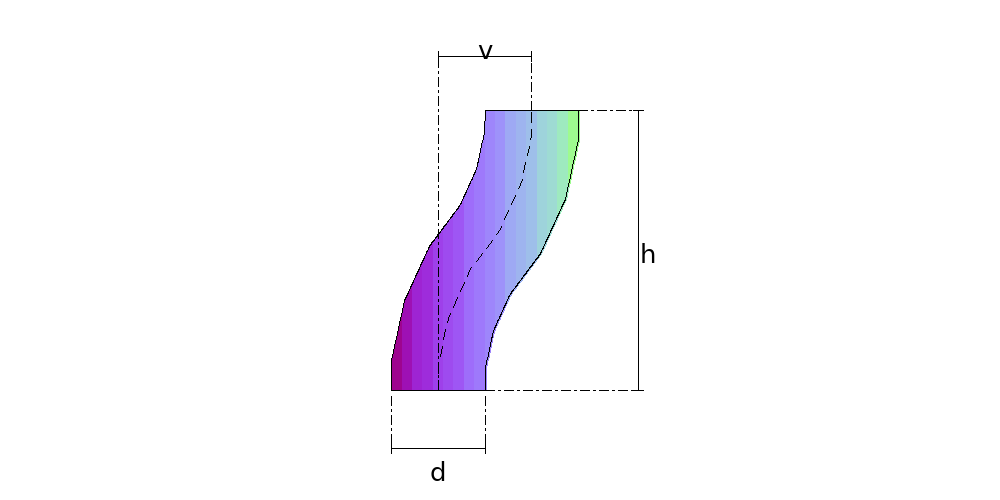
The segmented S-offset moves a round pipe across without changing its direction: the centreline makes two bends of the same radius, one each way, and the pipe leaves parallel to how it came in, offset. It is the lobster back offset made from plate, in gores like the segmented bend, and the calculation finds the radius and turn of each bend from the offset and the length. There are three templates: the half gore at the ends, the gore of both bends, and the middle gore, with parallel cuts, which reverses the curve.
Where it is used
Chimneys and exhaust ducts that step round a beam, a slab or an eave; connecting a fan, hood or cyclone whose outlet is off the line of the run; dust extraction and pneumatic conveying; large-diameter rolled-plate pipework, where there is no ready-made bend.
Measurements the calculation needs
- D Pipe diameter
- V Offset between the centrelines
- H Length of the offset, along the pipe
- S Gores in each bend
- DV Divisions
- THK Plate thickness
- L Straight in the middle (on the centreline; 0 is the reverse curve)
- CS Seam position (degrees from the throat)
- REF Measured
Calculate with your own measurements
No account needed: enter the measurements in millimetres or inches and get the figures and the drawing. The scaled PDF template, the DXF for the cutting table and the 3D model take a free account.
Diameters and sides outside to outside, inside or on the mean line, as set in “Measured”. The pattern already takes off the thickness, on the mean line.
Inches or millimetres? mm inches
How it develops: the formulas
- Turn and radius of each bend
θ = 2 × arctan(v / (h + l)) ; R = (h − l × cos θ) / (2 × sin θ)v is the offset between the centrelines, h the length of the offset and l the middle straight. With no straight it is the reverse curve of surveying, R = (v² + h²) / (4 × v). In the example, 400 over 1200: θ = 36.87° and R = 1000 mm.- Half mitre of each gore
β = θ / (2 × gores)Each full gore turns 2β and each half gore β. In the example, 3 gores per bend: β = 6.14°.- Height of each generator
half gore: (R − r × cos φ) × tan β ; gore: 2 × (R − r × cos φ) × tan βr = (D − t) / 2 is the mid-line radius and φ the angle from the throat. In the example, the half gore measures 86.3 mm at the throat and 129.0 mm at the heel, and the gore 172.6 and 258.1 mm, on L = π × (D − t) = 1247.2 mm.- The middle gore
height = 2 × R × tan β + l, all the way roundThe two cuts are parallel: the bottom and top edges are the same wave, shifted. In the example, 215.3 mm.- How many pieces to cut
half gores: 2 ; gores: 2 × (gores − 1) ; middle gore: 1In the example, 2, 4 and 1: seven pieces.
Worked example
The values the form comes pre-filled with, run through the tool itself:
| Pipe diameter | 400 mm |
|---|---|
| Offset between the centrelines | 400 mm |
| Length of the offset, along the pipe | 1200 mm |
| Gores in each bend | 3 |
| Divisions | 16 |
| Plate thickness | 3 mm |
| Straight in the middle (on the centreline; 0 is the reverse curve) | 0 mm |
| Seam position (degrees from the throat) | 0° |
| Measured | Outside (outer face to outer face) |
| The flat pattern fits a plate of | 1247 × 258 mm |
| Flat patterns produced | 3 |
Result of the example
| Plate 1 | 1247 × 129 mm, cut 2 times |
|---|---|
| Area and weight | 0.13 m² · ≈ 3.2 kg in 3 mm steel |
| Plate 2 | 1247 × 258 mm, cut 4 times |
| Area and weight | 0.27 m² · ≈ 6.3 kg in 3 mm steel |
| Plate 3 | 1247 × 258 mm |
| Area and weight | 0.27 m² · ≈ 6.3 kg in 3 mm steel |

Ordinate table
| # | Position on the plate | Element height |
|---|---|---|
| 1 | 0 mm | 86.3 mm |
| 2 | 78 mm | 87.9 mm |
| 3 | 155.9 mm | 92.6 mm |
| 4 | 233.9 mm | 99.5 mm |
| 5 | 311.8 mm | 107.7 mm |
| 6 | 389.8 mm | 115.8 mm |
| 7 | 467.7 mm | 122.8 mm |
| 8 | 545.7 mm | 127.4 mm |
| 9 | 623.6 mm | 129 mm |
| 10 | 701.6 mm | 127.4 mm |
| 11 | 779.5 mm | 122.8 mm |
| 12 | 857.5 mm | 115.8 mm |
| 13 | 935.4 mm | 107.7 mm |
| 14 | 1,013.4 mm | 99.5 mm |
| 15 | 1,091.3 mm | 92.6 mm |
| 16 | 1,169.3 mm | 87.9 mm |
| 17 | 1,247.2 mm | 86.3 mm |
Assembly notes
Each bend of the S turns 36.9°, with a 1,000 mm centreline radius. The second bend is the first turned half a turn round: cut the half gores and the gores of both from the same templates.
The middle gore has its two cuts parallel: it is the piece that reverses the curve. Build the first bend up to it and the second after it, with the throat on the opposite side to the first.
Every template comes with the longitudinal seam on the throat of its own bend, the shortest weld, and the middle gore on the throat of the first bend. Do not turn a cut gore half a turn round to stagger the seams: the long side goes to the throat and the bend loses angle.
How to mark it out on the plate
- Enter the diameter, the offset between the centrelines, the length of the offset, the gores in each bend and the thickness; and the middle straight, if the radius of the reverse curve does not fit.
- Cut the two half gores, the gores and the middle gore from the templates, and roll each one like a shell.
- Build the first bend from the inlet up to the middle gore, heel to heel, like a segmented bend.
- Weld on the middle gore and build the second bend after it, turned half a turn round: its throat is on the side of the first bend's heel.
- Check the ends: the outlet has to be parallel to the inlet, offset by v and h away from it.
Common mistakes and tolerances
- Building the second bend like the first
- It comes out as a 2θ elbow, not an S. The second bend is the first turned half a turn round, and the piece that turns it is the middle gore, with parallel cuts.
- Cutting the middle gore like an ordinary gore
- An ordinary gore has its two cuts converging, the middle one parallel. With an ordinary gore in its place the curve does not reverse.
- Working out the two bends separately with another radius
- The radius comes from the offset and the length: R = (v² + h²) / (4 × v), with no straight. With another radius the bends do not close the offset, or the outlet comes out askew.
- A radius smaller than half the diameter
- With R < D/2 the throat disappears and the gores cross; the calculation refuses. Lengthen the offset or shorten the middle straight.
Frequently asked questions
- How do you work out the radius and angle of an S-offset?
- From the offset v and the length h: each bend turns θ = 2 × arctan(v / h), and the centreline radius is R = (v² + h²) / (4 × v). In the example, a 400 offset over a 1200 length: θ = 36.87° and R = 1000 mm, two and a half times the diameter of the 400 pipe.
- Why is the middle gore different from the others?
- Because that is where the curve reverses. The inner half gore of each bend lies on the same line, and the two become one piece; as the second bend turns the other way, its two cuts are parallel, and the generator measures the same all the way round: 215.3 mm in the example, while the gore runs from 172.6 mm at the throat to 258.1 mm at the heel.
- How many pieces do I cut?
- With g gores in each bend, two half gores, 2 × (g − 1) gores and one middle gore: 2g + 1 pieces. In the example, 3 gores per bend: 2 half gores, 4 gores and the middle gore. The gores of both bends come from the same template, because the second bend is the first turned half a turn round.
- What if the radius of the reverse curve is too large?
- Enter a straight in the middle. The bends then turn θ = 2 × arctan(v / (h + l)) and the radius drops to R = (h − l × cos θ) / (2 × sin θ). In the example, with a 300 mm straight, each bend turns 29.86° and the radius drops to 943.75 mm; the straight goes into the middle gore, which then measures 464.4 mm.
- What is the largest offset I can make?
- The length plus the middle straight: then each bend turns 90°, and the offset is two 90° bends back to back. The centreline radius also has to be more than half the diameter, or the throat disappears and the gores cross: the calculation refuses, and the cure is a longer offset or a shorter straight.
You can work out the figures right here, with no account. PDF, DXF, 3D and history take an account — free, with unlimited calculations.