Starting Collar (Round Takeoff) flat pattern
What it is
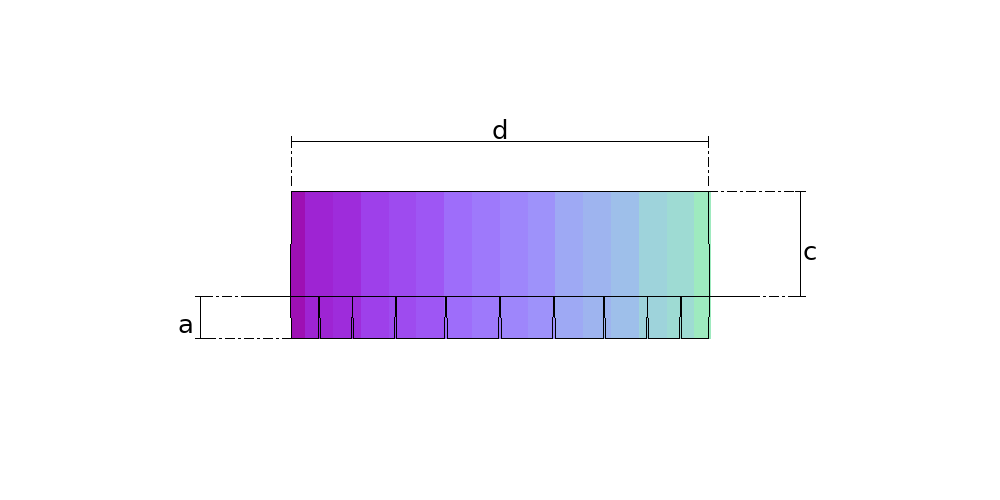
A starting collar connects a round duct, or a flex duct, to a flat face: the end cap of a plenum, the wall of a rectangular duct. This is the tabbed collar of the duct shop, the dovetail collar: a short pipe with tabs cut along one edge, pushed into a hole the size of its outside diameter and locked without welding, one tab outside and the next inside. The sheet is a strip with the tabs, the fold line at their base and the seam between two tabs.
Where it is used
Start collar for flex duct and round branch takeoffs on plenums, distribution boxes and rectangular duct; diffuser and grille takeoffs.
Measurements the calculation needs
- D Outside diameter of the collar
- C Height of the collar above the sheet
- A Height of the tabs
- NA Number of tabs (even)
- THK Plate thickness
Calculate with your own measurements
No account needed: enter the measurements in millimetres or inches and get the figures and the drawing. The scaled PDF template, the DXF for the cutting table and the 3D model take a free account.
Diameters and sides are outside measurements. The flat pattern already allows for the plate thickness, working on the mean line.
Units: mm inches
How it develops: the formulas
- The length of the strip
P = π × (D − t)On the mean line: π × 199.35 = 626.3 mm for a 200 mm collar in 0.65 mm sheet.- The height of the strip
C + AThe collar above the sheet plus the tabs: 50 + 20 = 70 mm in the example. The fold line runs at A from the edge of the tabs.- The width of each tab
b = P / NA − 2tThe pitch less the gap of two thicknesses: 626.3 / 24 − 1.3 = 24.8 mm in the example. The seam falls in a gap, with half a gap at each end of the strip.
Worked example
The values the form comes pre-filled with, run through the tool itself:
| Outside diameter of the collar | 7-7/8" (7.874) |
|---|---|
| Height of the collar above the sheet | 1-15/16" (1.9685) |
| Height of the tabs | 13/16" (0.7874) |
| Number of tabs (even) | 24 |
| Plate thickness | 0.0256" |
| The flat pattern fits a plate of | 24-11/16" × 2-3/4" |
Result of the example
| Plate | 24-11/16" × 2-3/4" |
|---|---|
| Area and weight | 0.47 ft² · ≈ 0.49 lb in 0.0256" steel |

Ordinate table
| # | Position on the plate | Element height |
|---|---|---|
| 1 | 0" | 1-15/16" |
| 2 | 0.0276" | 13/16" |
| 3 | 1" | 13/16" |
| 4 | 1-1/16" | 13/16" |
| 5 | 2" | 13/16" |
| 6 | 2-1/16" | 13/16" |
| 7 | 3-1/16" | 13/16" |
| 8 | 3-1/8" | 13/16" |
| 9 | 4-1/16" | 13/16" |
| 10 | 4-1/8" | 13/16" |
| 11 | 5-1/8" | 13/16" |
| 12 | 5-3/16" | 13/16" |
| 13 | 6-1/8" | 13/16" |
| 14 | 6-3/16" | 13/16" |
| 15 | 7-3/16" | 13/16" |
| 16 | 7-3/16" | 13/16" |
| 17 | 8-3/16" | 13/16" |
| 18 | 8-1/4" | 13/16" |
| 19 | 9-1/4" | 13/16" |
| 20 | 9-1/4" | 13/16" |
| 21 | 10-1/4" | 13/16" |
| 22 | 10-5/16" | 13/16" |
| 23 | 11-1/4" | 13/16" |
| 24 | 11-5/16" | 13/16" |
| 25 | 12-5/16" | 13/16" |
| 26 | 12-3/8" | 13/16" |
| 27 | 13-5/16" | 13/16" |
| 28 | 13-3/8" | 13/16" |
| 29 | 14-3/8" | 13/16" |
| 30 | 14-7/16" | 13/16" |
| 31 | 15-3/8" | 13/16" |
| 32 | 15-7/16" | 13/16" |
| 33 | 16-7/16" | 13/16" |
| 34 | 16-7/16" | 13/16" |
| 35 | 17-7/16" | 13/16" |
| 36 | 17-1/2" | 13/16" |
| 37 | 18-7/16" | 13/16" |
| 38 | 18-1/2" | 13/16" |
| 39 | 19-1/2" | 13/16" |
| 40 | 19-9/16" | 13/16" |
| 41 | 20-1/2" | 13/16" |
| 42 | 20-9/16" | 13/16" |
| 43 | 21-9/16" | 13/16" |
| 44 | 21-5/8" | 13/16" |
| 45 | 22-9/16" | 13/16" |
| 46 | 22-5/8" | 13/16" |
| 47 | 23-5/8" | 13/16" |
| 48 | 23-5/8" | 13/16" |
| 49 | 24-5/8" | 13/16" |
| 50 | 24-11/16" | 1-15/16" |
Assembly notes
Close the collar's seam and cut a Ø200 mm hole in the face, its outside diameter. Of the 24 tabs, bend every other one out to 90°; push the straight ones into the hole until the bent ones sit on the sheet and, from the inside, bend the straight ones out as well, flat against the sheet, which is clamped between the two rings of tabs. Seal the joint.
How to mark it out on the plate
- Enter the collar's outside diameter, its height above the sheet, the height and number of tabs, and the thickness.
- Cut the strip with the tabs and the gaps, and roll it on the mean line to the diameter.
- Close the collar's seam, butt to butt, in the gap at the ends.
- Cut a hole in the face at the collar's outside diameter.
- Bend every other tab out to 90°; push the straight ones into the hole until the bent ones sit on the sheet and, from the inside, bend the straight ones out as well, flat against the sheet. Seal the joint.
Common mistakes and tolerances
- Cutting the hole to the inside diameter
- A tabbed collar goes through the sheet, so the hole is its outside diameter. At the inside diameter it will not go in.
- An odd number of tabs
- The tabs alternate, one outside the sheet and the next inside; with an odd number two neighbours end up on the same side at the seam. The page takes only an even number.
- Bending the tabs before closing the collar
- The tabs bend with the collar already closed: the outside ones before it goes into the hole, the inside ones after. Bent while still on the strip, they get in the way of the rolls and the collar will not close round.
Guides about this part
Frequently asked questions
- What hole do I cut in the sheet?
- The collar's outside diameter, D: the collar goes through the sheet. Every other tab bends outwards and sits on top; the rest go straight through the hole and, from the inside, bend outwards too, flat against the sheet, which ends up clamped between the two rings of tabs. The end cap of the [Plenum Box with End Cap](/en/pecas/plenum) comes out with that hole.
- Why an even number of tabs?
- Because they alternate, one outside the sheet and the next inside, and the turn has to close with one of each. With an odd number, two neighbours would end up on the same side of the sheet at the seam.
- What is the gap between the tabs for?
- Two neighbouring tabs end up on opposite sides of the sheet, and the gap of two thicknesses is the clearance that keeps one from catching on the other. The collar's seam falls in a gap: each end of the strip carries half a gap, and rolled up it closes on a whole one.
- How do I check the strip on the bench?
- The length is the perimeter of the mean line, π × (D − t): 626.3 mm for a 200 mm collar in 0.65 mm sheet. The height is the collar plus the tabs, 50 + 20 = 70 mm in the example, and each tab is the pitch, the length divided by the number of tabs, less the gap: 24.8 mm with 24 tabs.
- And the collar's seam?
- The pattern is net: the strip closes butt to butt, as it comes. If your shop closes it with a lap or a lock, add the allowance on one side, from your machine's chart.
- Does it make a spin-in or a conical collar?
- No: those come from the factory, with the bead rolled by machine. This part is the tabbed collar the shop cuts, rolls and closes itself.
You can work out the figures right here, with no account. PDF, DXF, 3D and history take an account — free, with unlimited calculations.