Truncated Rectangular Tube flat pattern
What it is
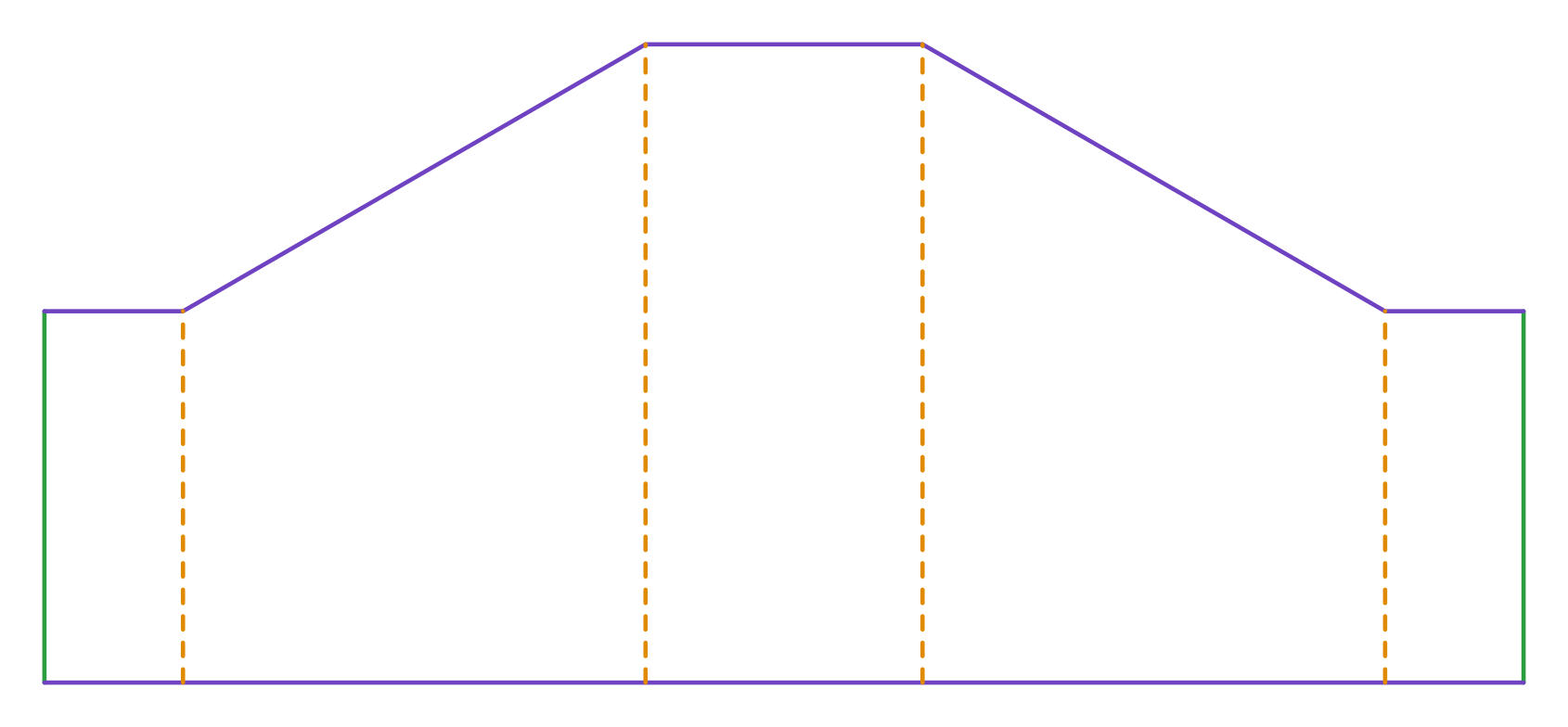
The rectangular-section duct that ends on a tilted plane — a roof, a sloping wall, the bottom of a funnel. It is to the rectangular section what the truncated cylinder is to the round shell, and the catalogue had one without the other. Rolled flat, the mouth becomes a line of four runs: straight on the low and high faces, sloping on the two sides.
Where it is used
Ducts dying into a roof or a sloping wall, intakes beside a graded floor, duct connections to equipment with a tilted face.
Measurements the calculation needs
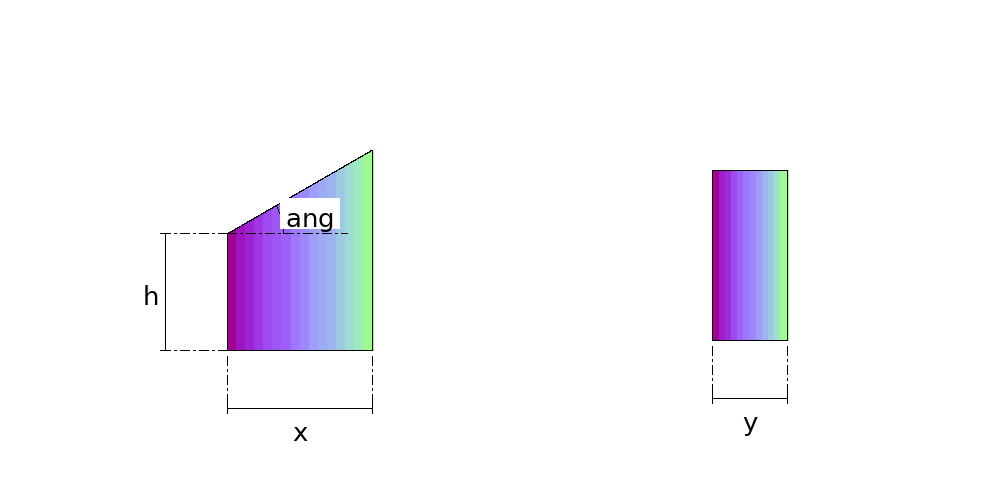
- X Side along the tilt
- Y Side across the tilt
- H Height of the low side
- ANG Cut angle from square
- THK Plate thickness
- R Bend radius
Calculate with your own measurements
No account needed: enter the measurements in millimetres or inches and get the figures and the drawing. The scaled PDF template, the DXF for the cutting table and the 3D model take a free account.
Diameters and sides are outside measurements. The flat pattern already allows for the plate thickness, working on the mean line.
Units: mm inches
Worked example
The values the form comes pre-filled with, run through the tool itself:
| Side along the tilt | 19-11/16" (19.685) |
|---|---|
| Side across the tilt | 11-13/16" (11.811) |
| Height of the low side | 15-3/4" (15.748) |
| Cut angle from square | 30° |
| Plate thickness | 1/16" (0.0591) |
| Bend radius | 0" |
| The flat pattern fits a plate of | 62-3/4" × 27-1/8" |
Result of the example
| Plate | 62-3/4" × 27-1/8" |
|---|---|
| Area and weight | 9.3 ft² · ≈ 22.5 lb in 1/16" steel |
Ordinate table
| # | Position on the plate | Element height |
|---|---|---|
| 1 | 0" | 15-3/4" |
| 2 | 5-7/8" | 15-3/4" |
| 3 | 25-1/2" | 27-1/8" |
| 4 | 37-1/4" | 27-1/8" |
| 5 | 56-7/8" | 15-3/4" |
| 6 | 62-3/4" | 15-3/4" |
Assembly notes
The pattern develops the SHARP CORNER, on the mean line — the theoretical layout, which is what gets delivered. If you fold it on a press brake with an inside radius, the blank comes out LONG: each fold needs the deduction 2*(r+t)*tan(a/2) − a*(r + k*t), with r the inside radius, a the bend angle in radians, and your tooling's k. On a 500x300 tube in 1.5 mm sheet with four 90° folds that is 3.5 mm at radius 0.75 and 9.0 mm at radius 4.5 — always to be taken off. A welded corner from separate plates needs no deduction at all.
Fold to an angle of 90° BETWEEN THE TWO FACES — what a protractor reads on the finished part, not the press stroke angle. Every crease on this part has the same angle.
Frequently asked questions
- Are all four faces cut the same?
- No, and it is the same trap as the rectangular bend. The low and high faces come out RECTANGULAR, cut square: each lies wholly at one distance from the axis, so the cut does not vary along it. Only the two side faces come out trapezoidal.
- Which side is the height given for?
- The LOW side. The high side follows from the arithmetic — it is the given height plus the width times the tangent of the angle. Same convention as the truncated cylinder.
- Why can't the angle reach 90 degrees?
- Because at 90 the plane runs parallel to the tube's axis and cuts no mouth at all — it slides down the side instead of crossing. And at zero the part is a straight tube, with no cut.
- Where does the seam go?
- In the middle of the low face, which is the shortest generator and so the shortest weld. And on a straight line, which closes better than a corner.
You can work out the figures right here, with no account. PDF, DXF, 3D and history take an account — free, with unlimited calculations.