Y Piece Leg (Breeches) flat pattern
What it is
The leg of the cylindrical breeches, the Y-branch of three pipes of one diameter. It is not the Double Cut Cylinder: its lower end has TWO planes in one turn. The outer half meets the Y Piece Trunk on the half-mitre, and the inner half meets the other leg on the crotch plane. Rolled flat, the sheet comes out with two peaks, which sit on the points of the fish mouth, and with its deepest cut in the middle, at the crotch.
Where it is used
Pipework bifurcations of one diameter, extraction and flue breeches, air and dust headers and splitters, twin outlets from fans and cyclones.
Measurements the calculation needs
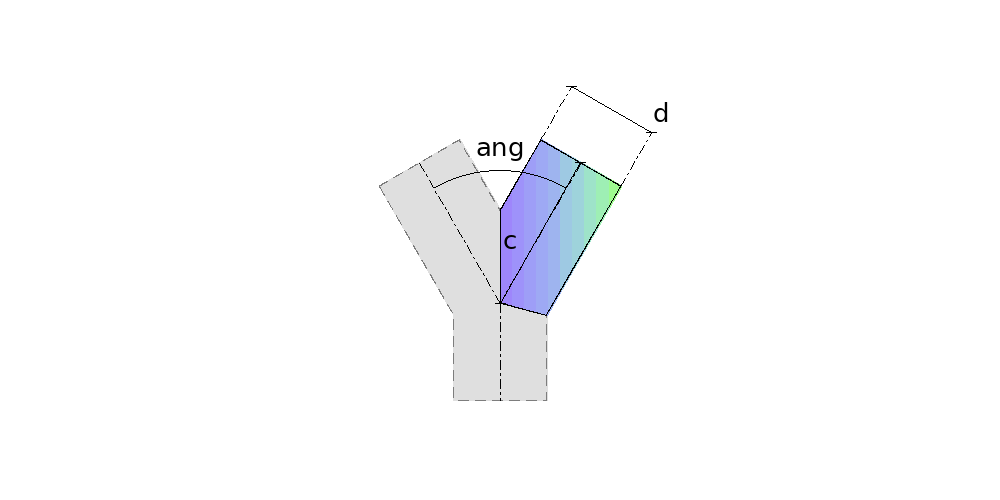
- D Outside diameter of all three pipes
- C Length of the leg, from the axis crossing to the mouth
- ANG Angle between the two legs
- DV Divisions
- THK Plate thickness
Calculate with your own measurements
No account needed: enter the measurements in millimetres or inches and get the figures and the drawing. The scaled PDF template, the DXF for the cutting table and the 3D model take a free account.
Diameters and sides are outside measurements. The flat pattern already allows for the plate thickness, working on the mean line.
Units: mm inches
How it develops: the formulas
- The outer half, against the trunk
L(θ) = c − rn × cos θ × tan(ang/4)From θ = −90° to 90°, counted from the heel, with rn = (d − t)/2 the mid-line radius: it is the trunk's half-mitre. In the example, the heel measures 700 − 197 × tan 15° = 647.2 mm.- The inner half, against the other leg
L(θ) = c − rn × |cos θ| × cot(ang/2)From 90° to 270°: the plane of symmetry of the Y. In the example, the middle of the sheet, which is the crotch, measures 700 − 197 × cot 30° = 358.8 mm.- The width of the sheet
P = π × (d − t)On the mid-line: 1,237.8 mm in the example. At the two points, a quarter and three quarters of P along, both formulas give c, the full length.
Worked example
The values the form comes pre-filled with, run through the tool itself:
| Outside diameter of all three pipes | 400 mm |
|---|---|
| Length of the leg, from the axis crossing to the mouth | 700 mm |
| Angle between the two legs | 60° |
| Divisions | 32 |
| Plate thickness | 6 mm |
| The flat pattern fits a plate of | 1238 × 700 mm |
Result of the example
| Plate | 1238 × 700 mm, cut 2 times |
|---|---|
| Area and weight | 0.71 m² · ≈ 33.5 kg in 6 mm steel |
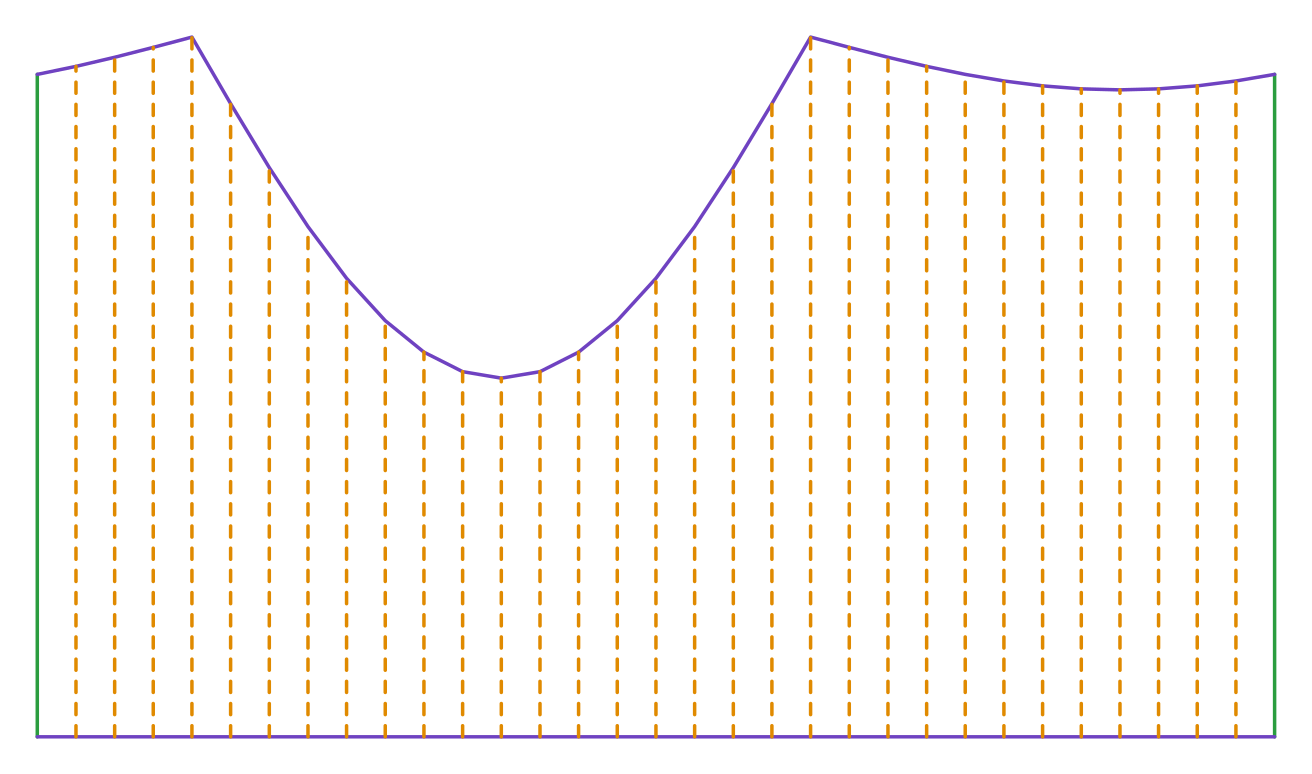
Ordinate table
| # | Position on the plate | Element height |
|---|---|---|
| 1 | 0 mm | 662.7 mm |
| 2 | 38.7 mm | 670.7 mm |
| 3 | 77.4 mm | 679.8 mm |
| 4 | 116 mm | 689.7 mm |
| 5 | 154.7 mm | 700 mm |
| 6 | 193.4 mm | 633.4 mm |
| 7 | 232.1 mm | 569.4 mm |
| 8 | 270.8 mm | 510.4 mm |
| 9 | 309.4 mm | 458.7 mm |
| 10 | 348.1 mm | 416.3 mm |
| 11 | 386.8 mm | 384.8 mm |
| 12 | 425.5 mm | 365.3 mm |
| 13 | 464.2 mm | 358.8 mm |
| 14 | 502.9 mm | 365.3 mm |
| 15 | 541.5 mm | 384.8 mm |
| 16 | 580.2 mm | 416.3 mm |
| 17 | 618.9 mm | 458.7 mm |
| 18 | 657.6 mm | 510.4 mm |
| 19 | 696.3 mm | 569.4 mm |
| 20 | 734.9 mm | 633.4 mm |
| 21 | 773.6 mm | 700 mm |
| 22 | 812.3 mm | 689.7 mm |
| 23 | 851 mm | 679.8 mm |
| 24 | 889.7 mm | 670.7 mm |
| 25 | 928.3 mm | 662.7 mm |
| 26 | 967 mm | 656.1 mm |
| 27 | 1,005.7 mm | 651.2 mm |
| 28 | 1,044.4 mm | 648.2 mm |
| 29 | 1,083.1 mm | 647.2 mm |
| 30 | 1,121.7 mm | 648.2 mm |
| 31 | 1,160.4 mm | 651.2 mm |
| 32 | 1,199.1 mm | 656.1 mm |
| 33 | 1,237.8 mm | 662.7 mm |
Assembly notes
Both legs come from this one template: cut two sheets. Each seam goes 45° from the heel, on the outside of the Y: on the heel it would meet the trunk's seam, which sits in the trough of the fish mouth. The crotch, 3/8 along the sheet, faces the other leg; the two peaks, at 1/8 and 5/8 of the sheet, sit on the two points of the trunk's fish mouth, and the heel is at 7/8.
How to mark it out on the plate
- Enter the outside diameter, the same for all three pipes, the leg length from the crossing of the axes, the angle between the legs, the divisions and the thickness.
- Cut two sheets from the template: the two legs are identical.
- Roll each one with the seam at the ends of the sheet, 45° from the heel, and weld the seam.
- Put the two legs together at the crotch, the middle of the sheet, and weld one to the other.
- Seat the legs on the trunk's fish mouth, with the peaks of the sheet on the points of the crotch, and weld the joint.
Common mistakes and tolerances
- Making the leg from the double-cut cylinder
- The double-cut cylinder has one plane at each end, and the lower end of the leg has two. Made with one, the leg runs into the other leg at the crotch.
- Entering the angle of one leg instead of the angle between the two
- ang is the angle between BOTH legs; each makes half of it with the trunk. With the angle of one leg, the Y comes out half as wide open.
- Measuring the length along the shortest element
- c runs from the crossing of the axes to the mouth. The crotch element is much shorter: 358.8 mm in the example, against the 700 of c.
Frequently asked questions
- Why is the leg not the double-cut cylinder?
- Because the double-cut cylinder has a single plane at each end, and the lower end of the leg has two. The outer half meets the trunk on the half-mitre, at ANG/4, and the inner half meets the other leg on the plane of symmetry of the Y. Made with one plane, the leg runs into the other leg at the crotch.
- Where do the two planes meet?
- At the two points of the trunk's fish mouth, a quarter and three quarters of the way round. There the element has the full length, c, which is why the divisions are a multiple of four: a station lands on each point, and the chord does not cut it off.
- Where is the leg length measured from?
- From the crossing of the axes to the mouth, centre to face, the way any Y-fitting is dimensioned. With all three pipes equal the crossing sits at the height of the crotch points, which is the trunk's height h: both measurements start from the same point.
- How do I check the template on the bench?
- Each half is the cut of a single-cut mitred elbow. The outer one is the elbow between the trunk and the leg, which turns half the angle between the legs: it loses rn × tan(ANG/4) at the heel, 52.8 mm in the example. The inner one is the elbow between the two legs, which turns 180° − ANG: it loses rn × cot(ANG/2) at the crotch, 341.2 mm. With 90° between the legs it is the 90-degree elbow, and the crotch loses the whole radius; at 120°, both lose the same.
- Where does the seam go?
- 45° from the heel, on the outer side of the Y, as on the Conical Y Piece. On the heel it would meet the trunk's seam, which sits in the trough of the fish mouth; at the crotch, the weld of one leg to the other; and on the points all three pieces meet. At 45° it is clear of them all.
- How many sheets come out?
- One, cut twice: the two legs are identical, one being the other turned half a turn about the trunk axis. With the trunk, the whole breeches comes out of two templates.
You can work out the figures right here, with no account. PDF, DXF, 3D and history take an account — free, with unlimited calculations.