Rectangular Duct Bend flat pattern
What it is
The mitred bend with its section changed: a rectangular duct instead of a round shell. The cut is the same calculation as the round bend — the mitre height at a point is its distance from the bend axis times the tangent of half the angle per gore. What changes is the path: on the round one that distance varies as a cosine and the cut comes out a sine wave; here it is constant on two faces and varies linearly on the other two.
Where it is used
Extraction and air-conditioning ductwork, dust collection runs, ventilation trunking, any change of direction in rectangular section.
Measurements the calculation needs
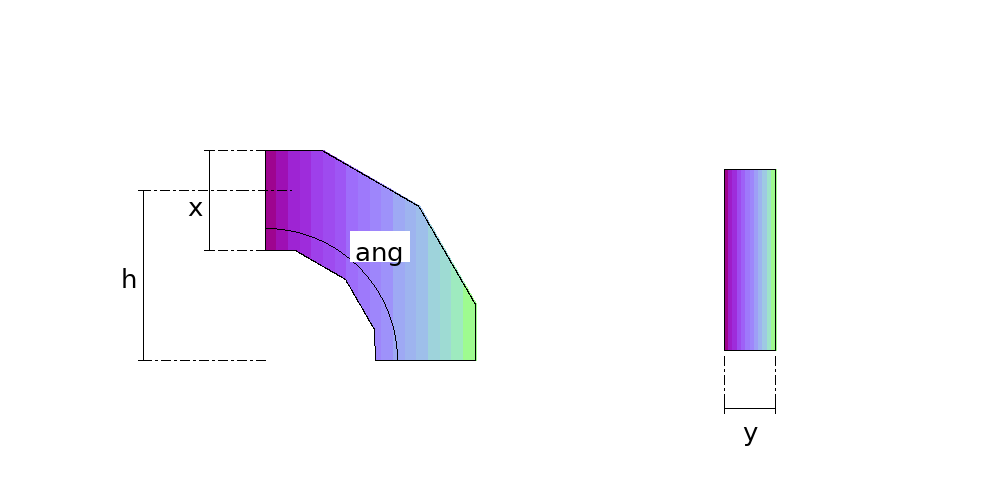
- H Radius to the bend axis
- X Side from throat to heel
- Y Side between the cheeks
- ANG Total angle of the bend
- S Number of gores
- THK Plate thickness
- R Bend radius
Calculate with your own measurements
No account needed: enter the measurements in millimetres or inches and get the figures and the drawing. The scaled PDF template, the DXF for the cutting table and the 3D model take a free account.
Diameters and sides are outside measurements. The flat pattern already allows for the plate thickness, working on the mean line.
Units: mm inches
Worked example
The values the form comes pre-filled with, run through the tool itself:
| Radius to the bend axis | 31-1/2" (31.4961) |
|---|---|
| Side from throat to heel | 19-11/16" (19.685) |
| Side between the cheeks | 11-13/16" (11.811) |
| Total angle of the bend | 90° |
| Number of gores | 3 |
| Plate thickness | 1/16" (0.0591) |
| Bend radius | 0" |
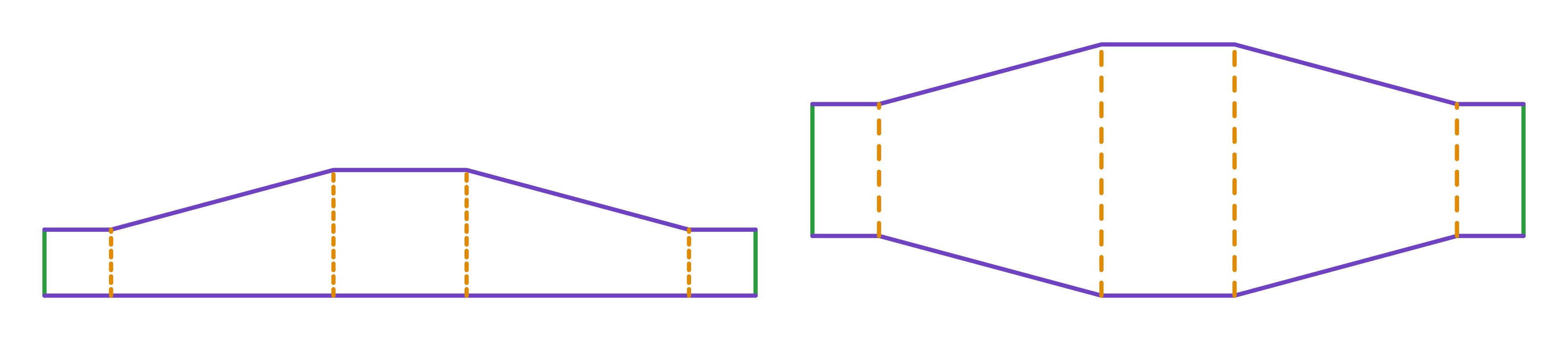
| The flat pattern fits a plate of | 62-3/4" × 22-1/8" |
| Flat patterns produced | 2 |
Result of the example
| Plate 1 | 62-3/4" × 11-1/16", cut 2 times |
|---|---|
| Area and weight | 3.7 ft² · ≈ 8.9 lb in 1/16" steel |
| Plate 2 | 62-3/4" × 22-1/8", cut 2 times |
| Area and weight | 7.4 ft² · ≈ 17.7 lb in 1/16" steel |
Ordinate table
| # | Position on the plate | Element height |
|---|---|---|
| 1 | 0" | 5-13/16" |
| 2 | 5-7/8" | 5-13/16" |
| 3 | 25-1/2" | 11-1/16" |
| 4 | 37-1/4" | 11-1/16" |
| 5 | 56-7/8" | 5-13/16" |
| 6 | 62-3/4" | 5-13/16" |
Assembly notes
Every gore comes with its longitudinal seam on the throat, the shortest weld, and the gores go together all the same way round, heel to heel. Do not turn a cut gore half a turn to stagger the seams: its long side goes to the throat and the bend loses angle. To stagger them, mark every second gore from the heel instead — cut the paper template on its middle line and swap the two halves.
The pattern develops the SHARP CORNER, on the mean line — the theoretical layout, which is what gets delivered. If you fold it on a press brake with an inside radius, the blank comes out LONG: each fold needs the deduction 2*(r+t)*tan(a/2) − a*(r + k*t), with r the inside radius, a the bend angle in radians, and your tooling's k. On a 500x300 tube in 1.5 mm sheet with four 90° folds that is 3.5 mm at radius 0.75 and 9.0 mm at radius 4.5 — always to be taken off. A welded corner from separate plates needs no deduction at all.
Fold to an angle of 90° BETWEEN THE TWO FACES — what a protractor reads on the finished part, not the press stroke angle. Every crease on this part has the same angle.
Frequently asked questions
- Are all four faces of a gore cut the same?
- No, and that is the classic mistake on this part. The throat and heel faces come out RECTANGULAR, cut square, however tight the bend — each of them lies wholly at one distance from the axis, so the cut does not vary along it. Only the two side faces come out trapezoidal.
- Where is the radius measured to?
- To the bend axis, at the centre of the section. The throat is half of X inside it and the heel half of X outside, and that difference is what makes the heel come out longer than the throat.
- Why are there two sheets?
- Because the end gores are cut once and the middle ones twice. The first sheet comes in two copies — the two half-ends — and the second in one fewer than the number of gores. With a single gore the part is just the two half-ends, and the second sheet does not exist.
- Is there a limit to the angle per gore?
- Ninety degrees, the same as the round bend. At that point the half-mitre reaches 45 degrees, which is the single-cut mitred elbow. Past it the cut is steeper than 45 degrees and the part stops being makeable — anyone needing more turn adds gores.
You can work out the figures right here, with no account. PDF, DXF, 3D and history take an account — free, with unlimited calculations.