Plate with Hole for an Angled Pipe flat pattern
What it is
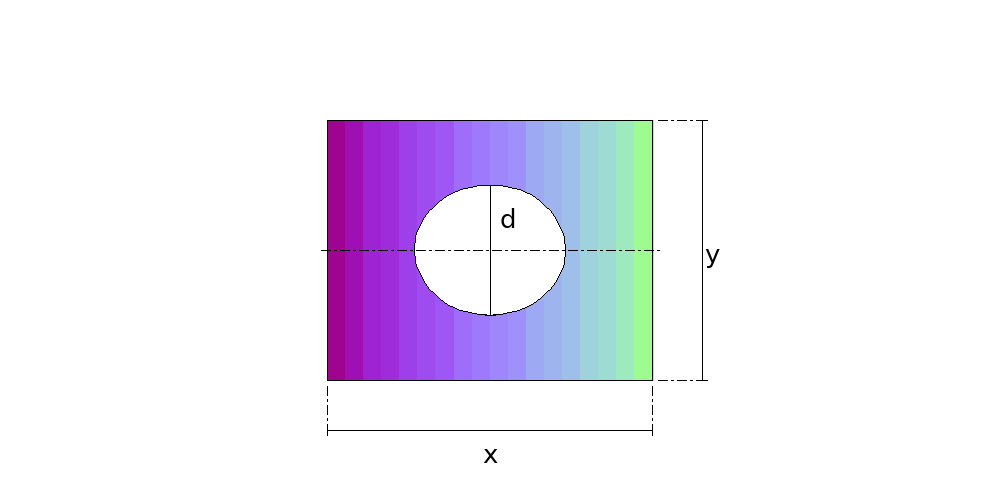
The plate with a hole for an angled pipe is the flat plate that a pipe crosses at an angle: the flue through a pitched roof, the angled nozzle in a flat shell, the base plate of a raked tubular column. The hole is neither round nor a four-centre oval: it is the ellipse of the pipe cut by the plane of the plate, longer along the slope. Cut square, it is the envelope of the ellipses on the two faces, and the pipe passes through.
Where it is used
Flues and exhaust pipes through roofs and pitched decks; angled nozzles in flat shells, lids and bottoms of rectangular tanks; base and cap plates of raked tubular columns and braces; sleeves for pipework through sloping walls.
Measurements the calculation needs
- D Pipe diameter (outside)
- ANG Angle between the pipe and the perpendicular to the plate
- X Plate length (along the slope)
- Y Plate width
- DV Hole divisions
- THK Plate thickness
Calculate with your own measurements
No account needed: enter the measurements in millimetres or inches and get the figures and the drawing. The scaled PDF template, the DXF for the cutting table and the 3D model take a free account.
Diameters and sides are outside measurements. The flat pattern already allows for the plate thickness, working on the mean line.
Units: mm inches
How it develops: the formulas
The worked figures on this page are for the metric example: D 200 mm · ANG 30° · X 500 mm · Y 400 mm · DV 64 · THK 3 mm. In inches the example and the calculator start from those sizes rounded to the tape, so their numbers differ slightly.
- Semi-axes of the ellipse
a = d / (2 × cos α) ; b = d / 2α is the angle between the pipe and the perpendicular to the plate. In the example, 115.5 and 100 mm.- Offset between the faces
s = t × tan αThe ellipses on the two faces are s apart along the slope: 1.7 mm in the example, in 3 mm plate.- The hole cut square
length = 2a + s ; width = dHalf an ellipse from each face, joined by two straights of s. In the example, 232.7 by 200 mm.
Worked example
The values the form comes pre-filled with, run through the tool itself:
| Pipe diameter (outside) | 8" |
|---|---|
| Angle between the pipe and the perpendicular to the plate | 30° |
| Plate length (along the slope) | 20" |
| Plate width | 16" |
| Hole divisions | 64 |
| Plate thickness | 1/8" |
| The flat pattern fits a plate of | 20" × 16" |
Result of the example
| Plate | 20" × 16" |
|---|---|
| Area and weight | 1.8 ft² · ≈ 9.3 lb in 1/8" steel |
Assembly notes
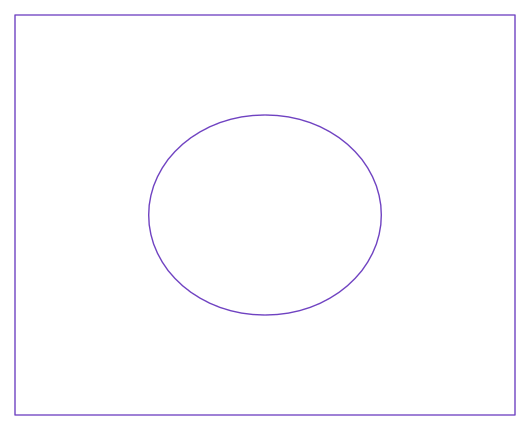
The hole measures 236.5 mm along the slope and 203.2 mm across it, cut square to the plate: it is the pipe's ellipses at 30° on both faces, 1.8 mm apart. The pipe touches the edge at both ends of the slope, one on each face, and beyond each end there is a wedge gap of up to 1.8 mm.
How to mark it out on the plate
- Enter the outside diameter of the pipe, the angle between it and the perpendicular to the plate, the plate size and the thickness.
- To mark out by hand, draw the axes of the hole at the centre of the plate, the major one along the slope, and strike half an ellipse of semi-axes a and b on each side, with the centres s apart.
- Join the two half ellipses with the top and bottom straights, at the pipe width.
- Cut square and pass the pipe through at the angle, with its axis in the plane of the slope.
Common mistakes and tolerances
- A round hole the size of the pipe
- The angled pipe will not go through: along the slope the hole needs d / cos α, 230.9 mm in the example instead of 200.
- Forgetting the thickness
- In thick plate the ellipses on the two faces move apart: 20 mm plate at 45° adds 20 mm to the length of the hole.
- Measuring the angle from the plate
- The angle is between the pipe and the perpendicular to the plate. A nozzle at 60° to the plate is 30° here.
Frequently asked questions
- How big is the hole?
- Across the slope, the pipe diameter; along it, d / cos α, plus t × tan α for the thickness. In the example, a 200 flue through a 30° roof in 3 mm plate: 232.7 mm by 200 mm.
- Why does the hole have two straight stretches?
- Because the plate has thickness. Each face cuts the pipe in an ellipse, and the two are t × tan α apart along the slope: 1.7 mm in the example. Cut square, the hole has to let the pipe through both, and the outline that does that is half an ellipse from each face, joined by two straights of that length. In thin sheet the straights all but vanish.
- Which angle do I enter?
- The angle between the pipe and the perpendicular to the plate. For a vertical flue through a roof, it is the roof pitch; for a nozzle at 60° to the plate, it is 30°. At zero the pipe is square to the plate and the hole is round.
- Is there a gap between the pipe and the hole?
- At both ends of the slope the pipe touches, one on each face, and beyond each end there is a wedge gap reaching t × tan α. To weld from above, bevel the hole on the gap side, or add the weld gap to the pipe diameter.
- What if the plate is curved?
- Then the hole is that of the shell with branch hole, which develops the hole in the rolled plate. This part is for flat plate.
You can work out the figures right here, with no account. PDF, DXF, 3D and history take an account — free, with unlimited calculations.