Flange drilling
The plate flange: the ring with the drilling that mates with its counterpart. The part is already flat, so there is nothing to develop -- what is calculated is the position of each hole, and the ASME B16.5 and EN 1092-1 drillings fill in with one click.
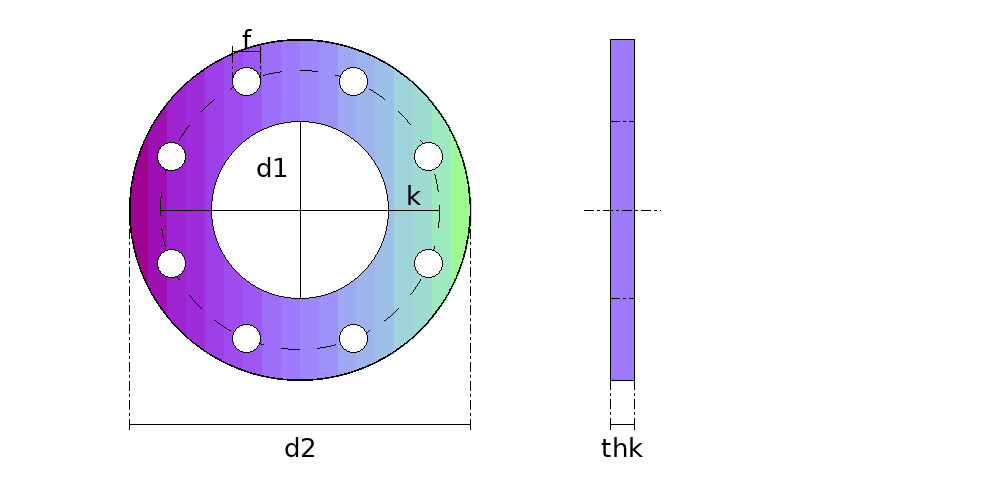
Flange
Plate flange drilling: the outside diameter, the bolt circle and the position of every hole, with the ASME B16.5 and EN 1092-1 drillings ready to fill in.
Which flange to use
- Pipe flange, round duct flange, tank or equipment nozzle flange, with the standard drilling or the mating flange's: Flange.
- Blind flange, the cover with no bore: the same Flange, with a bore of zero.
- A pressure piping flange is forged, with a hub and a raised face. Its drilling comes from here, and so does the plate flange.
- A chain sprocket, the other part born flat: Chain Sprocket.
How it is calculated
The holes sit on the bolt circle every 360°/n, the first half a pitch from the centre line: that is how the standards do it, so that no hole falls on an axis. The chord between neighbouring holes, K × sin(180°/n), is the divider setting that steps the circle out at the bench.
The dimensions are the bore, the outside diameter, the bolt circle, the number and diameter of the holes and the thickness. The result comes with the hole positions, the PDF template at 1:1 scale and the DXF for plasma or laser.
Frequently asked questions
- How do you divide a flange bolt circle?
- Divide 360° by the number of holes to get the pitch, and put the first hole half a pitch from the centre line. To mark without a protractor, set the dividers to the chord K × sin(180°/n): with a 180 circle and 8 holes it is 68.9 mm. The Flange page does the sum and draws the holes.
- What is the drilling of a 4 inch flange?
- It depends on the standard. ASME B16.5 class 150 has 8 holes of 3/4 in (19.05 mm) on a 190.5 mm circle; EN 1092-1 PN 16, DN 100, has 8 holes of 18 mm on a 180 mm circle. The two do not mate. The tables are on the Flange page.
- Why are the holes not on the centre lines?
- So that the flange mates with its counterpart in any of the symmetric positions, and so that no bolt sits at the lowest point, where water collects. Every flange standard does it: the first hole half a pitch from the centre line.