How to bend square tube with a V notch
What it is
A V-notch bend turns a corner in rectangular or square steel tube without cutting the bar through: a V taken out of both sides and the inside face leaves the outside face whole, and it folds like a hinge until the V closes. With several small notches the tube makes a curve. The page gives the depth and opening of each V, the spacing for a curve and the template to wrap around the tube and mark the cut, which curves over the rounded corners.
Where it is used
Gates, railings and frames in box section without welded corners, picture frames and table bases, canopy and shade structures, curved handrails, and square tube arches for pergolas and gardens.
Measurements the calculation needs
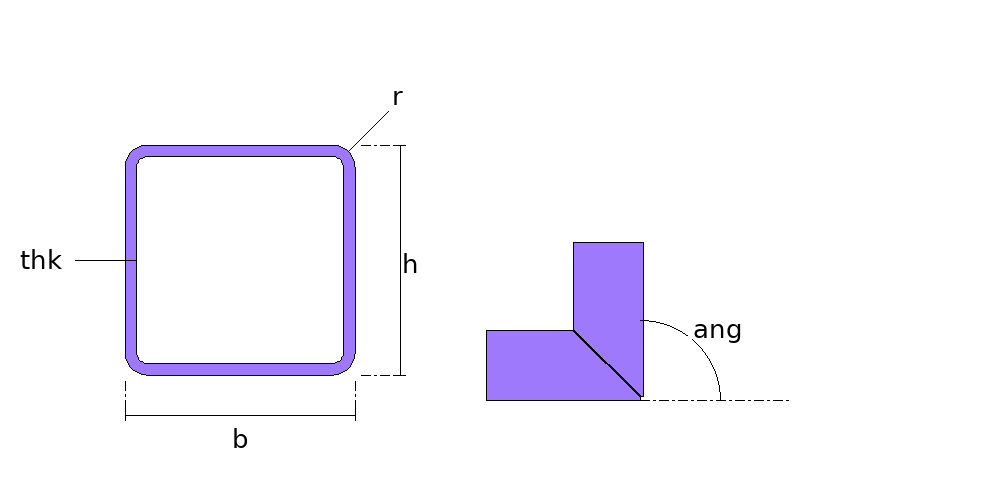
- B Tube width, outside (the outside face of the bend)
- H Tube height, outside (the depth of the V)
- THK Tube wall
- R Tube corner radius, outside
- ANG Bend angle (90 = square corner)
- NC Number of notches (1 = one corner)
- RC Bend radius on the outside face (with more than one notch)
Calculate with your own measurements
No account needed: enter the measurements in millimetres or inches and get the figures and the drawing. The scaled PDF template, the DXF for the cutting table and the 3D model take a free account.
Diameters and sides are outside measurements. The flat pattern already allows for the plate thickness, working on the mean line.
Units: mm inches
How it develops: the formulas
The worked figures on this page are for the metric example: B 40 mm · H 40 mm · THK 2 mm · R 4 mm · ANG 90° · NC 1. In inches the example and the calculator start from those sizes rounded to the tape, so their numbers differ slightly.
- Depth and opening of the V
depth = h − t ; opening = 2 × (h − t) × tan(α / 2)h is the tube height in the plane of the bend, and the outside face, which stays, is the hinge. In the example, 40 − 2 = 38 mm deep and, at 90°, 2 × 38 × tan 45° = 76 mm open on the inside face.- Template perimeter
G = 2 × (b − 2r) + 2 × (h − 2r) + 2π × rThe outside face unrolled, with the corner of outside radius r. In the example, 2 × 32 + 2 × 32 + 25.1 = 153.1 mm.- Outline of the V on the tube
y = ± (z − t) × tan(α / 2)z is the depth of the point from the outside face: zero on the hinge, straight on the sides and curved over the corners. On the inside face z = h, and y = ±38 mm in the example.- Kerf bend
α = angle / n ; pitch = 2 × (R − t) × sin(α / 2) ; web = pitch − 2 × (h − t) × tan(α / 2)R is the bend radius on the outside face. With 90° in 10 notches and R = 300: α = 9°, a 46.8 mm pitch and a 40.8 mm web.
Worked example
The values the form comes pre-filled with, run through the tool itself:
| Tube width, outside (the outside face of the bend) | 1-1/2" |
|---|---|
| Tube height, outside (the depth of the V) | 1-1/2" |
| Tube wall | 1/16" |
| Tube corner radius, outside | 3/16" |
| Bend angle (90 = square corner) | 90° |
| Number of notches (1 = one corner) | 1 |
| Bend radius on the outside face (with more than one notch) | 0" |
| The flat pattern fits a plate of | 5-11/16" × 5-1/4" |
Result of the example
| Plate | 5-11/16" × 5-1/4" |
|---|---|
| Area and weight | 0.15 ft² · ≈ 0.39 lb in 1/16" steel |
Assembly notes
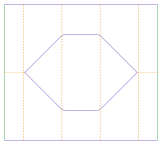
Wrap the template around the tube with the straight edges square, the long dashed lines on the tube's edges and the short dashed one, the cut line, on the outside face of the bend, the one that stays whole. Mark the V and cut both sides and the inside face down to the hinge line, 1.6 mm from the outside face, without cutting the outside face. The V opens 73 mm on the inside face; bend 90°, until the two faces of the V meet, and weld the V from the inside if you want the corner closed.
How to mark it out on the plate
- Enter the outside width and height of the tube, the wall, the corner radius, the bend angle and, for a curve, the number of notches and the radius.
- Print the 1:1 template, cut it out and wrap it around the tube, with the straight edges square and the short dashed line, the cut line, on the outside face of the bend.
- Mark the outline of each V and the hinge line, one wall from the outside face.
- Cut both sides and the inside face with a disc or a saw down to the hinge line, without cutting the outside face.
- Bend slowly until the faces of the V meet, and weld the V from the inside if you want the corner closed.
Common mistakes and tolerances
- Cutting through to the outside face
- The outside face is the hinge: cut it and the tube comes apart. The V stops one wall short of it, 2 mm in 40 × 40 × 2.
- Marking the V straight over the corners
- Over the rounded corners the V line curves, and marked straight it leaves a gap in the bent corner. The template wrapped around the tube gives the right curve.
- Notches too close in a curve
- If the Vs touch on the inside face there is no web left and the curve will not hold. The calculation refuses a web thinner than one wall: increase the radius or use fewer notches.
Frequently asked questions
- How do you bend square tubing to 90° without welding the corner?
- With a V notch: cut both sides and the inside face of the bend in a V down to the hinge line, one wall from the outside face, and leave the outside face whole; it is the hinge. Bent, the V closes and the outside face makes the corner in one piece. In the 40 × 40 × 2 of the example, the V is 38 mm deep and opens 76 mm on the inside face.
- How big is the V notch?
- Its depth is the tube height minus one wall, h − t, and its opening on the inside face is 2 × (h − t) × tan(angle/2): 76 mm at 90° in 40 × 40 × 2, 31.5 mm at 45°. On the sides the V is straight; over the rounded corners it curves, which is why the template wraps around the tube.
- How do you make a curve in square tube?
- With several small V notches, a kerf bend: pick the radius on the outside face and the number of notches, and each one bends the total angle divided by the number. In the example of 90° at a 300 radius with 10 notches, each V is 9°, opens 6.0 mm and sits 46.8 mm from the next, with 40.8 mm of web between two. More notches make a smoother curve.
- What corner radius do I enter?
- The outside radius of the tube's corner. If unsure, twice the wall: that is the EN 10219-2 value up to 6 mm wall, and what most box section has. It only changes the V where it crosses the corners.
- Why wrap the template around the tube instead of measuring?
- Because the V runs over the rounded corners, and there the cut line is curved; marked on the tube, the outline comes out right on all four faces at once. The template has the tube's outside perimeter, 153.1 mm for 40 × 40 with a 4 mm corner, and runs 30 mm past the V on each side to sit square.
You can work out the figures right here, with no account. PDF, DXF, 3D and history take an account — free, with unlimited calculations.